
Your scorecard is how the buyer sees you
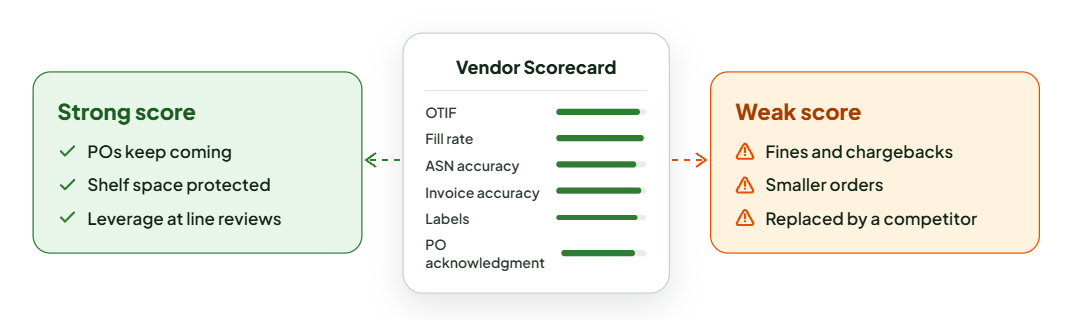
You can have a great product, a strong sales pitch and a buyer who loves your brand. But once the purchase orders start flowing, the retailer judges you mostly by a single report: your vendor scorecard.
That report decides more than most suppliers realize. A strong score keeps POs coming, protects your shelf space and gives you leverage at line reviews. A weak one brings fines, smaller orders and, eventually, a buyer who quietly replaces you with a competitor that ships cleaner.
Most guides stop at defining OTIF and fill rate. This one goes further. You'll learn:
- The six metrics retailers use to grade suppliers, with the formula for each
- Why the common shortcut for calculating OTIF gives you the wrong number
- Exactly which EDI document feeds each metric, so you know where to look when a score drops
- The root causes behind most lost points
- A 30-day plan to raise your score, whether you sell to one retailer or twenty
What a vendor scorecard is
A vendor scorecard (also called a supplier scorecard) is a recurring report that grades how reliably you fulfill a retailer's orders. It compares what the retailer asked for on the purchase order with what actually happened: when your shipment arrived, how much of it arrived, and whether your paperwork and data matched the freight.
Retailers use scorecards because their stores and distribution centers run on predictable inbound freight. One late or short shipment can mean an empty shelf, a missed promotion and a lost sale. The scorecard turns that risk into numbers they can act on.
What retailers do with your score:
- Issue fines and chargebacks when a metric falls below its target
- Adjust order volume, shifting POs toward suppliers who ship more reliably
- Inform line reviews, where buyers decide which items stay, grow or get cut
- Trigger compliance reviews or improvement plans for chronically low performers
- Reward top performers with better visibility, faster approvals or preferred-vendor status
Where you'll find it depends on the retailer. Walmart suppliers use Retail Link and Luminate. Target uses Partners Online, Home Depot uses its supplier portal, and Amazon Vendor Central has its own operational metrics. The names and targets differ, but the underlying metrics are remarkably similar.
The six metrics that make up your score
Most retailer scorecards are built from six measurements. Each retailer sets its own targets and windows, so always check your partner's vendor compliance guide for the exact numbers.
1. On-time in-full (OTIF)
OTIF asks one strict question per order: did it arrive inside the delivery window, with every unit ordered? It is pass or fail. An order that arrives on time but one case short fails. So does a complete order that arrives a day late.

The shortcut that gives you the wrong number. Many guides tell you to multiply your on-time rate by your in-full rate. That only works if late orders and short orders are unrelated, and in real operations they rarely are. A warehouse having a bad week tends to ship late and short at the same time.
Here's a worked example. Say you shipped 1,000 orders last quarter:
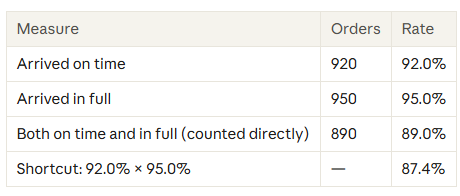
The shortcut is off by 1.6 points here, and it can be off in either direction. When you're arguing a fine or setting an improvement target, count passing orders directly.
2. Fill rate
Fill rate measures how much of what was ordered you actually shipped, regardless of timing.

If a retailer orders 100 cases and you ship 90, your case fill rate is 90%. Watch which level your retailer measures. Some use units, some use cases, and some use line fill rate (the share of PO lines shipped complete). You can have a high unit fill rate and a poor line fill rate if you consistently short a few slow-moving SKUs.
A healthy fill rate with a weak OTIF score usually means a transportation or scheduling problem, not an inventory one.
3. ASN timeliness and accuracy
Your advance ship notice (EDI 856) tells the distribution center what's coming before the truck arrives. Retailers score two things:
- Timeliness: Was the ASN sent within the required window, typically before the shipment arrives or within a set number of hours after it leaves your dock?
- Accuracy: Do the quantities, item numbers, SSCC carton labels and hierarchy in the ASN match what's physically on the truck?
An inaccurate ASN forces the DC to receive your freight manually, which is slow and expensive for them, and they'll pass that cost back to you.
4. Invoice accuracy
Your invoice (EDI 810) should match the PO price and the quantity on your ASN. When it doesn't, the retailer's accounts payable system flags it, payment stalls, and a deduction often follows. Invoice errors don't always show up on the operational scorecard, but they show up in your cash flow.
5. Label and packaging compliance
This covers GS1-128 / SSCC carton labels, label placement, pallet height and build, and packaging standards from the retailer's routing guide. A barcode that won't scan or a label on the wrong side of the carton can fail an otherwise perfect shipment.
6. PO acknowledgment speed
Many retailers expect a PO acknowledgment (EDI 855) within a set window after they send the purchase order (EDI 850). The 855 confirms what you can ship, and when. Late or missing acknowledgments leave the buyer guessing, and some retailers score or fine them directly.
Selling dropship or through a marketplace? Add inventory feed accuracy (EDI 846) to this list. If your feed shows stock you don't have, orders get cancelled, and cancellation rate becomes one of your most important scores.
Which EDI document feeds each metric
Every scorecard metric is calculated from the EDI documents you and the retailer exchange. When a score drops, this map tells you which document to check first.
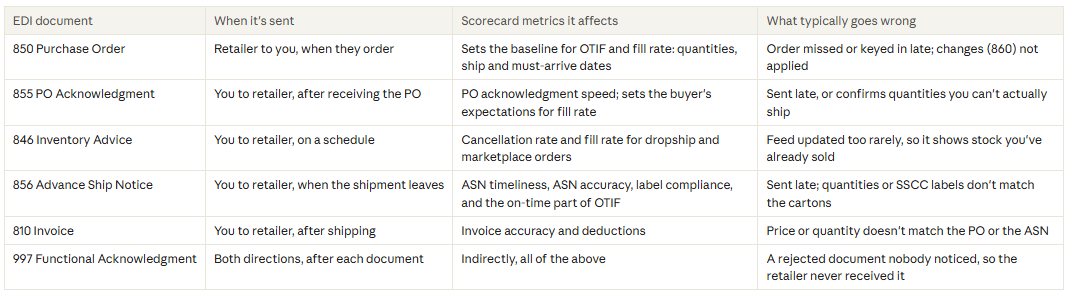
The pattern to notice: one bad number in one document can hurt several metrics at once. A wrong quantity in the 856 can fail ASN accuracy, trigger a receiving chargeback and cause an invoice mismatch, all from the same mistake. For a closer look at ASN problems specifically, see our EDI 856 ASN troubleshooting guide.
Where suppliers lose points
Scorecard failures are almost always symptoms of a problem further upstream. These are the root causes we see most often among retail suppliers.
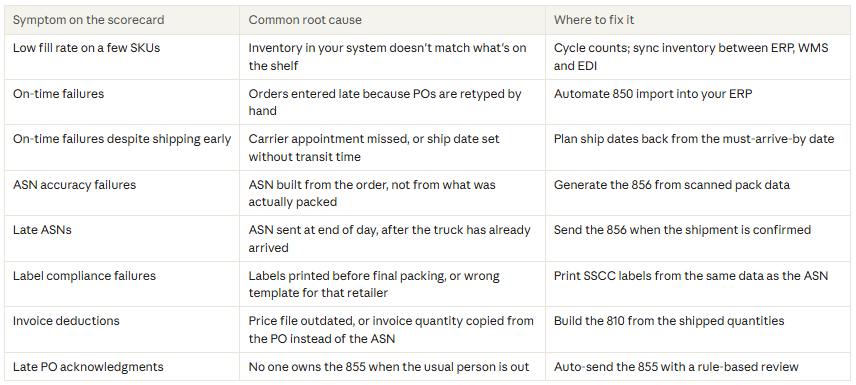
Notice how many of these come from re-entering the same data by hand at different steps. Every retype is a chance for the PO, the pack, the label, the ASN and the invoice to disagree. When they disagree, the scorecard catches it.
When the failure has already turned into a fine, see our guides on fighting retail chargebacks and recovering revenue from retailer deductions.
A 30-day plan to raise your score
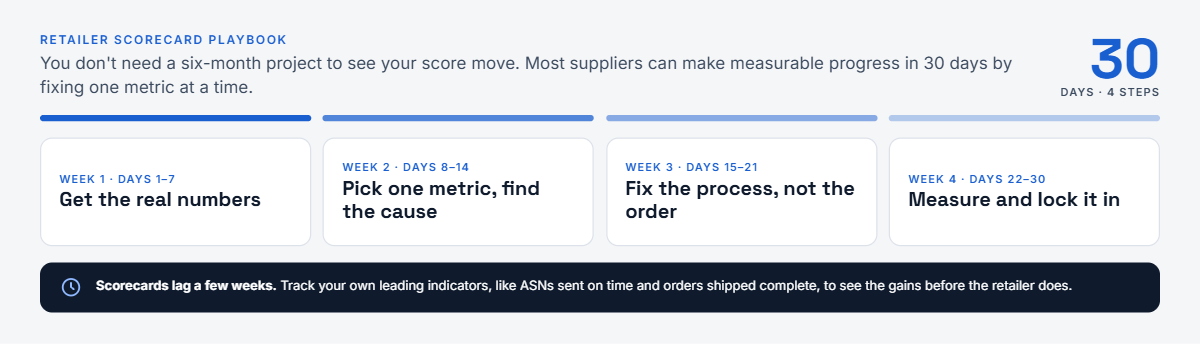
You don't need a six-month project to see your score move. Most suppliers can make measurable progress in 30 days by fixing one metric at a time.
Week 1: Get the real numbers
- Download the last 13 weeks of scorecard data from each retailer portal.
- Put every retailer's metrics side by side in one sheet: OTIF, fill rate, ASN timeliness and accuracy, invoice accuracy, label compliance and PO acknowledgment.
- Pull the matching fines and deductions for the same period, so you can see what each metric is costing you in dollars.
- Flag any scores where the retailer's data looks wrong. Check those against your own ship dates, proof of delivery and 997 acknowledgments.
Week 2: Pick one metric and find the cause
- Choose the metric with the biggest gap to target, weighted by the dollars it costs you.
- Pull 20 to 30 failed orders for that metric.
- Trace each one through the documents in the map above: 850, 855, 856, 810. Note where the data first went wrong.
- Group the failures by cause. Usually one or two causes explain most of them.
Week 3: Fix the process, not just the order
- Fix the root cause you found, whether that's a manual entry step, a late handoff, an outdated price file or a label template.
- Write the change down as a standard procedure, with one named owner.
- Add a check before the document leaves your system. For example, block any ASN whose carton count doesn't match the scanned pack.
Week 4: Measure and lock it in
- Compare the metric's daily or weekly results against your week-1 baseline.
- Dispute any fines from the period where you have documentation showing they were invalid.
- Set up a weekly 15-minute scorecard review with operations, warehouse and finance.
- Pick the next metric and repeat.
Retailer scorecards usually lag by a few weeks, so the official number may not move until after day 30. Track your own leading indicators, like ASNs sent on time and orders shipped complete, so you can see the improvement before the retailer does.
How SBSA Technology can help
The 30-day plan fixes today's biggest problem. Automation keeps new ones from showing up, because it removes the manual steps where most scorecard failures start.
Here's how SBSA Technology supports each part of the scorecard:
- Faster, cleaner orders: Retailer POs flow straight into your ERP and WMS, including QuickBooks, NetSuite and Fishbowl. No retyping means orders hit the warehouse sooner, which protects on-time performance.
- Documents built from the same data: The ASN, carton labels and invoice all draw from one shipment record, so they agree with each other and with what's on the truck.
- Compliant labels at volume: Bulk shipping label generation prints retailer-ready SSCC labels for large orders without manual setup.
- Accurate inventory across channels: Inventory syncs between your systems and your trading partners, which supports fill rate and reduces dropship cancellations. See our dropship and brokerage solution.
- Visibility before the retailer sees it: Analytics dashboards help you spot late shipments, rejected documents and order exceptions while there's still time to fix them.
- One platform for every retailer: Walmart, Target, Costco, Home Depot, Amazon and hundreds more connect through the same system, each with its own requirements handled for you.
The result is fewer chances for your data to disagree, and fewer reasons for a retailer to mark you down.
Frequently asked questions
What is a good OTIF score? It depends on the retailer and your product category. Major retailers often set targets in the 90s, and many high-performing suppliers aim for 95% or higher. Check your retailer's current compliance guide, since targets change.
What's the difference between fill rate and OTIF? Fill rate measures how much of the order you shipped. OTIF measures whether each whole order arrived complete and on time. You can have a 98% fill rate and a much lower OTIF score if shipments are arriving late.
How often do retailers update scorecards? Most portals refresh weekly or monthly, and the data usually lags actual deliveries by a few weeks.
Can I dispute a scorecard result? Yes, in most cases. Retailers make receiving errors, and some delays are outside your control. Keep the PO, ASN, bill of lading, proof of delivery and 997 acknowledgments for every shipment, and file within the retailer's dispute window.
Do new suppliers get a grace period? Some retailers track new suppliers' performance for a period before fines apply. Use that window to fix problems while mistakes are still free.
Do scorecards apply to dropship orders? Yes, though the metrics differ. Dropship scorecards usually focus on ship time, cancellation rate, tracking upload and inventory feed accuracy.
Can a small supplier really compete on scorecards with large brands? Yes. Scorecards measure reliability, not size. A small supplier with automated, accurate EDI can outscore a much larger company that still keys orders in by hand.
Turn your scorecard into an advantage
Your vendor scorecard isn't just a report card. It's the clearest feedback a retailer will ever give you about where your operation is leaking time and money. Learn the six metrics, know which EDI document drives each one, and fix one root cause at a time. Do that, and your score stops being a source of fines and becomes a reason buyers want to order more from you.
Want to know where your scorecard points are going? Talk to SBSA Technology for a walkthrough of how automated EDI, integrated labeling and analytics can help you hit every retailer's targets.
- Book a demo: sbsatech.com/consultancy
- Talk to the team: sbsatech.com/contact
- Explore the platform: sbsatech.com
- More insights: sbsatech.com/blog