
For retail vendors and suppliers, receiving a retailer payment does not always mean receiving the full amount expected. Short payments, pricing discrepancies, shortage claims, promotional deductions, and chargebacks can create gaps between invoiced amounts and actual payments.
When these discrepancies are tracked manually across spreadsheets, accounting software, retailer portals, and EDI documents, finance teams can spend hours identifying the cause of each deduction. Unresolved claims may remain outstanding, while valid deductions and recoverable errors become difficult to distinguish.
EDI automation and connected business systems can help suppliers improve payment visibility, identify discrepancies sooner, and organize the information needed to investigate deductions.
This illustrative case study examines how a supplier could improve its payment reconciliation process by connecting EDI transactions with its accounting and operational workflows.
The Challenge: Retailer Payments Did Not Match Invoices
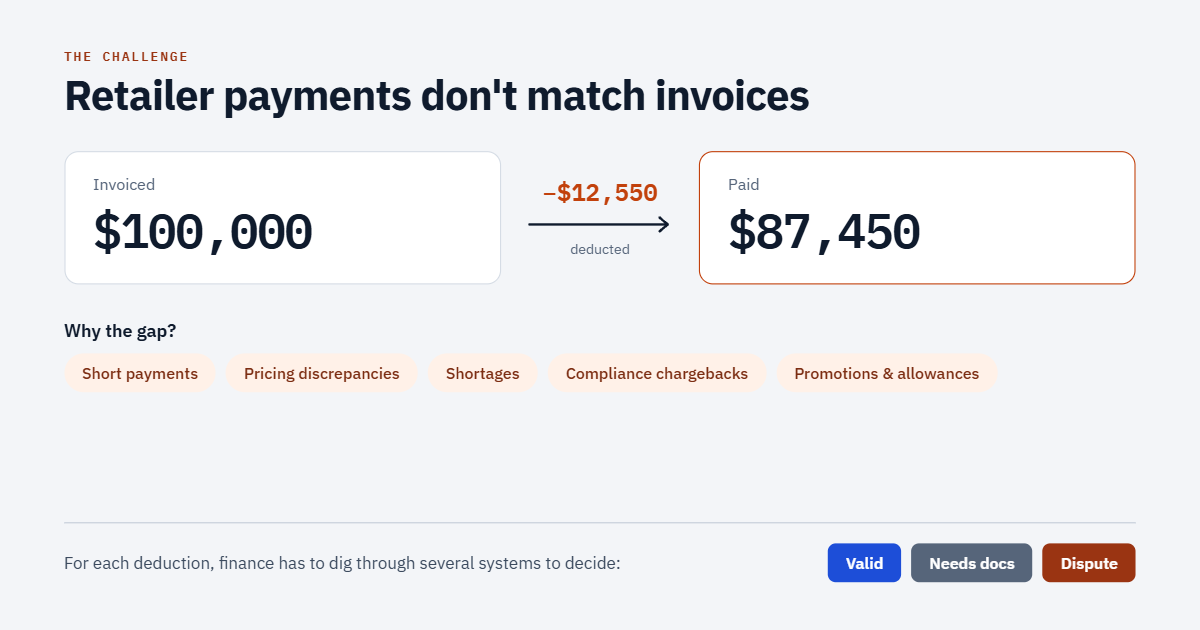 A growing consumer goods supplier sells products to multiple retail chains. Its finance team sends invoices electronically and receives payments according to each retailer's payment terms.
However, the amounts received frequently differ from the original invoices.
Common discrepancies include:
-
Short payments: Retailers pay less than the invoiced amount.
-
Pricing discrepancies: Invoice prices do not match agreed-upon prices or purchase order terms.
-
Shortage deductions: Retailers report that some products were missing or quantities did not match expectations.
-
Compliance chargebacks: Retailers deduct fees associated with shipping, labeling, documentation, or delivery requirements.
-
Promotional and contractual deductions: Retailers apply allowances, discounts, or other agreed-upon adjustments.
The finance team must determine whether each deduction is valid, requires additional documentation, or should be disputed.
Without a consistent reconciliation process, the team may need to search several systems to match payments with invoices, review shipment records, locate retailer notices, and determine the appropriate next action.
The Business Impact
The manual process creates several operational challenges:
-
Delays in matching payments to invoices.
-
Limited visibility into outstanding deductions.
-
Time-consuming research across multiple systems.
-
Difficulty locating supporting shipment and invoice documentation.
-
Increased risk of missing retailer dispute deadlines.
-
Inconsistent reporting on accounts receivable and unresolved discrepancies.
The issue is not simply that payments arrive short. It is that the supplier lacks a reliable, repeatable process for determining why the difference occurred and what to do next.
The Solution: A More Connected EDI Reconciliation Workflow
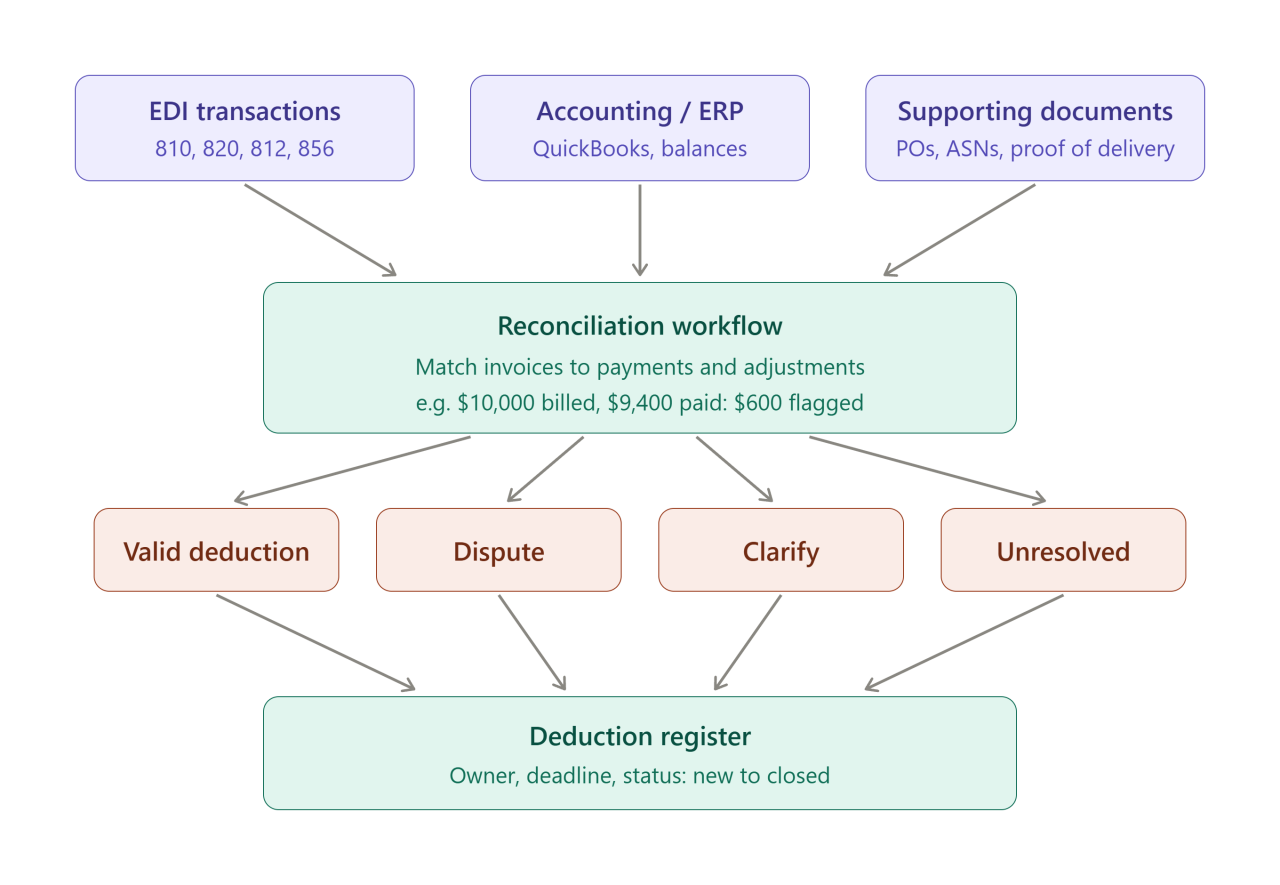
To address these challenges, the supplier can implement a workflow that connects EDI transaction records, accounting data, and supporting operational documents.
SBSA Technology helps businesses automate EDI transactions and connect retail operations with business systems. Depending on the retailer, trading-partner requirements, and accounting platform, an integrated workflow can help reduce manual data entry and make transaction information easier to trace.
1. Match Retailer Invoices With Payment Information
The supplier first establishes a consistent process for matching customer invoices against incoming payment and remittance records.
Relevant EDI documents may include:
-
EDI 810 — Invoice: Communicates invoice details and the amount billed to the retailer.
-
EDI 820 — Payment Order/Remittance Advice: Communicates payment or remittance information, including applicable invoice references and adjustment details.
-
EDI 812 — Credit/Debit Adjustment: Communicates credit or debit adjustment information when supported and used by the trading partner.
These documents serve different purposes. The actual transaction set used depends on the retailer's requirements and the supplier's EDI configuration.
By organizing these records around invoice numbers, retailer identifiers, payment references, and adjustment amounts, the supplier can establish a clearer view of which invoices have been paid, partially paid, or remain outstanding.
2. Identify Payment Discrepancies Earlier
The next step is to compare the expected invoice amount with the payment and adjustment information available.
For example, suppose a supplier issues a $10,000 invoice and receives a payment of $9,400.
The $600 difference should be investigated rather than automatically classified as a loss or a recoverable amount.
A structured reconciliation workflow can flag the discrepancy and direct the finance team to review the relevant remittance details, retailer deduction notices, purchase order terms, and shipment documentation.
The team can then classify the difference as a valid deduction, a possible dispute, an adjustment requiring clarification, or an unresolved item.
Automation can help surface these exceptions, but the underlying records and retailer-specific rules must be configured appropriately.
3. Connect Invoice Records With Supporting Documents
Identifying a discrepancy is only part of the process. The supplier also needs evidence to determine whether the retailer's deduction is justified.
Depending on the reason for the deduction, supporting records may include:
-
Purchase orders and order acknowledgments.
-
Shipment confirmations and advance ship notices (EDI 856).
-
Carrier tracking and proof-of-delivery records.
-
Original invoices and credit memos.
-
Retailer compliance notices and deduction explanations.
-
Pricing agreements and promotional terms.
When these records can be located through a consistent workflow, the finance and operations teams can investigate discrepancies without repeatedly searching disconnected systems.
For example, a shortage deduction may require reviewing the original order, shipped quantity, shipment confirmation, and available delivery evidence before deciding whether to challenge the claim.
4. Integrate EDI With Accounting and Operational Systems
When EDI data and accounting records are disconnected, employees may need to enter or compare the same information in multiple places.
Integrating EDI with an accounting platform or ERP can help synchronize relevant transaction data, subject to the capabilities of the systems involved.
For a supplier using QuickBooks or another supported business system, an appropriately configured integration may help the team:
-
Maintain more consistent invoice records.
-
Reduce repetitive data entry.
-
Improve visibility into customer balances.
-
Link relevant EDI transactions to accounting workflows.
-
Identify discrepancies that require further review.
The precise automation depends on the retailer's transaction requirements, the accounting platform, and the integration scope. Payment reconciliation, deduction classification, and dispute submission may still require separate configuration or human review.
5. Track Deductions Through Resolution
A discrepancy should not disappear from view simply because someone has reviewed it.
The supplier can maintain a deduction register that records the retailer, invoice number, amount, reason, supporting documents, assigned owner, dispute deadline, and current status.
Suggested statuses include:
-
New discrepancy
-
Under investigation
-
Awaiting documentation
-
Dispute submitted
-
Accepted deduction
-
Credit or payment adjustment received
-
Closed
This approach helps finance managers identify unresolved items, assign responsibility, prioritize time-sensitive disputes, and report on outstanding balances.
Illustrative Example: Investigating a $600 Payment Difference
Consider a hypothetical supplier that invoices a retailer $10,000 for a shipment but receives a remittance of $9,400.
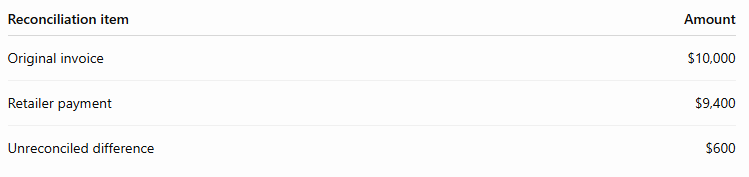
The reconciliation workflow flags the $600 difference and directs the finance team to the retailer's remittance details.
The team then discovers that the retailer reported a shortage deduction. It reviews the purchase order, invoice, EDI 856 shipment information, and available delivery documentation.
After reviewing the evidence, the supplier determines that $400 of the deduction appears supportable, while the remaining $200 requires clarification from the retailer.
The supplier records the $400 as an accepted deduction and opens an investigation into the $200 balance.
The important result is improved visibility, not an automatic recovery of $200. The supplier can pursue the disputed amount with supporting evidence, but recovery depends on the retailer's review and the facts of the transaction.
This example demonstrates how a structured process can help distinguish valid deductions from discrepancies that deserve further investigation.
The Results: What Suppliers Can Measure
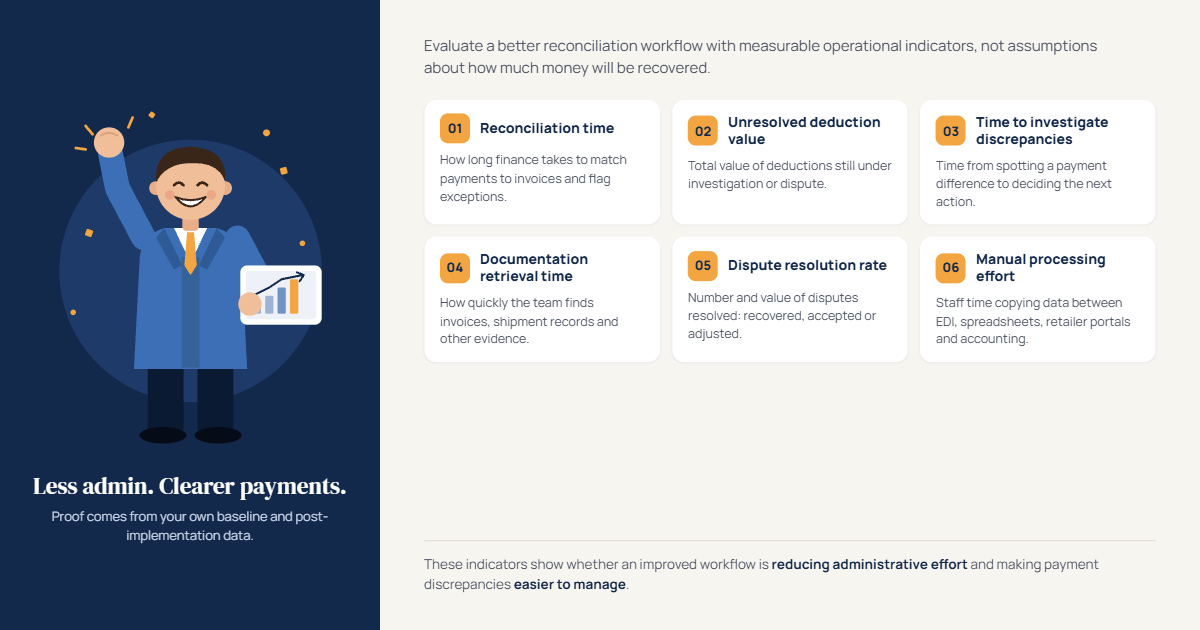
A better reconciliation workflow should be evaluated using measurable operational indicators rather than assumptions about how much money will be recovered.
Potential performance indicators include:
1. Reconciliation time
Measure how long the finance team takes to match payments to invoices and identify exceptions.
2. Unresolved deduction value
Track the total value of deductions that remain under investigation or dispute.
3. Time to investigate discrepancies
Measure the time between identifying a payment difference and determining the next action.
4. Documentation retrieval time
Track how quickly the team can locate the invoices, shipment records, and other evidence required for an investigation.
5. Dispute resolution rate
Monitor the number and value of disputes resolved, including the amount recovered, accepted, or otherwise adjusted.
6. Manual processing effort
Estimate the staff time spent copying information between EDI records, spreadsheets, retailer portals, and accounting systems.
These indicators give suppliers a practical way to evaluate whether their improved workflow is reducing administrative effort and making payment discrepancies easier to manage.
Actual improvements should be calculated from the supplier's own baseline and post-implementation data.
How SBSA Technology Can Help
SBSA Technology provides EDI automation and retail operations integration capabilities for businesses that exchange electronic transactions with retail trading partners.
For suppliers experiencing payment reconciliation challenges, SBSA can help assess the EDI workflow and identify opportunities to improve transaction visibility and reduce repetitive processing.
Depending on the business requirements, relevant capabilities may include:
-
Retail EDI automation: Manage supported electronic transactions between suppliers and retail partners.
-
Invoice workflow integration: Connect supported EDI invoice processes with accounting and operational systems.
-
ERP and accounting integration: Reduce manual data entry by connecting relevant business records.
-
Shipment transaction visibility: Make shipment-related EDI information available for operational review and investigation.
-
Exception handling: Establish workflows for identifying transactions or discrepancies that need attention.
-
Operational reporting: Improve access to transaction information for monitoring and follow-up.
The objective is to help suppliers create a more consistent flow of information between retail transactions, fulfillment operations, and accounting records.
The exact solution should be tailored to the supplier's retailers, transaction requirements, existing software, and reconciliation process.
Best Practices for Preventing Future Payment Discrepancies
Automation becomes more effective when combined with consistent operating procedures.
Suppliers should consider these practices:
-
Validate invoice data before transmission. Check quantities, pricing, purchase order references, and other required fields.
-
Maintain accurate product and shipment records. Consistent SKU, quantity, and shipping information can make investigations easier.
-
Review remittance advice regularly. Identify short payments and adjustment details promptly.
-
Preserve supporting documentation. Keep invoices, shipment confirmations, delivery evidence, and retailer notices accessible.
-
Establish dispute ownership and deadlines. Assign responsibility for investigating and following up on deductions.
-
Monitor recurring deduction reasons. Repeated shortages or compliance fees may indicate an upstream fulfillment or data-quality problem.
-
Reconcile transactions consistently. Use a documented process for matching invoices, payments, adjustments, and outstanding balances.
These practices help suppliers move from reactive deduction research toward a more controlled accounts receivable process.
Conclusion
Retailer deductions and short payments can make accounts receivable management difficult, particularly when transaction information is scattered across EDI systems, accounting software, retailer portals, and spreadsheets.
A connected reconciliation workflow helps suppliers identify differences between invoices and payments, retrieve supporting documentation, assign follow-up actions, and monitor unresolved deductions.
With the right EDI automation and system integrations, suppliers can reduce repetitive administrative work and make payment discrepancies easier to investigate. Recovering disputed amounts still requires appropriate evidence, timely follow-up, and retailer approval.
For retail vendors, manufacturers, distributors, and wholesalers, improving payment reconciliation is an opportunity to strengthen financial visibility while building a more efficient retail operations process.
Ready to improve your retail EDI workflows?
Contact SBSA Technology to discuss how EDI automation and business system integration can help your organization improve transaction visibility and streamline retail operations.
- Book a demo: sbsatech.com/consultancy
- Talk to the team: sbsatech.com/contact
- Explore the platform: sbsatech.com
- More insights: sbsatech.com/blog