
EDI in Plain Terms
EDI replaces paper and email-based order processing with a structured, automated exchange between two companies' systems. Instead of a buyer faxing a PO or a supplier emailing a PDF invoice, the same information moves electronically, in a standardized format, with no manual re-keying required.
For a high-volume, drop-ship-driven marketplace like Zoro, EDI isn't optional — it's the mechanism that makes the entire order-to-payment cycle work. When your systems and Zoro's systems are set up to exchange documents this way on an ongoing basis, you become what's known as a trading partner.
Why Zoro Requires It
Zoro operates as an online-only marketplace with more than 10 million products, and the majority of that assortment is fulfilled through supplier drop-ship rather than Zoro-held inventory. That means every consumer order on Zoro.com potentially becomes a live purchase order landing directly in your system — dozens or hundreds of times a day, depending on your catalog.
EDI compliance matters to Zoro because it:
- Keeps consumer orders moving from Zoro to your system without delay or manual entry
- Removes the errors that come with rekeying order, shipment, and invoice data by hand
- Gives Zoro (and its customers) real-time visibility into order status, from acknowledgment to shipment
- Protects the consumer experience Zoro is built around — fast shipping confirmations and accurate tracking
- Builds the operational reliability Zoro expects before expanding a supplier into higher-volume programs
Important: Zoro Is a Separate Trading Partner from Grainger
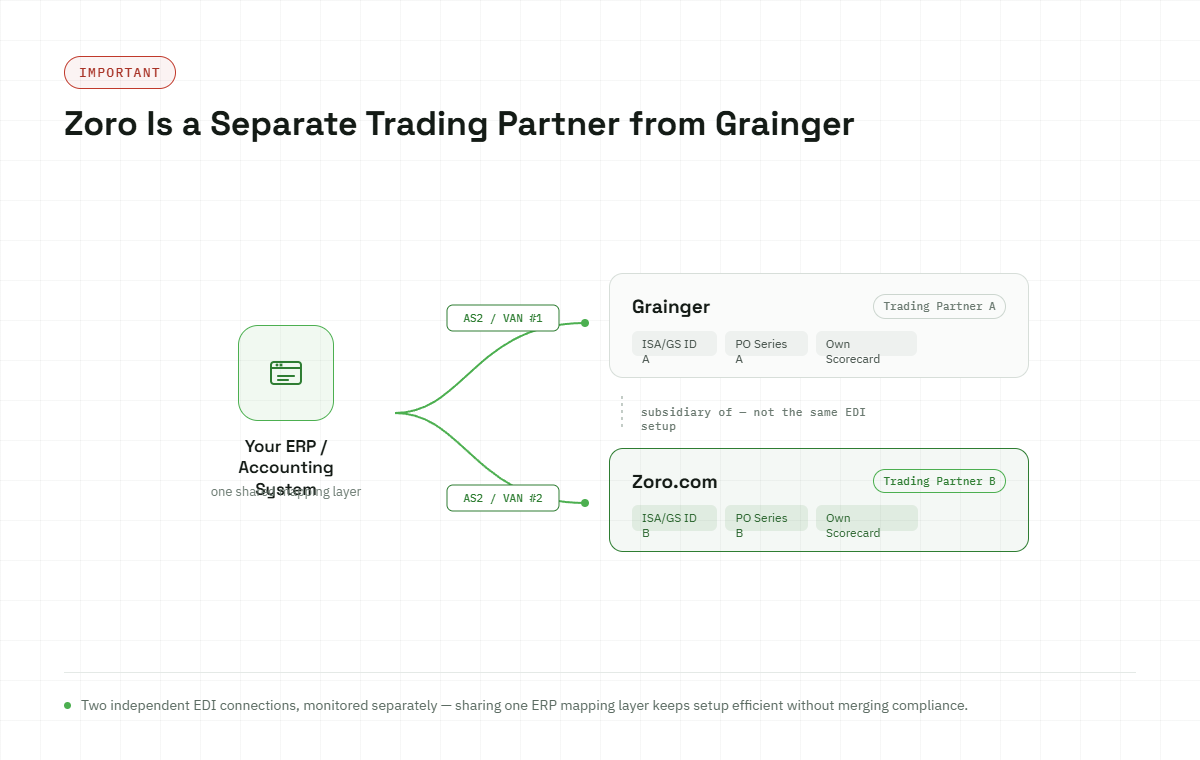 If you already supply Grainger, don't assume your existing EDI setup covers Zoro too. Despite being a Grainger subsidiary, Zoro.com operates as its own distinct EDI trading partner — with its own ISA/GS sender and receiver IDs, its own purchase order number series, and its own compliance requirements and scorecard. Suppliers doing business with both must maintain two separate EDI connections. It's common (and efficient) to set both up at once, sharing a single ERP or accounting-system mapping layer between them, but they remain independently monitored channels.
How Zoro and Its Suppliers Connect
Zoro supports multiple transmission methods, and which one makes sense for you often depends on order volume and how your existing systems are built:
- AS2 (Applicability Statement 2) — a direct, real-time, encrypted connection using digital certificates and Message Disposition Notifications (MDNs) to confirm delivery. This is generally the best fit for drop-ship suppliers processing high order volumes, since it supports the same-day turnaround Zoro expects on acknowledgments and shipment notices.
- SFTP (Secure File Transfer Protocol) — a file-based exchange where documents are deposited into and retrieved from a secure server on a scheduled basis. This suits suppliers running batch-oriented ERP or warehouse systems, particularly in wholesale/replenishment fulfillment.
- VAN (Value-Added Network) — a managed mailbox network that routes documents through a third-party intermediary. Zoro's supplier program has historically worked closely with SPS Commerce as a VAN and onboarding partner, and many suppliers still connect this way, especially if they already run a VAN subscription for other retail trading partners.
Whichever method you use, mapping your internal order and invoice data correctly into Zoro's expected EDI format is what determines whether documents actually process cleanly on the other end.
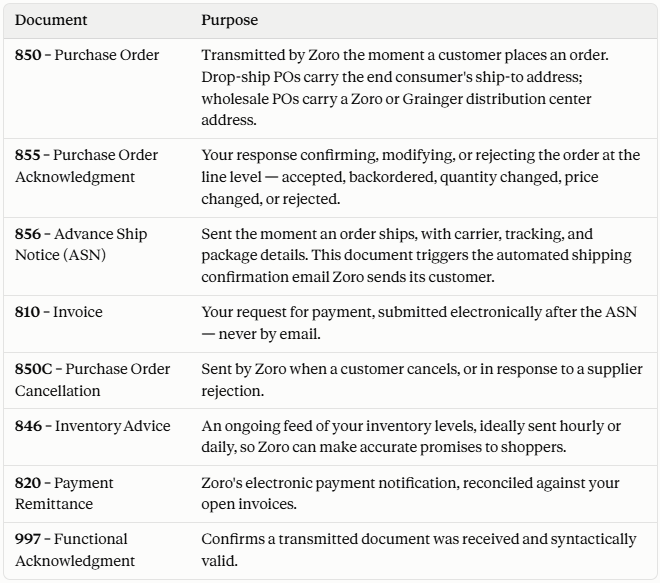
The EDI Documents You'll Actually Use
Zoro's supplier program centers on a core set of transactions, all built on the ANSI X12 standard:
The Timing Requirements That Actually Matter
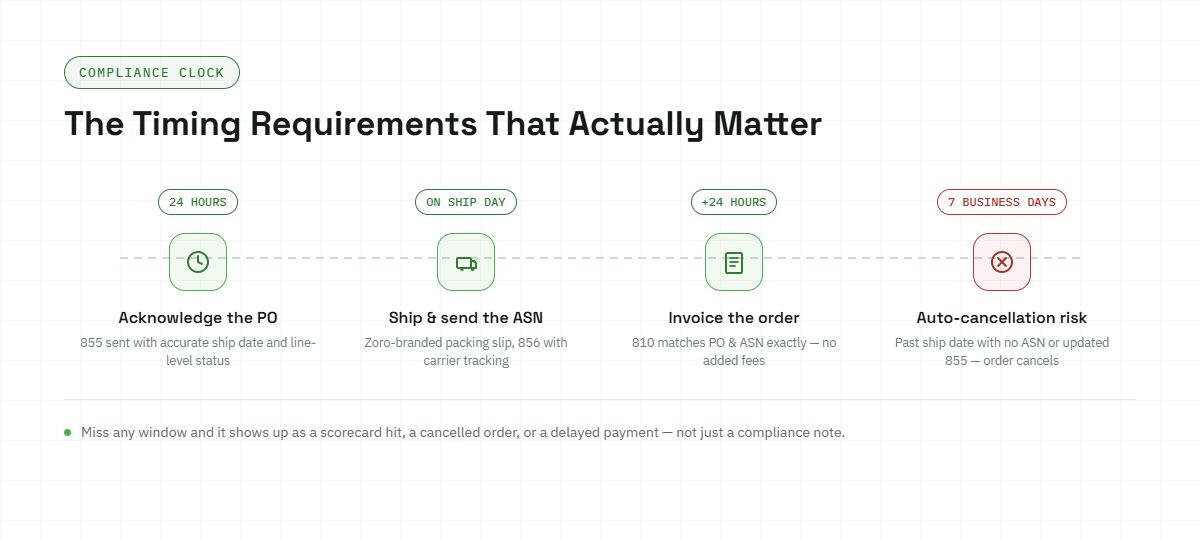 Zoro's compliance expectations aren't just about format — they're about speed. These are the windows suppliers are held to:
1. Acknowledge within 24 hours. The 855 Purchase Order Acknowledgment must go out as soon as the order is received, and always within 24 hours. It needs an accurate expected ship date and honest line-level status — accepted, backordered, quantity- or price-adjusted, or rejected.
2. Ship under Zoro's branding, not yours. For drop-ship orders, the packing slip inside the box must be Zoro-branded. Your company name, logo, and any marketing materials cannot appear anywhere the consumer sees — the box, the packing slip, or any insert. The shipping label must also follow Zoro's required format, including "C/O Zoro" in the ship-from field and your own returns address (never a Zoro location).
3. Send the ASN the same day the order ships. The 856 isn't just a compliance formality — it's what fires the tracking-number email to the end customer. A late or missing ASN creates a poor consumer experience and a compliance flag, and it increases the risk of a cancellation if it isn't received before Zoro's automatic cancellation window closes.
4. Invoice within 24 hours of shipment. The 810 must match the PO and ASN exactly — no added fees or freight charges beyond what was agreed, since Zoro expects you to use its own shipping accounts for orders routed on its behalf. Mismatches are a common cause of payment delays and deductions.
5. Watch the automatic cancellation clock. Zoro will automatically cancel an order that's seven business days past its expected ship date if it hasn't received a valid ASN or an updated 855 with a new expected ship date. Backorders are accepted if the revised ship date falls within 30 calendar days of the original — beyond that, Zoro expects the order to be rejected rather than left open indefinitely.
Drop-Ship vs. Wholesale: Two Different Fulfillment Paths
Most suppliers start in Zoro's drop-ship program: Zoro captures the consumer order, routes you a PO by EDI, and you ship straight to that consumer under Zoro's branding — Zoro never touches inventory. As volume on a SKU grows, some suppliers are invited into a wholesale/stock replenishment path, shipping in bulk to a Zoro or Grainger distribution center instead. That model looks more like traditional retail EDI: GS1-128 carton labels are required on every case, and the ASN must reach Zoro's system before the physical shipment arrives at the DC — not just before it ships.
Shipping Rules Behind the EDI Layer
EDI compliance and shipping compliance go hand in hand at Zoro. A few requirements worth knowing before your first order ships:
- Parcel shipments must move via FedEx Ground, using Zoro's third-party account number — using another small-parcel carrier without prior consent is treated as noncompliant and can trigger chargebacks.
- LTL and full truckload shipments are set up through the RXO Connect portal, with a Bill of Lading generated by that portal accompanying every shipment.
- Packing lists must include specific fields — Zoro SKU, PO number, sales order number, and Zoro's customer-service and returns language — regardless of whether they visually match Zoro's own template.
Choosing the Right EDI Approach
Zoro doesn't mandate a specific software vendor, but it does expect suppliers to be able to generate, transmit, and receive core documents automatically and on schedule. In practice, that means your translation layer — whatever converts your ERP or accounting system's internal order and invoice data into valid X12 — has to be reliable enough to hit same-day ASN and 24-hour acknowledgment windows consistently, order after order. Getting that mapping wrong doesn't just cause a failed transmission; it shows up as a missed compliance window, a scorecard hit, or a delayed payment.
How SBSA Technology Can Help
Standing up a compliant Zoro EDI connection — and keeping it running cleanly as order volume grows — takes more than checking a box on a transaction list. SBSA Technology helps suppliers configure AS2, SFTP, or VAN connectivity with Zoro, build out accurate 850/855/856/810 mapping for drop-ship or wholesale fulfillment, and automate the process end to end through pre-built integrations with QuickBooks, NetSuite, SAP, Microsoft Dynamics 365, Oracle ERP Cloud, and more. For suppliers who also sell to Grainger, SBSA can stand up both trading partner connections at once, sharing a single ERP mapping layer to cut onboarding time and cost.
Frequently Asked Questions
Does every Zoro supplier need EDI? Yes — Zoro's supplier program runs on electronic document exchange, with no manual fallback for ongoing order processing.
Which EDI documents matter most? The core set is the 850 (PO), 855 (acknowledgment), 856 (ASN), and 810 (invoice). Depending on your program, you may also need the 846 (inventory advice), 820 (remittance), or 860 (PO change request).
How fast do I need to acknowledge an order? Within 24 hours of receiving the 850, using the correct acknowledgment type at the line level.
Is Zoro the same trading partner as Grainger? No. Even though Zoro is a Grainger company, it maintains a fully separate EDI setup, PO numbering, and compliance profile.
Do I need specific EDI software? No particular vendor is required, but your solution needs to reliably produce valid X12 documents and hit Zoro's timing windows.
Conclusion
Zoro's EDI requirements are built around speed and accuracy — a 24-hour acknowledgment window, same-day ASNs, and invoices that match exactly, all wrapped around a consumer-facing drop-ship model that leaves little room for manual delay. Get the connection type, document mapping, and timing right from the start, and Zoro orders move through your systems with almost no hands-on effort. Treat it as an afterthought, and you'll be chasing missed windows and payment delays instead of scaling the channel.
Connect with SBSA Technology
Ready to get Zoro EDI-compliant — or want a second opinion on your current setup? SBSA Technology works with suppliers, distributors, and drop-ship brands to automate EDI, order processing, and retailer/marketplace compliance.
- Book a demo: sbsatech.com/consultancy
- Talk to the team: sbsatech.com/contact
- Explore the platform: sbsatech.com
- More insights: sbsatech.com/blog