
What Happens After a Retailer Sends an 850 Purchase Order? A Complete Order-to-Cash Workflow
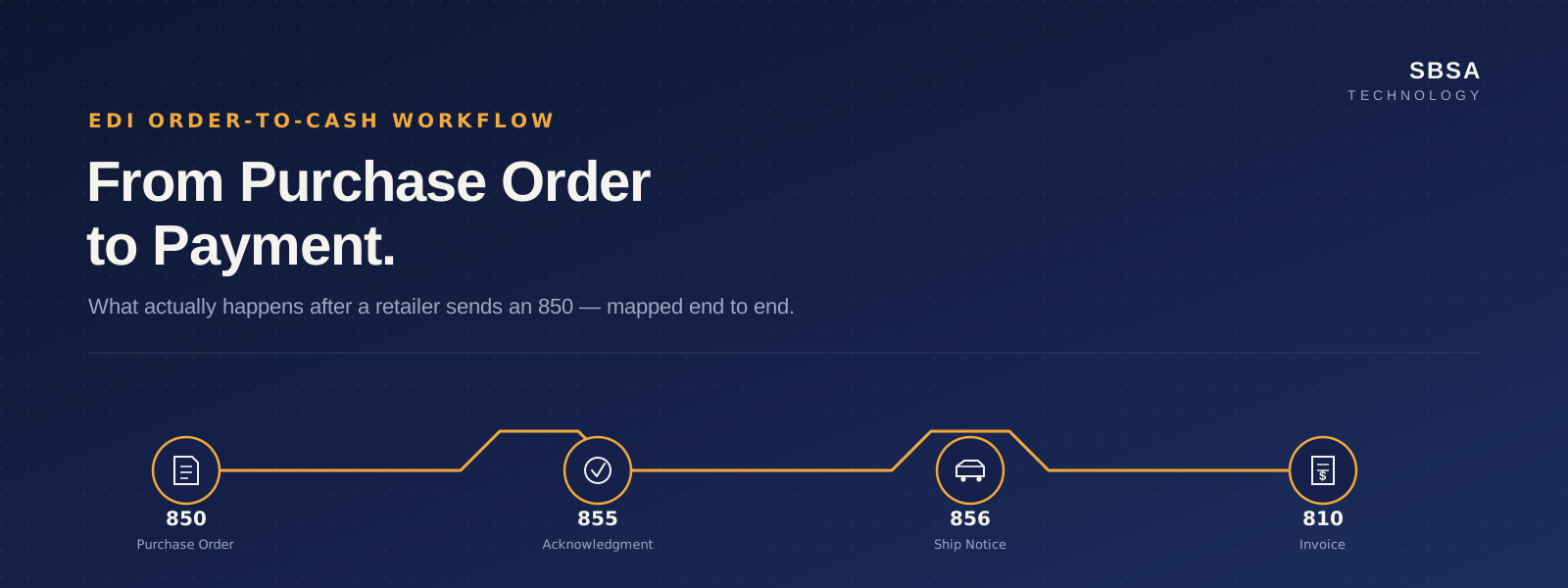
When a retailer sends an EDI 850 Purchase Order, it's easy to assume the hard part is over — the order is placed, and all that's left is to ship it and get paid. In our experience working with suppliers and retail trading partners every day, that assumption is where a lot of costly mistakes begin.
The 850 is only the first document in a much longer electronic conversation. Behind the scenes, that single purchase order sets off a chain of EDI transactions — acknowledgments, shipping notices, invoices, and remittances — that together make up what's known as the order-to-cash cycle. At SBSA Technology, we spend our days helping suppliers manage exactly this cycle, and we've seen firsthand how much revenue and time gets lost when one link in that chain breaks.
Here's what actually happens after that 850 lands in your system — and where the risk points are along the way.
What Is an EDI 850?
An EDI 850 Purchase Order is the electronic document a retailer sends to a supplier to formally place an order. It typically includes:
- The purchase order number
- Item numbers or UPCs and quantities
- Agreed-upon pricing
- Ship-to and bill-to addresses
- Requested delivery or "must-arrive-by" dates
It's the digital equivalent of a signed order form — but unlike a paper order, it triggers an entire downstream workflow that both sides need to execute correctly and on time.
The Order-to-Cash Workflow, Step by Step
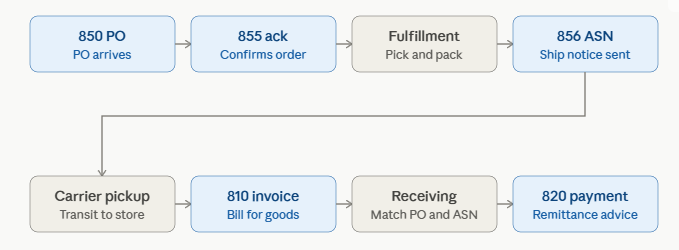
Step 1: The 850 Purchase Order Arrives
The cycle begins when the retailer transmits the 850. Depending on how a supplier is set up, this document lands in an EDI translator, an integration platform, or gets mapped directly into an ERP system. This is the moment where accuracy matters most — if the PO isn't captured correctly here, every document that follows inherits that error.
Step 2: The 855 Purchase Order Acknowledgment
The supplier responds with an 855, confirming the order has been received and accepted — or flagging changes like backorders, quantity adjustments, or pricing discrepancies. Many retailers require an 855 within a strict time window (often 24–48 hours). A late or missing acknowledgment is one of the simplest, most avoidable ways suppliers fall out of compliance before they've even shipped anything.
Step 3: Order Fulfillment
This is the only step in the cycle that isn't an EDI document — it's the physical work of picking, packing, and preparing the shipment. But it's also where the next document, the ASN, gets its data. If warehouse and inventory systems aren't tightly integrated with the EDI platform, this is where mismatches quietly get introduced.
Step 4: The 856 Advance Ship Notice (ASN)
Sent before or at the time of shipment, the 856 tells the retailer exactly what's in the shipment — carton contents, quantities, tracking numbers, and GS1-128 label data. In our experience, the ASN is the single biggest source of retailer chargebacks. If the carton contents don't match what's actually on the label, or the ASN is transmitted late, retailers will deduct the cost from payment — sometimes automatically, with little room for dispute.
Step 5: Carrier Pickup and Delivery
The shipment moves through the carrier network to the retailer's distribution center or store. Larger retail programs may also require a 214 Transportation Carrier Shipment Status transaction to track it along the way.
Step 6: The 810 Invoice
Once the order has shipped, the supplier sends an 810 Invoice. For this invoice to be paid without delay, its data has to align exactly with both the original 850 and the 856 — what's known as a three-way match. Any discrepancy in price, quantity, or item number between these three documents is a near-guaranteed way to trigger a delay or a deduction.
Step 7: Retailer Receiving and Matching
On the retailer's side, the PO, ASN, and invoice are reconciled against what physically arrived. This is where most deductions and chargebacks originate — not from bad intent, but from small data inconsistencies that crept in somewhere earlier in the cycle.
Step 8: The 820 Payment Order / Remittance Advice
Finally, once everything matches, the retailer issues an 820, confirming payment and detailing exactly which invoices it covers. This closes the loop — and it's the step every supplier is ultimately waiting on.
Why This Workflow Matters More Than It Seems
It's tempting to think of EDI compliance as a back-office technicality. In practice, every step in this workflow has a direct line to cash flow:
- Payment speed depends on clean, matching data across the 850, 856, and 810.
- Chargebacks and deductions — some of the most frustrating and hard-to-recover costs in retail supply chains — almost always trace back to a mismatch somewhere in this cycle.
- Vendor compliance scorecards, which many major retailers use to grade suppliers, are built directly from how accurately and quickly these documents are exchanged.
- Scalability breaks down fast when any of these steps depend on manual data entry. What works for 10 orders a week rarely works for 500.
Where the Cycle Typically Breaks Down
In the work we do with suppliers, the same handful of issues come up again and again:
- Manually re-keying purchase order data instead of receiving it directly into internal systems
- 855 acknowledgments sent late, or not at all
- ASN data that doesn't match what's actually packed and shipped
- Invoices that don't reconcile cleanly with the PO and ASN
- No real-time visibility across ERP, warehouse, and EDI systems — so problems aren't caught until a chargeback already happened
None of these are complicated problems on their own. But without the right integration in place, they compound quickly, and they tend to hit hardest during peak volume — exactly when suppliers can least afford the disruption.
How SBSA Technology Fits Into This Workflow
This is the exact cycle we built our EDI integration services around. Rather than treating the 850, 855, 856, 810, and 820 as separate, disconnected tasks, we help suppliers connect them into a single automated flow — from the moment a purchase order arrives to the moment payment is confirmed.
That means:
- Purchase orders flow directly into your existing ERP or order management system, without manual re-entry
- Acknowledgments and ASNs are generated from the same clean data set, reducing the chance of mismatches
- Invoices are built to match the original PO and ASN automatically, supporting a clean three-way match
- Retail trading partner requirements are handled as part of the integration, not as a manual afterthought
If your team is still managing any part of this cycle manually, or if chargebacks and payment delays have become a recurring headache, we'd be glad to walk through where automation could help.
EDI 850 Purchase Order
EDI 855 Purchase Order Acknowledgement
EDI 856 Advanced Shipping Notice
EDI 810 Invoice