
EDI in Plain Terms
EDI is the electronic replacement for paper-based business documents. Instead of faxing a purchase order or emailing a PDF invoice, EDI lets two companies' computer systems exchange that same information in a structured, standardized format — automatically, with no manual re-keying.
For large retailers like Walmart, EDI isn't a nice-to-have. It's the backbone of how they process orders, track shipments, and issue payments across tens of thousands of vendor relationships. Automating this exchange cuts down on typos and mismatched data, speeds up the order-to-cash cycle, and gives both sides real-time visibility into what's moving through the supply chain. When two companies set up this kind of ongoing electronic exchange, they're referred to as trading partners.
Why Walmart Requires It
Walmart operates thousands of stores, supercenters, and distribution points across multiple countries, moving an enormous volume of goods every day. Coordinating that volume manually simply isn't feasible. EDI compliance is a non-negotiable part of doing business with Walmart because it:
- Keeps data flowing accurately between Walmart's systems and yours
- Removes manual data entry, and the errors that come with it
- Gives Walmart (and you) a clearer view into inventory and order status
- Builds the operational trust needed for a long-term retail partnership
How Walmart and Its Suppliers Connect: AS2
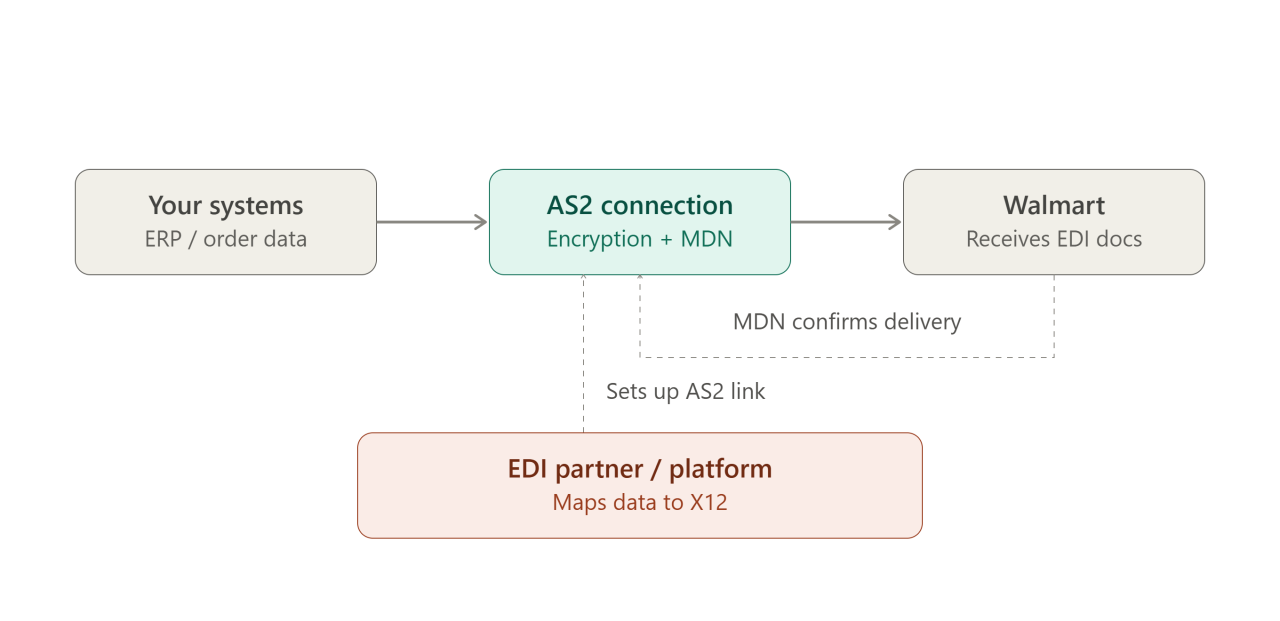
Walmart standardizes on AS2 (Applicability Statement 2), a protocol built specifically for secure business document transmission over the internet. AS2 combines encryption with digital certificates to keep data safe in transit, and it uses Message Disposition Notifications (MDNs) so both sides get confirmation that a document actually arrived intact.
Setting up a reliable AS2 connection — along with correctly mapping your data into X12 format — usually goes more smoothly with an established EDI partner or platform rather than building it from scratch in-house.
Which EDI Formats Does Walmart Accept?
Walmart works with a mix of standards depending on the type of transaction and where the supplier is located:
- ANSI X12 — the core American standard, including two important sub-variants:
- UCS (Uniform Communications Standards) — used heavily in Walmart's grocery and retail operations
- VICS (Voluntary Inter-industry Commerce Standards) — used for general retail transactions like order processing, logistics, and inventory in the US and Canada
- EDIFACT — reserved for international suppliers, particularly those handling direct import or export transactions with Walmart outside North America
Whichever format applies to you, the underlying goal is the same: structured data that both your system and Walmart's system can interpret the same way, without ambiguity.
The Two Building Blocks of EDI: Translation and Transmission
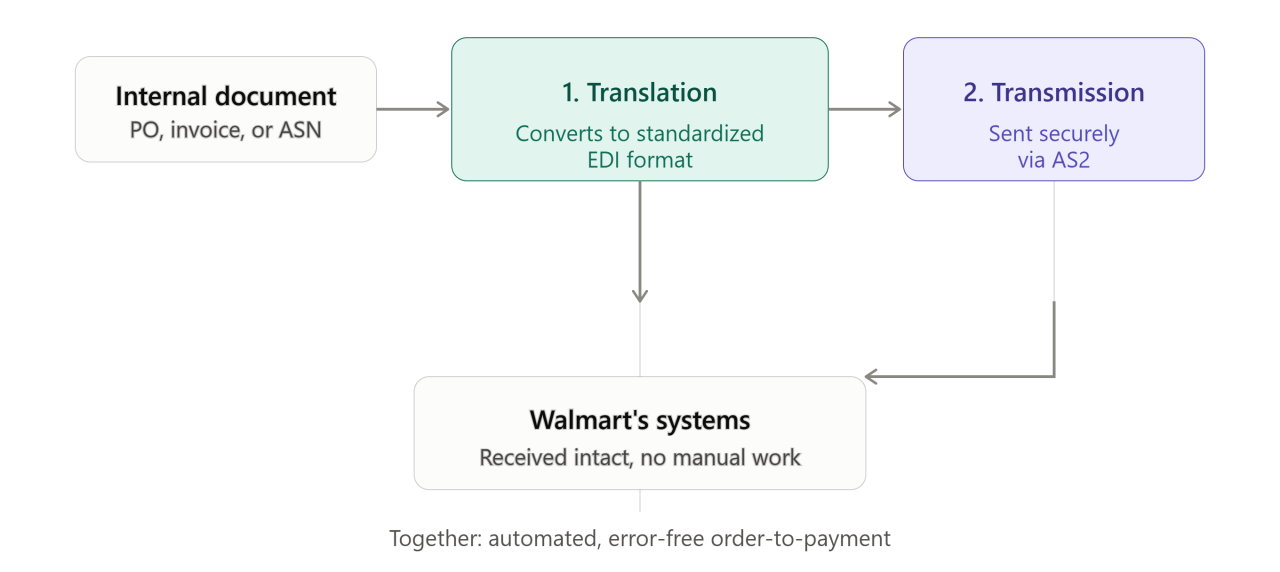
Translation comes first. Your internal purchase order, invoice, or ASN — whatever format your ERP or accounting system produces — gets converted into a standardized EDI document that Walmart's systems can read, regardless of what software generated it.
Transmission comes next. That translated document is sent securely to Walmart, almost always over AS2, ensuring it reaches Walmart's systems intact and without anyone needing to intervene manually.
Together, these two steps are what make automated, error-free order-to-payment cycles possible.
Step-by-Step: Becoming an EDI-Ready Walmart Supplier
Walmart doesn't mandate a specific EDI software vendor — you're free to use whatever tool supports the required formats and protocol. But the onboarding path itself follows a defined sequence:
1. Confirm you're EDI-capable. Every document exchanged with Walmart — POs, ASNs, invoices — must move electronically. There's no manual fallback for ongoing business. You need the ability to generate, transmit, and receive these documents automatically, over a stable AS2 connection.
2. Set up your AS2 environment. Once your AS2 software is configured, gather the technical details Walmart will need: your system's IP address, your AS2 identifier, and your digital certificates.
3. Register with Walmart's EDI team. Send that connection information to Walmart's EDI Implementation team. They'll use it to provision your GEM mailbox — the specific endpoint through which your EDI documents will flow to and from Walmart.
4. Test the AS2 connection itself. After certificates are exchanged, you'll run AS2-level connectivity tests to confirm the link is secure and stable — separate from testing the actual EDI documents.
5. Confirm active items before document testing. You can't validate order or invoice transactions without real product data behind them, so check with your buyer or sales contact that your items are active in Walmart's system first.
6. Complete testing in the Vendor Self-Testing Portal. This is where you validate that your purchase orders, invoices, and ASNs are correctly formatted and transmit properly — all inside a sandboxed environment before anything touches production. Typical testing takes about two weeks, with six weeks as the outer limit for a standard document set. If you're going to run longer than that, you're expected to proactively notify Walmart with an updated timeline and a reason for the delay.
7. Meet the 24-hour acknowledgment window. Once you're live, functional acknowledgments (997s) need to go out within 24 hours of receiving a purchase order. If you're going to miss that window, contact Walmart's EDI Support Desk right away.
The EDI Documents You'll Actually Use
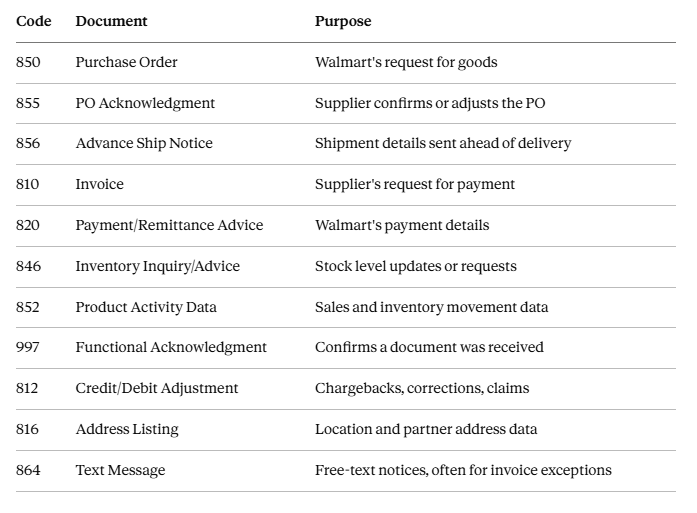
Walmart relies on a core set of transaction types to run its supplier relationships. The exact list can shift depending on your specific program, but these are the ones you'll see most often:
Choosing the Right EDI Translation Approach
Whatever tool you use, its job is the same: take your internal data — whatever format it's stored in — and reliably convert it into the X12 or EDIFACT structure Walmart expects, and vice versa on the way back in. The quality of that mapping directly affects how smoothly your orders, shipments, and invoices flow once you're live.
How SBSA Technology Can Help
Standing up a compliant, tested AS2 connection and getting your document mapping right on the first try isn't trivial — and getting it wrong costs you time during onboarding, or worse, delays in getting paid once you're live. SBSA Technology helps suppliers plan, configure, and validate their Walmart EDI integration from the AS2 handshake through Vendor Self-Testing Portal sign-off, so you're not troubleshooting connection issues on your own timeline.
Frequently Asked Questions
Does Walmart require EDI from every supplier? Yes. There's no manual alternative for ongoing business — every supplier must be able to exchange core documents electronically and pass Walmart's testing before receiving live orders.
Which EDI documents matter most? The essentials are the 850 (PO), 855 (PO acknowledgment), 856 (ASN), 810 (invoice), and 997 (functional acknowledgment). Depending on your program, you may also need the 820, 846, or 852.
How long does testing take? Typically around two weeks, with six weeks as the maximum for a standard document set. If you exceed that window, you need to give Walmart an updated ETA and explanation.
Do I need a specific software product? No — Walmart doesn't require a particular vendor. You just need a solution that produces valid X12 documents and connects over AS2.
Conclusion
Walmart's EDI requirements aren't just a formality — they're the operational foundation your entire relationship with the retailer runs on. Get the AS2 connection, GEM mailbox registration, and document testing right up front, and the day-to-day exchange of purchase orders, shipments, and invoices becomes largely automatic. Rush or skip a step, and you'll be fielding delays right when you're trying to get your first orders out the door.
Connect with SBSA Technology
Ready to get compliant with Walmart — or want a second opinion on your current EDI setup? SBSA Technology works with retail suppliers, distributors, e-commerce brands, and 3PL providers to automate EDI, order processing, and retailer compliance.
- Book a demo: sbsatech.com/consultancy
- Talk to the team: sbsatech.com/contact
- Explore the platform: sbsatech.com
- More insights: sbsatech.com/blog