
The Challenge
For growing manufacturers, distributors, wholesalers, and consumer brands, landing a major retailer can be a huge opportunity.
But there is a problem many vendors discover too late:
Getting the retailer account is only the beginning.
Every new retail partner can introduce new requirements for purchase orders, order acknowledgments, shipping notifications, invoices, inventory updates, compliance rules, and reporting.
When these processes are handled through spreadsheets, emails, manual data entry, or disconnected systems, growth can quickly become an operational headache.
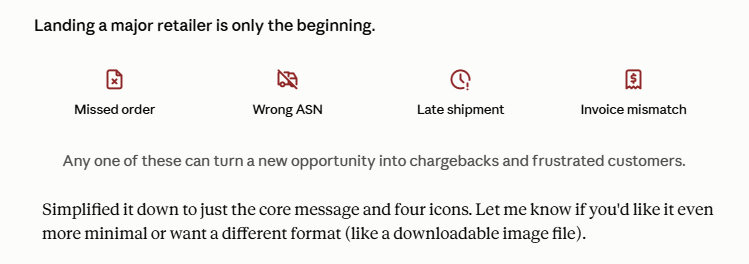
One missed order.
One incorrect ASN.
One late shipment.
One invoice mismatch.
And suddenly, a new retail opportunity can become a source of chargebacks, delays, and frustrated customers.
The Vendor's Real Problem
The vendor needed more than an EDI connection.
They needed a way to connect their retailers, ERP, warehouse, inventory, orders, shipments, and invoicing processes into one reliable workflow.
Their existing process created several risks:
- Manual entry between systems
- Limited visibility into order status
- Repetitive data entry
- Difficulty keeping inventory synchronized
- Shipping and ASN errors
- Invoice discrepancies
- Retailer compliance concerns
- Increasing operational workload as order volume grew
The business faced a critical question:
How do you add more retail customers without adding more manual work?
The SBSA Technology Solution
SBSA Technology approached the problem as an end-to-end retail operations challenge, rather than simply an EDI integration project.
SBSA connected the vendor's business systems with its retail trading partners and automated the flow of critical retail transactions.
The workflow could include:
Retailer → SBSA → ERP/WMS → Warehouse → SBSA → Retailer
Instead of employees manually moving information between systems, SBSA Technology automated the movement of critical transaction data.
What SBSA Automated
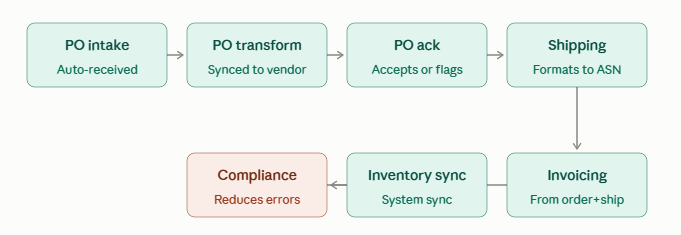
Purchase Orders
Retail purchase orders are received electronically and routed into the appropriate business workflow.
Order Processing
Orders can be transformed and synchronized with the vendor's internal systems, reducing manual entry.
PO Acknowledgments
Automated acknowledgments help vendors communicate order acceptance and exceptions back to retailers.
Shipping & ASNs
Shipment information can be captured and converted into the required Advance Shipping Notice format before being sent to the retailer.
Invoicing
Invoice information can be generated from the completed order and shipment workflow, helping reduce discrepancies between what was ordered, shipped, and billed.
Inventory Synchronization
Inventory information can be synchronized across connected systems, helping vendors maintain better visibility into available products.
Retail Compliance
The workflow helps vendors identify and manage retailer-specific requirements before small errors become expensive problems.
The Bigger Business Impact
The value of automation isn't simply sending EDI documents.
It is creating an infrastructure that allows the vendor to grow without multiplying administrative work.
With a connected retail operations workflow, vendors can work toward:
- Faster order processing
- Fewer manual data-entry errors
- Better inventory visibility
- More reliable shipping documentation
- Improved invoice accuracy
- Reduced compliance risk
- Better operational visibility
- Easier onboarding of additional retailers
- Less dependency on spreadsheets and repetitive tasks
Why This Matters to Growing Retail Vendors
A vendor may start with one or two retail customers.
Then growth happens.
Suddenly they are supporting Costco, Walmart, Target, Amazon, Home Depot, Kroger, Grainger, or other retail partners—each with different requirements and transaction workflows.
The question is no longer whether you can connect to a retailer.
The question becomes:
Can your operation scale when you add the next 5, 10, or 20 retailers?
That's where SBSA Technology becomes more than an EDI provider.
SBSA Technology: Your Retail Vendor Operating System
SBSA Technology helps connect the systems and processes that keep retail businesses moving—from EDI and order processing to shipping, inventory, invoicing, compliance, and ERP integrations.
Instead of adding more people to manage increasingly complex retail workflows, vendors can build a more automated infrastructure designed for growth.
Ready to Make Retail Operations Easier to Scale?
If spreadsheets, manual order entry, disconnected systems, or retailer compliance requirements are slowing down your business, SBSA Technology can help you evaluate where automation can make the biggest impact.
Let's turn your retail workflow into a scalable operation.