
Running a product business means juggling purchase orders from Walmart, shipment confirmations for Amazon, invoices for Home Depot, and trying to keep QuickBooks balanced — all at once. For most growing companies, that juggling act ends in one of two places: an overwhelmed team drowning in manual data entry, or a stack of chargeback notices from retailers who never received compliant EDI documents.
SBSA Technology was built to eliminate both problems. As an Intuit-approved QuickBooks software partner, SBSA bridges your entire sales operation — marketplaces, retailers, distributors, e-commerce channels — directly into QuickBooks Online or QuickBooks Enterprise. No spreadsheets. No copy-paste. No chargebacks from missing ASNs.

What "Marketplace Connector" Actually Means
The phrase gets used loosely, but SBSA's connector is a full-stack integration: it receives orders from your sales channels, processes and ships them, and then automatically reconciles every transaction in QuickBooks — customers, invoices, tracking numbers, and all.
The platform handles orders from two distinct relationship types:
EDI-based retail partners — large retailers and distributors that require structured electronic documents: 850 Purchase Orders, 856 Advance Ship Notices, 810 Invoices. These partners assess chargebacks when documents are late, missing, or non-compliant. SBSA handles certification, mapping, and transmission so your team never touches EDI transaction files directly.
API-connected marketplaces and e-commerce channels — platforms like Amazon Seller Central (SP-API), Shopify, and others that exchange data via REST APIs. SBSA pulls orders in automatically, processes them through the same workflow, and pushes acknowledgements, tracking, and invoices back without manual intervention.

How the QuickBooks Integration Works
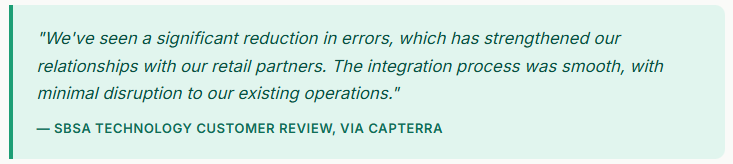
SBSA Technology is approved in the QuickBooks App Store — an approval process that tests for security, technical specification, and data integrity. That certification matters because the integration isn't a one-way export of completed orders. It's a live, bi-directional sync that keeps your books current throughout the fulfillment process.
-
Order received across all channels
Purchase orders from EDI retailers, API marketplaces, distributors, and e-commerce platforms land in one unified queue inside the SBSA platform.
-
Fulfillment team reviews and ships
The warehouse reviews orders, performs sorting and preparation tasks, and generates shipping labels — individually or in bulk, with UPS, FedEx, DHL, USPS, or LTL carriers for shipments over 150 lbs.
-
QuickBooks invoice created automatically
The moment an order is processed, SBSA creates an invoice in QuickBooks. New buyers get new customer records; existing buyers are matched to the existing record — no duplicates.
-
Tracking synced back to QuickBooks and your partners
Shipping labels trigger automatic tracking updates. Tracking numbers are written into the QuickBooks invoice and transmitted back to every marketplace and retail partner as required by their compliance standards.
-
EDI documents sent and confirmed
856 Advance Ship Notices and 810 Invoices go out to retail trading partners in the required format, on time. Compliance is handled by SBSA — not your team.
The accounting record is complete before your fulfillment team's shift ends. No separate invoicing step. No tracking copy-paste. No after-the-fact reconciliation.
Why Chargebacks Disappear
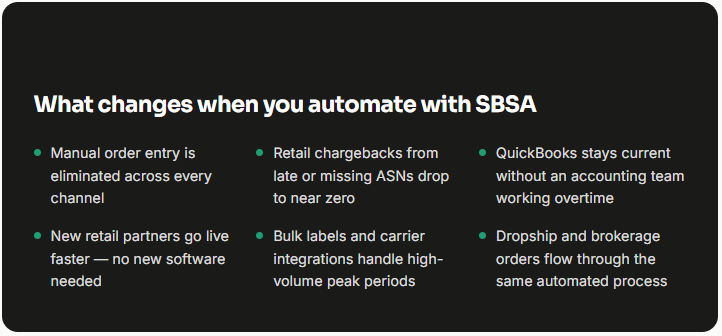
Retail chargebacks are almost always documentation problems, not shipping problems. A package arrives on time, but the retailer's system never received a compliant ASN, or the invoice referenced a wrong PO number, or the SSCC label on the pallet didn't match what was transmitted. The result: a deduction against your next payment that can easily outpace the margin on the original order.
Because SBSA generates ASNs, invoices, and SSCC box labels directly from the same order data used to create the shipment and the QuickBooks invoice, there is no translation layer where errors can enter. The document the retailer receives matches what shipped, because it was generated from the same source of truth.
Key Features of the Platform
EDI VAN + AS2: The Infrastructure Behind the Connector
Every EDI transaction has to travel somewhere. SBSA operates its own EDI VAN (Value-Added Network) with AS2 and SFTP communication protocols, meaning your data moves securely between you and your trading partners without relying on a third-party intermediary that adds latency or cost per document.
This matters especially for companies scaling their retailer relationships quickly. Adding a new trading partner doesn't require a new software contract — SBSA handles the onboarding, certification, and EDI mapping setup, then the connection is live.
Who It's Built For
SBSA Technology's platform fits companies that sell physical products through multiple channels and have reached the point where manual processing is a growth bottleneck — typically businesses working with two or more retail partners, running at least moderate order volumes, and using QuickBooks as their accounting system of record.
It's especially valuable for teams where the same person handling warehouse operations is also responsible for invoicing and retail compliance. SBSA collapses that workload into a single, one-click fulfillment step.
Companies currently using SBSA include suppliers for Walmart, Home Depot, Tractor Supply, Grainger, Zoro, Northern Tool & Equipment, and Ace Hardware — retailers with exacting EDI compliance requirements and real chargeback programs that punish non-compliance.
Getting Started
SBSA Technology provides a free consultation to assess your current order processing workflow, identify which trading partner connections need to be built, and map out how QuickBooks will be configured. Because the platform handles EDI certification and API onboarding, you don't need in-house EDI expertise to get started.
Once live, the system operates behind the scenes. Orders come in. Fulfillment happens. QuickBooks is updated. Partners receive their documents. Your team's job becomes reviewing exceptions — not managing the routine transactions that make up 95% of the daily workload.