
Landing a Target partnership is a milestone for any consumer brand. With nearly 2,000 stores nationwide and a shopper base skewing toward millennials and Gen Z, Target gives suppliers a rare mix of premium brand positioning and mass-market reach.
What many new vendors don't fully appreciate, though, is that Target is just as selective about how you do business with them as it is about what you sell. Target runs its vendor relationships through a strict EDI (Electronic Data Interchange) compliance program, monitored continuously through its Partners Online vendor portal. Miss a requirement and you're not just facing a warning — you're facing a chargeback that eats into your margin before the product even reaches the shelf. Unlike some retailers that phase in requirements for new suppliers, Target expects full compliance starting with your very first purchase order.
This guide walks through what it actually takes to get — and stay — compliant as a Target EDI vendor in 2026, including:
- The EDI documents Target requires
- The setup process, from vendor agreement to go-live
- How Partners Online fits into your day-to-day operations
- GS1 and barcode/labeling requirements
- ASN (Advance Ship Notice) specifics that most often trigger chargebacks
- Routing guide essentials
- The most common compliance mistakes — and how to avoid them
Whether you're a growing DTC brand about to ship your first Target PO, or an established supplier looking to tighten up operations, this is meant to be a practical reference for getting it right.
Understanding Target's EDI Requirements
What Target EDI Actually Is
Target EDI refers to the standardized electronic system Target uses to exchange business documents — purchase orders, shipping notices, invoices, and more — with its vendors. Rather than emailing PDFs or manually keying in orders, these documents move through structured data formats that plug directly into Target's supply chain systems.
The bottom line: Target does not offer a manual, non-EDI path for ongoing vendor relationships. If you intend to sell to Target on a recurring basis, EDI capability is mandatory, not optional.
The Technical Standards Behind Target EDI
Target's EDI program is built on the same foundation most major U.S. retailers use:
- Standard: ANSI X12, version 5010
- Preferred connection: AS2 (Applicability Statement 2), with SFTP available to some vendors
- VAN support: Target works with several established Value Added Networks, including SPS Commerce and TrueCommerce, among others
- Certification: All new trading partners must pass testing in Target's certification environment before moving to production
Vendor Categories and How Requirements Differ
Target doesn't treat every vendor identically — your category shapes which requirements apply:
Domestic vendors ship from U.S. warehouses into Target's distribution centers and follow the standard EDI document set plus Target's Routing Guide.
Import (direct import) vendors manufacture overseas and ship internationally, which adds customs and logistics documentation on top of the core requirements; FOB terms are typical here.
Drop-ship vendors fulfill Target.com orders directly to consumers, using a different transaction set geared toward e-commerce, with tighter shipping SLAs.
Target Plus marketplace partners sell through Target.com as third-party sellers and connect via API rather than traditional EDI — a fundamentally different integration path from store vendors.
The Core EDI Documents Target Vendors Must Support
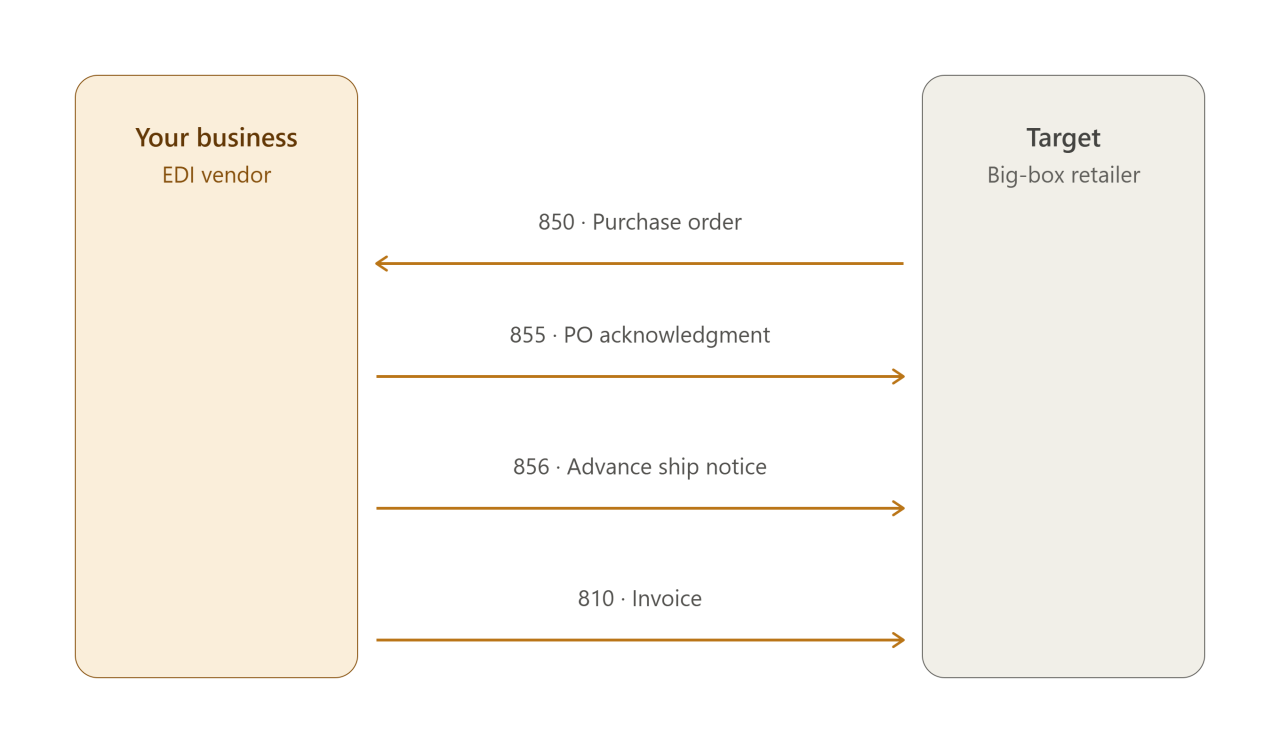
The Four Non-Negotiables
EDI 850 — Purchase Order. This is how every Target transaction begins: Target sends you an 850 when it wants to order product. It includes item identifiers (DPCI and UPC), quantities, cost, the destination distribution center, and requested delivery dates. How often you receive one depends on the item's sales velocity and your replenishment model, and Target expects an acknowledgment in return.
EDI 855 — Purchase Order Acknowledgment. Your reply confirming you received the order and can fulfill it as specified — validating pricing, confirming line items, and flagging any issues. Target generally expects this within 24–48 hours of the original 850.
EDI 856 — Advance Ship Notice (ASN). Arguably the single most important document in the relationship. The ASN tells Target precisely what's in a shipment and how it's packed — carton-level contents, pallet configuration, SSCC-18 codes, and carrier details. It must reach Target before the shipment physically arrives, and it must match the actual shipment exactly. This is where the majority of chargebacks originate.
EDI 810 — Invoice. Your bill for goods shipped, generally transmitted within 24 hours of shipment. It needs to reconcile cleanly with both the PO and the ASN, or payment gets held up.
Supporting Documents
Beyond the core four, several other transaction sets come into play depending on your program:
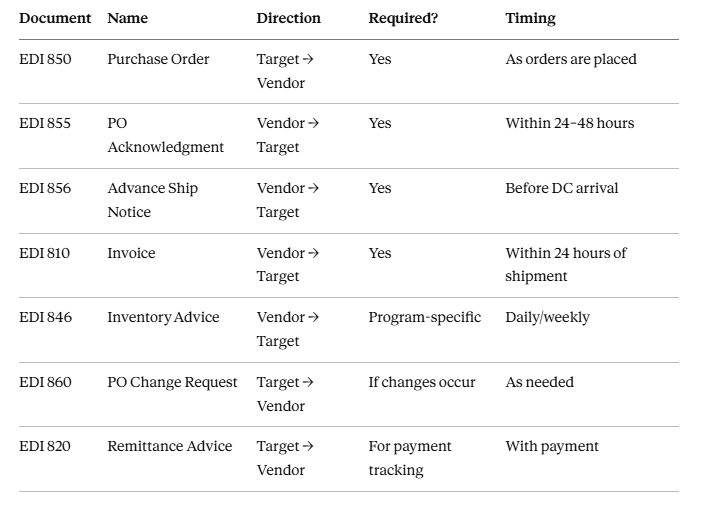
- EDI 846 (Inventory Inquiry/Advice): reports your available inventory to help Target plan replenishment; required for vendor-managed inventory (VMI) programs
- EDI 860 (PO Change Request): Target's mechanism for modifying an existing order — quantities, dates, or cancellations
- EDI 865 (PO Change Acknowledgment): your required response to any 860
- EDI 812 (Credit/Debit Adjustment): used for returns, allowances, and chargeback-related adjustments
- EDI 820 (Payment/Remittance Advice): Target's notice of payment processing, including any deductions
Quick-Reference Table
Getting Set Up: The Target EDI Onboarding Process
Standing up Target EDI touches your company, your EDI provider, and Target's own vendor systems. Broadly, it breaks into four phases.
Phase 1 — Vendor Agreement and Onboarding
Once Target's buying team approves your products, you'll finalize a Vendor Agreement covering assortment, pricing, payment terms (commonly Net 30–60), and compliance expectations, including EDI deadlines.
Next comes registration in Partners Online, Target's vendor portal, where you'll submit company and tax information (W-9), banking details for ACH payment, and designated contacts for orders, shipping, and compliance.
Finally, Target issues you a vendor number — a unique identifier that appears on every EDI transaction going forward and is required to move ahead with setup.
Phase 2 — Choosing and Configuring Your EDI Connection
You generally have three paths to Target EDI connectivity:
- A full-service EDI provider that manages the technical setup, offers pre-built Target mappings, and typically gets you live fastest.
- A VAN (Value Added Network), useful if you already route documents through one, though it comes with per-transaction fees.
- A direct AS2 connection, which avoids VAN fees but demands more in-house technical resources.
Whichever path you choose, you'll need to exchange trading partner IDs with Target, configure AS2 certificates or VAN routing, and confirm connectivity before mapping any documents. Mapping itself means translating Target's data formats into your internal systems — linking DPCI numbers to your item catalog, configuring DC location codes, setting unit-of-measure conversions, and defining how exceptions get handled.
Phase 3 — Testing and Certification
Before you can trade live, Target requires you to pass certification testing:
- Test 855: confirm the acknowledgment format is correct and every required field is populated
- Test 856 (ASN): validate the hierarchical structure, SSCC-18 formatting, and carton-content accuracy
- Test 810: confirm pricing, quantities, and reference numbers match the test PO
Once your test documents pass, Target approves you for production trading and your first live orders go out — typically monitored closely for compliance.
Phase 4 — Go-Live and Ongoing Optimization
At go-live, keep a close eye on your first purchase orders: verify ASN timing, confirm invoices reconcile properly, and resolve any 997 acknowledgment errors immediately. From there, compliance becomes an ongoing discipline — reviewing your vendor scorecard weekly, tracking chargeback trends monthly, and updating your mappings whenever Target adjusts its requirements.
How Long Should This Take?
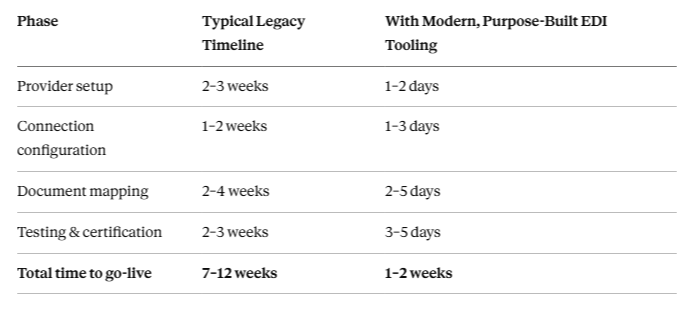
This is where the choice of EDI partner matters most. At SBSA Technology, we've built Target-specific mappings and a guided certification process designed to compress this timeline — helping vendors move from signed agreement to live trading in a fraction of the time a legacy setup usually takes.
Partners Online: Target's Vendor Portal
What It's For?
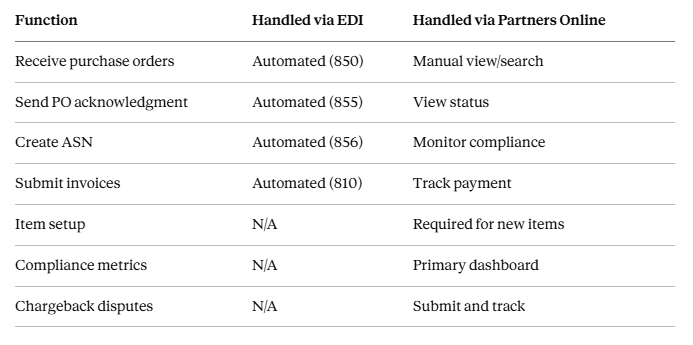
EDI automates the document exchange itself, but Partners Online is where you manage the relationship day to day. It covers:
- Order management — viewing, searching, and tracking POs
- Compliance scorecards — fill rate, on-time performance, quality metrics
- Item management — product setup, UPC registration, content
- Financial data — invoice status, payments, deductions
- Communications — buyer messages, bulletins, alerts
- Routing Guide access — shipping and carrier requirements
What EDI Vendors Use It For Specifically
Inside Partners Online, you can track the status of your EDI documents (sent, received, acknowledged, or rejected), review your compliance scorecard and fill-rate/on-time metrics, and manage chargebacks — viewing details, submitting disputes within the allowed window, and tracking resolution. It's also where new item setup happens, including UPC and DPCI registration and product content uploads.
GS1 Numbers and Barcode Requirements
Getting a GS1 Company Prefix
Before you can become a Target vendor, you need a GS1 Company Prefix — the basis for identifying every product you sell. This lets you generate unique GTINs for products and SSCC-18 codes for shipping containers. Licensing costs scale with your catalog size, ranging from roughly $250 (up to 10 products) to $10,500+ (100,000+ products), with annual renewals from about $50 to $2,100+.
GTIN and UPC Rules
Every consumer unit needs a unique GTIN-12 or GTIN-13, and every case pack needs its own GTIN-14 (ITF-14 barcode) — with a separate GTIN for each size, flavor, or variant. Barcodes must scan cleanly at point of sale (minimum quality grade C) and follow Target's packaging placement guidelines. Target also assigns its own internal identifier, the DPCI (Department, Class, Item number), which maps to your UPC and appears in your EDI transactions alongside it.
SSCC-18: Identifying Every Carton
The SSCC-18 (Serial Shipping Container Code) uniquely identifies each carton you ship to Target. It's an 18-digit code made up of an extension digit (usually 0), your GS1 Company Prefix, a serial reference you assign, and a calculated check digit. Every carton needs its own unique SSCC-18, it must appear on the GS1-128 shipping label, and — critically — it must match exactly what's in your ASN.
Shipping Label Requirements
Target requires GS1-128 compliant labels on every carton, including the SSCC-18 barcode, ship-to DC, ship-from information, PO reference, and carrier/tracking data. Standard format is a 4"x6" label with a clean barcode, proper quiet zones, human-readable text underneath, and placement on two adjacent sides of the carton.
The ASN (EDI 856): Where Most Chargebacks Start
Because the ASN is the document Target relies on most heavily for receiving, it's also the one most likely to generate a chargeback if something's off.
Timing
Your ASN needs to reach Target before the physical shipment arrives at the DC — Target actually tracks the gap between ASN receipt and truck arrival. As a rule of thumb, aim to transmit within 30 minutes of carrier pickup (or before the carrier's final en-route scan for LTL shipments). Late or missing ASNs disrupt Target's receiving labor scheduling and count against you.
Required Hierarchical Structure
Target's ASN follows a specific nested structure:
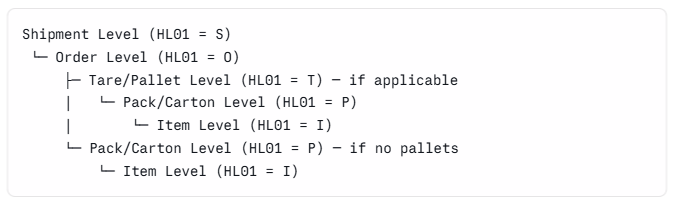
In plain terms: the shipment level carries overall carrier and date info; the order level ties back to the specific PO; the tare level groups cartons by pallet (when relevant); the pack level identifies each individual carton via its SSCC-18; and the item level details exactly what's inside that carton by GTIN/UPC.
What Belongs at Each Level
- Shipment: shipment ID, ship/estimated delivery dates, carrier SCAC code and tracking number, bill of lading number, ship-from/ship-to locations
- Order: Target PO number and PO date
- Carton: SSCC-18, weight, dimensions (if required)
- Item: UPC/GTIN, quantity, unit of measure, DPCI
The Errors That Actually Cause Chargebacks
- SSCC mismatch — the code in your ASN doesn't match the physical label, so the DC scanner can't find it, forcing manual receiving (at your cost) plus a chargeback
- Quantity variance — the ASN states a different unit count than what's physically in the carton
- Missing cartons — physical cartons that never made it into the ASN can't be received at all
- Wrong ship-to location — the ASN lists a different DC than the actual delivery point
- Items not on the PO — anything shipped that wasn't ordered can't be received against that order
Routing Guide Compliance
Target's Routing Guide dictates exactly how shipments must be prepared and moved, and it isn't negotiable.
Carrier selection follows Target's approved-carrier list per lane; collect shipments use Target's own carrier contracts, while prepaid shipments may use your carriers with prior approval. Appointment scheduling is required at most DCs, booked through Target's system — missing an appointment is itself a chargeback trigger. Pallets must be GMA-standard (48"x40"), within height limits of 48–60" depending on the DC, generally single-SKU unless otherwise specified, and properly wrapped with corner boards. Cartons need to meet minimum strength (ECT) ratings, avoid overhanging the pallet, and carry labels on two adjacent sides.
Fill Rate and On-Time Metrics
Target expects a 95%+ fill rate (units shipped ÷ units ordered) and 95%+ on-time delivery (arrival within the window implied by the ship date plus transit time), both tracked continuously in your Partners Online scorecard.
Practical steps that help: review every PO on receipt and flag issues via the 855 immediately; carry enough safety stock to protect fill rate and prioritize Target allocations; and ship complete whenever feasible, since partial shipments multiply the number of ASNs and invoices — and with them, the odds of an error.
Chargebacks: What Triggers Them and How to Fight Back
The Main Categories
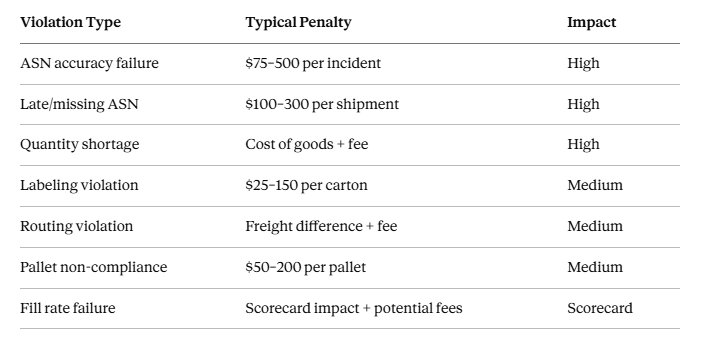
Target deducts chargebacks directly from your payments, generally falling into three buckets: compliance (ASN errors, timing violations, labeling and routing issues), shortage (quantity discrepancies, missing cartons, concealed shortages), and quality (damaged, expired, or non-compliant product).
How to Dispute One
Start by reviewing the chargeback detail in Partners Online, including the reason code and any evidence Target provides, to decide whether a dispute is actually worth pursuing. If it is, gather proof of delivery with quantities, your ASN transmission confirmation, photos if you have them, and the carrier's delivery receipt. Submit within Target's dispute window (typically 30–60 days depending on the violation type), then track the resolution and log the outcome so you can spot recurring root causes.
Preventing Chargebacks Before They Happen
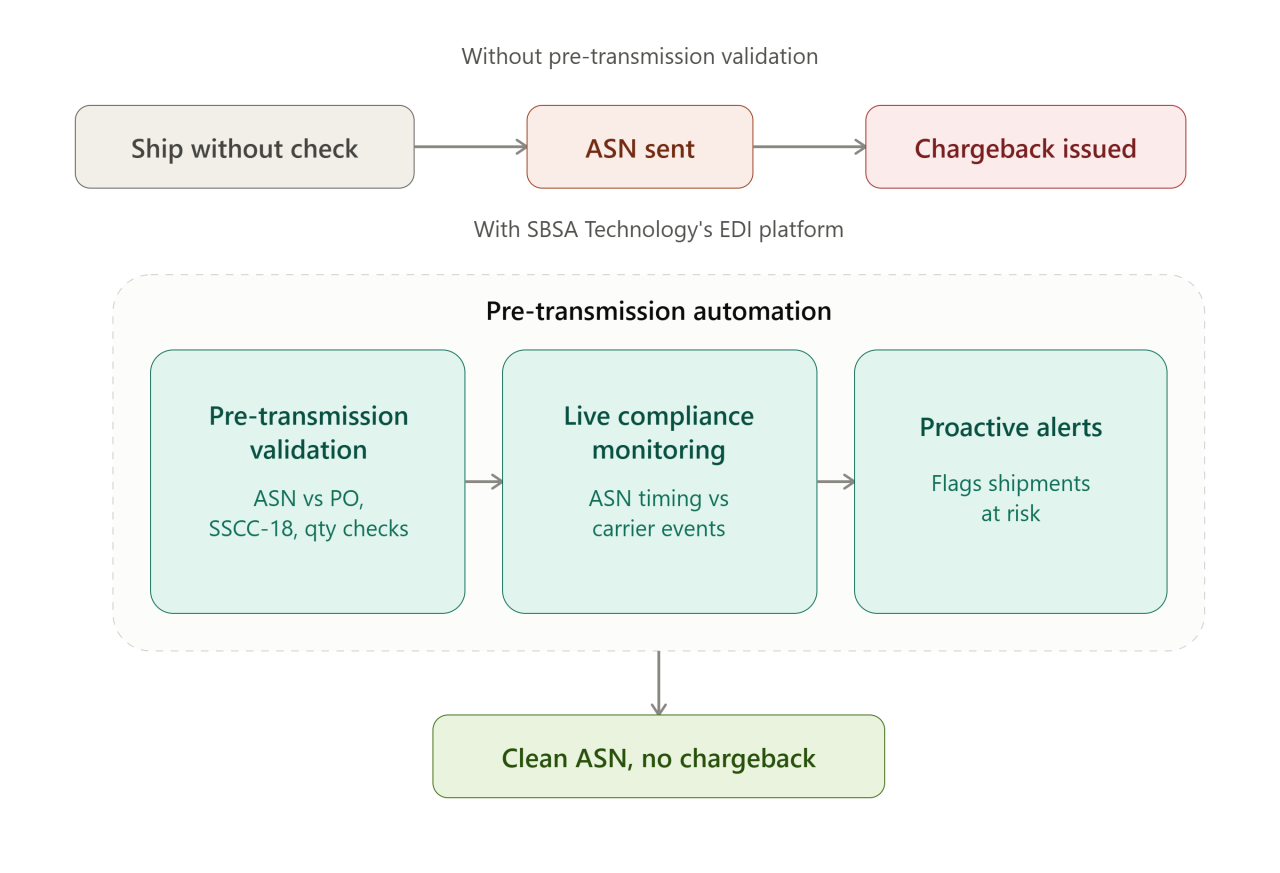
The most effective fix is catching problems before transmission, not disputing them after the fact. That means validating your ASN against the PO before it goes out, verifying SSCC-18 formatting and uniqueness, and checking quantities against what was actually ordered — all before a discrepancy has the chance to become a chargeback. Real-time monitoring of ASN timing against carrier events, automated alerts when a shipment is at risk, and pattern analysis on past chargebacks all add another layer of protection.
This is precisely the kind of automation SBSA Technology builds into its EDI platform: pre-transmission validation, live compliance monitoring, and proactive alerts, so problems get caught before Target ever sees them — not after a chargeback lands.
Target EDI Readiness Checklist
Before onboarding
- GS1 Company Prefix obtained
- GTINs created for all products (each and case)
- Products registered in GS1 US Data Hub
- EDI provider selected and under contract
- Internal owners identified (ops, finance, compliance)
- Warehouse capable of GS1-128 labeling
During setup
- Target Vendor Number received
- Partners Online access configured for the team
- EDI trading partner relationship established
- Connection tested (AS2 or VAN)
- Mappings built for 850, 855, 856, 810
- ERP/WMS integration configured
- DPCI-to-UPC mapping complete
- GS1-128 label templates created
- SSCC-18 generation process in place
Testing
- Test 855 accepted
- Test 856 accepted with correct hierarchy
- Test 810 accepted
- Full cycle tested end-to-end (850 → 855 → 856 → 810)
- Partial-shipment scenario tested, if relevant
- Certification approval received
Go-live readiness
- Ops team trained on EDI workflows
- Warehouse team trained on labeling
- Exception-handling process documented
- Chargeback monitoring in place
- Routing Guide reviewed
- Approved carriers confirmed
- Partners Online dashboards bookmarked
Ongoing
- Weekly scorecard review
- Weekly ASN accuracy check
- Monthly chargeback root-cause review
- Monthly fill-rate review
- Quarterly mapping review for Target updates
- Annual GS1 data verification/renewal
Frequently Asked Questions
What are the core Target EDI requirements? All vendors must trade electronically via ANSI X12 EDI. The four essential documents are the 850 (PO), 855 (PO acknowledgment), 856 (ASN), and 810 (invoice), connected via AS2 or an approved VAN. Products need GS1-compliant GTINs, and every carton needs an SSCC-18 that matches the ASN.
How long does setup take? With a traditional provider, plan on 7–12 weeks end to end. With modern, Target-ready EDI tooling — like the pre-built mappings and automated testing SBSA Technology provides — that can often compress to 1–2 weeks.
What does Target EDI cost? Traditional setups often run $1,000–5,000 in implementation fees, $300–800 monthly minimums, and $0.15–0.50 per document. Modern platforms increasingly offer flat monthly pricing (commonly $500–1,500/month) with no per-document fees. On top of that, budget for GS1 membership ($250–10,500/year depending on catalog size) and any ERP/WMS integration work.
How does Partners Online relate to EDI? EDI handles the automated document flow — orders, ASNs, invoices. Partners Online is the interface where you manage the relationship: viewing orders, monitoring your scorecard, handling chargebacks, setting up items, and pulling the Routing Guide. You need both.
What happens when my ASN doesn't match the shipment? It typically triggers a chargeback and receiving delays, since the DC can't efficiently process goods that don't match what was declared. Penalties commonly range from $75–500 per incident, and repeated failures hurt your scorecard and future allocation. Catching these before transmission is far cheaper than disputing them afterward.
How do I handle a chargeback? Review the reason code and evidence in Partners Online, decide if it's worth disputing, gather supporting documentation, and submit within the applicable window (usually 30–60 days). Track it through to resolution and use it to improve your process going forward.
Is Target.com different from store EDI? Yes. Store vendors use the traditional EDI flow covered here. Target Plus marketplace sellers connect via API instead. Drop-ship vendors sit somewhere in between, with e-commerce-focused requirements. Confirm your vendor type with Target directly.
Can I reuse my EDI setup from another retailer? Most retailers share the ANSI X12 foundation, but document content, timing, and hierarchy differ by retailer, so you'll need a distinct trading partner profile and mapping for Target even if you're already EDI-enabled elsewhere. Platforms with pre-built retailer templates — including Target-specific mappings — make adding a new retailer significantly faster.
Conclusion
Target EDI compliance isn't a box to check once — it's an ongoing operational discipline. Vendors who treat it that way tend to turn it into a genuine advantage rather than a recurring cost.
A few things worth keeping in mind: Target expects full compliance from your first order, so your 850/855/856/810 flow needs to be accurate and on time from day one. Your choice of EDI infrastructure has an outsized effect on both your time to go-live and your ongoing error rate. The ASN deserves the most attention of any single document, since it's where most chargebacks originate. And Partners Online should be a weekly habit, not something you only open when there's a problem.
SBSA Technology builds Target-ready EDI infrastructure specifically to take the friction out of this process — pre-built Target mappings, pre-transmission validation, and real-time compliance monitoring, so growing brands can get compliant quickly and stay that way without needing a dedicated in-house EDI team.
Connect with SBSA Technology
Ready to get compliant with Target — or want a second opinion on your current EDI setup? SBSA Technology works with retail suppliers, distributors, e-commerce brands, and 3PL providers to automate EDI, order processing, and retailer compliance.
- Book a demo: sbsatech.com/consultancy
- Talk to the team: sbsatech.com/contact
- Explore the platform: sbsatech.com
- More insights: sbsatech.com/blog