
EDI in Plain Terms
EDI (Electronic Data Interchange) replaces the fax, email, and manual re-keying that used to move purchase orders and invoices between trading partners. Instead, your system and Murdoch's system exchange the same documents in a structured, standardized format — automatically, with no one retyping line items by hand.
For a retailer running dozens of stores and two distribution centers, that automation isn't optional. It keeps inventory counts accurate, purchase orders flowing without delay, and invoices matching what was actually shipped. Once your business and Murdoch's are set up to trade documents this way on an ongoing basis, you're considered trading partners.
Why Murdoch's Requires It
Murdoch's may not move the volume of a national big-box chain, but it still runs a multi-store, multi-DC replenishment cycle that depends on clean, predictable data. EDI compliance matters to Murdoch's because it:
- Keeps purchase orders, acknowledgments, and invoices synced between your systems and theirs
- Cuts out manual order entry and the transcription errors that come with it
- Gives Murdoch's buyers and DC teams accurate, real-time visibility into what's inbound
- Signals that your business can operate as a reliable, long-term supply partner as the relationship grows
How Murdoch's and Its Suppliers Connect
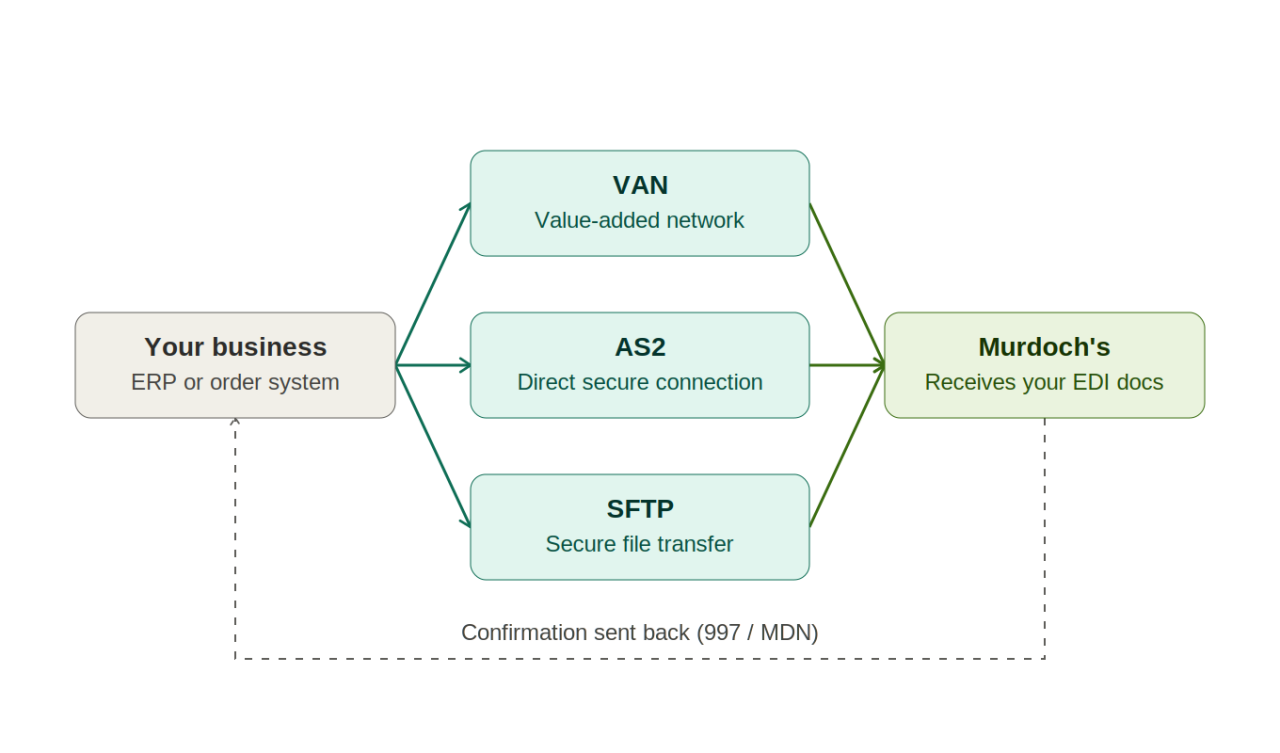 Murdoch's works with suppliers through standard EDI connection methods — most commonly a Value-Added Network (VAN), with direct AS2 or SFTP connections available depending on your setup and the volume you're moving. Whichever path you take, the goal is the same: a secure, reliable channel that gets documents to Murdoch's intact, with confirmation that they arrived.
Many suppliers find it faster to route their Murdoch's transactions through an established EDI VAN or platform rather than standing up and maintaining a direct connection in-house, especially if Murdoch's is one of several retail trading partners you're managing.
Which EDI Format Does Murdoch's Use?
Like most U.S. retailers, Murdoch's transacts in ANSI X12, the American standard for structured business documents. Your job — or your EDI provider's job — is to translate your internal order, invoice, and shipment data into valid X12 transaction sets that map cleanly to what Murdoch's expects on the other end, and translate their responses back into your system's format.
The Two Building Blocks of EDI: Translation and Transmission
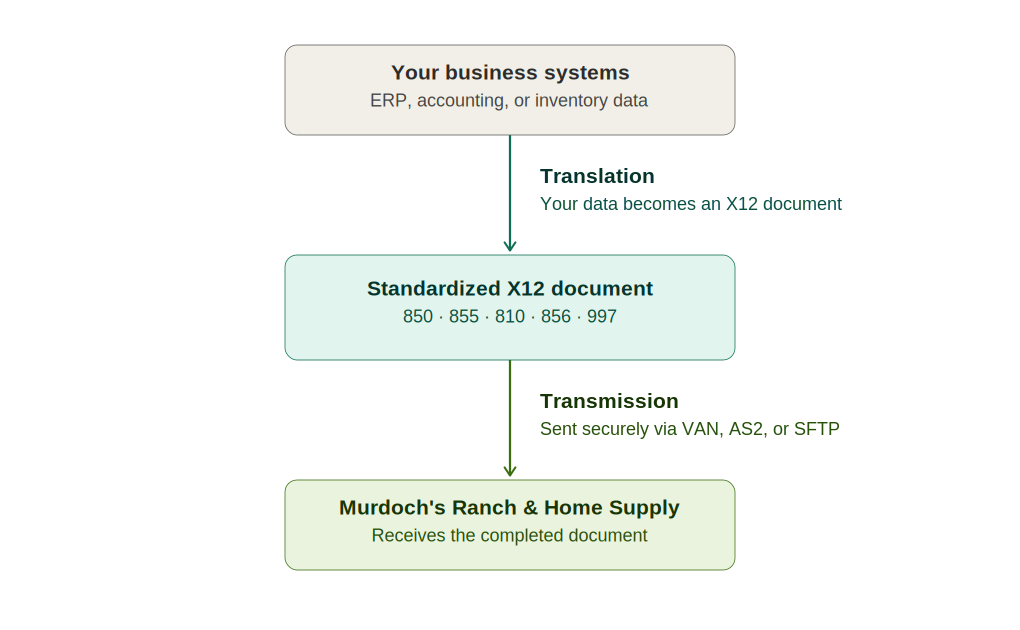
Translation happens first. The purchase order, invoice, or shipment data sitting in your ERP, accounting software, or inventory system gets converted into a standardized X12 document Murdoch's can read, no matter what system originally generated it.
Transmission happens next. That translated document is sent securely to Murdoch's over your VAN, AS2, or SFTP connection, so it arrives complete and without anyone needing to manually forward or re-key it.
Together, these two steps are what let a purchase order move from Murdoch's system into yours — and an invoice move back — without a person touching it in between.
Step-by-Step: Getting EDI-Ready for Murdoch's
Murdoch's doesn't require a specific software vendor, but onboarding generally follows a predictable sequence:
- Confirm you can trade electronically. You need the ability to generate, send, and receive core documents — POs, acknowledgments, invoices — without manual fallback.
- Set up your connection. Configure your VAN, AS2, or SFTP environment and gather the technical details (connection ID, credentials, certificates) your EDI provider or Murdoch's contact will need.
- Coordinate with Murdoch's EDI or vendor management contact. Confirm which transaction sets apply to your program and get your connection details on file so documents route correctly.
- Test the connection. Verify the link itself is stable and secure before pushing live documents through it.
- Confirm your items are set up. Order and invoice testing only works against real, active product data, so check with your Murdoch's buyer that your items are loaded before you try to validate transactions.
- Complete document testing. Work through sample purchase orders, acknowledgments, and invoices until they map and transmit correctly — ideally in a sandbox before anything touches production.
- Stay current once you're live. Acknowledge purchase orders promptly and keep an eye on any format or requirement changes Murdoch's communicates to its vendor base.
The EDI Documents You'll Actually Use
Murdoch's compliance program centers on a small set of required transactions, with a few optional ones layered in depending on your category and program:
Required
- 850 – Purchase Order
- 855 – Purchase Order Acknowledgment
- 810 – Invoice
- 997 – Functional Acknowledgment
Optional, depending on program
- 820 – Payment Order/Remittance Advice
- 856 – Ship Notice/Manifest (ASN)
- 860 – Purchase Order Change Request
- 864 – Text Message
If your program calls for GS1-128 shipping labels or a customized packing slip, that typically gets layered on top of the core transaction set rather than replacing it — confirm the specifics with your Murdoch's contact.
Choosing the Right EDI Translation Approach
Whatever tool sits behind your connection, its job is the same: take your internal order, invoice, and shipment data — however your ERP or accounting system stores it — and reliably convert it into valid X12 documents, and back again on the way in. How well that mapping is built directly affects whether your orders, acknowledgments, and invoices flow smoothly once you're live, or whether you're troubleshooting rejected transactions every week.
How SBSA Technology Can Help
Standing up a compliant EDI connection and getting your document mapping right the first time takes more effort than most suppliers expect — and mistakes tend to surface as delayed orders or held invoices, not as a friendly warning. SBSA Technology helps suppliers configure, test, and validate their Murdoch's EDI setup from the initial connection through document testing, so you're not figuring out rejected transactions on your own.
Frequently Asked Questions
Does Murdoch's require EDI from every supplier? Ongoing trading partners are expected to exchange core documents — POs, acknowledgments, invoices — electronically rather than manually.
Which EDI documents matter most? The 850 (PO), 855 (PO acknowledgment), 810 (invoice), and 997 (functional acknowledgment) form the required baseline. Depending on your program, you may also need the 820, 856, 860, or 864.
What format does Murdoch's use? ANSI X12, the standard most U.S. retailers rely on for EDI transactions.
Do I need a specific software product? No — Murdoch's doesn't mandate a particular vendor. You need a solution that produces valid X12 documents and connects reliably, whether over a VAN, AS2, or SFTP.
Conclusion
Murdoch's may run a leaner operation than a national big-box chain, but its EDI expectations follow the same logic: get the connection, the document mapping, and the testing right up front, and day-to-day order processing becomes automatic. Skip a step or leave your mapping half-finished, and you'll be the one explaining a held invoice or a missed PO acknowledgment to your buyer.
Connect with SBSA Technology
Ready to get compliant with Murdoch's Ranch & Home Supply — or want a second opinion on your current EDI setup? SBSA Technology works with retail suppliers, distributors, e-commerce brands, and 3PL providers to automate EDI, order processing, and retailer compliance.
- Book a demo: sbsatech.com/consultancy
- Talk to the team: sbsatech.com/contact
- Explore the platform: sbsatech.com
- More insights: sbsatech.com/blog