
Supplying a large wholesale grocery distributor requires more than having the right products at the right price. Food and consumer packaged goods (CPG) vendors must coordinate purchase orders, inventory, shipping, product identification, invoicing, and warehouse operations while meeting the requirements of each trading partner.
For suppliers working with C&S Wholesale Grocers, preparing for Electronic Data Interchange (EDI) can help establish a more reliable process for exchanging business documents and coordinating orders.
This guide outlines the common operational challenges food and CPG suppliers should assess before onboarding or improving their EDI workflows. It also explains how SBSA Technology can help vendors connect EDI with their existing business systems.
Case study format: This is an educational, scenario-based case study, not a verified implementation for a named C&S supplier. Specific customer results and C&S-specific requirements should be confirmed before publication.
Understanding the Challenge
Food manufacturers, beverage companies, packaged-food brands, and other CPG suppliers often manage several systems to process wholesale orders.
Purchase orders may arrive electronically, inventory may be maintained in an ERP or warehouse management system (WMS), and shipping information may be handled separately by warehouse personnel. Invoicing may then require another manual step.
As order volumes grow, these disconnected workflows can create operational problems.
Common challenges include:
-
Manual order entry: Employees re-enter purchase order details into internal systems.
-
Inventory discrepancies: Available stock in the ERP may not match actual warehouse inventory.
-
Shipping errors: Product quantities, case counts, or shipment information may not match the order.
-
Invoice discrepancies: Pricing, quantities, or product identifiers may differ between the purchase order and invoice.
-
Limited order visibility: Teams struggle to determine whether an order has been received, processed, shipped, or invoiced.
-
Food product data complexity: Vendors must maintain accurate product identifiers, case-pack information, units of measure, and applicable lot or expiration-date data.
These challenges can increase administrative work and create delays throughout the order-to-cash process.
The Vendor's Operational Objectives
For a food or CPG supplier preparing to work with C&S Wholesale Grocers, the objective is to establish a dependable workflow that connects customer orders with inventory, fulfillment, and accounting.
The key objectives are to:
-
Receive and process purchase orders accurately.
-
Confirm orders within the trading partner's required timeframe.
-
Maintain consistent product, pricing, and case-pack data.
-
Coordinate warehouse picking, packing, and shipment confirmation.
-
Submit accurate invoices that correspond with shipped orders.
-
Monitor transaction errors and resolve exceptions promptly.
-
Integrate EDI with existing business software wherever practical.
The exact documents, connection method, testing process, and operational rules must be confirmed with C&S Wholesale Grocers for the supplier's specific business relationship.
The EDI Workflow: From Purchase Order to Invoice
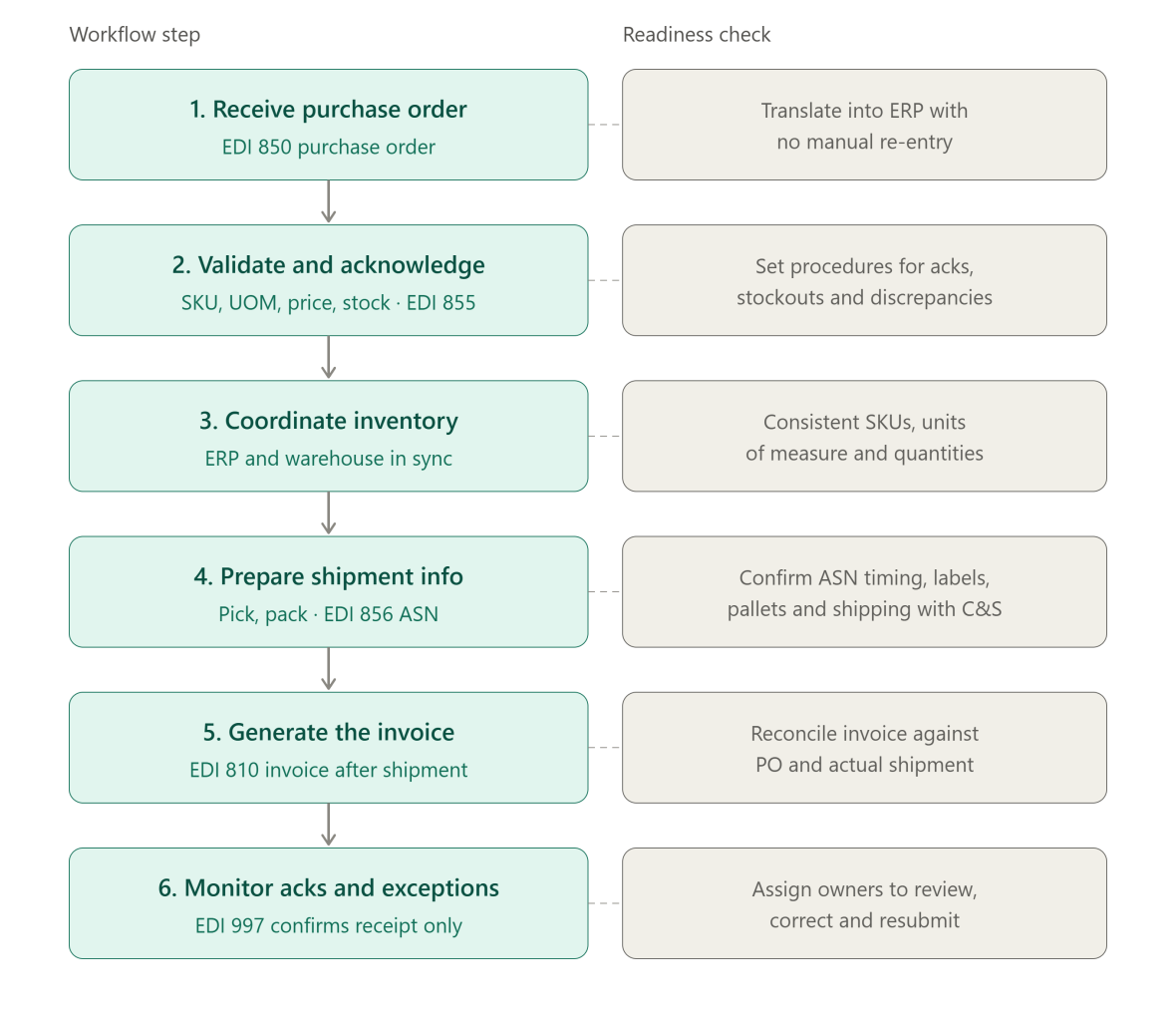
An integrated EDI workflow can reduce manual handling across the order lifecycle.
Step 1: Receive the purchase order
The supplier receives an electronic purchase order, commonly represented by the EDI 850 transaction set.
The order may contain product identifiers, quantities, prices, delivery details, and requested dates.
Readiness check: Confirm that the purchase order can be translated into the supplier's ERP or order-management system without requiring manual re-entry.
Step 2: Validate and acknowledge the order
The system checks important order details, including SKU mappings, units of measure, pricing, and inventory availability.
An EDI 855 Purchase Order Acknowledgment may be used when required by the trading partner.
Readiness check: Establish procedures for acknowledging orders, identifying unavailable products, and escalating discrepancies.
Step 3: Coordinate inventory and fulfillment
Once an order is approved, the ERP and warehouse systems should provide consistent information about available inventory and fulfillment requirements.
For food and CPG products, vendors should pay particular attention to case quantities, product variants, lot tracking, and date-sensitive inventory where applicable.
Readiness check: Verify that the system uses consistent SKU identifiers, units of measure, and inventory quantities.
Step 4: Prepare shipment information
The warehouse picks and packs the order, and the supplier prepares the required shipment documentation.
An EDI 856 Advance Ship Notice (ASN) may be required to communicate shipment details before delivery.
Readiness check: Confirm the required ASN timing, carton or pallet information, labeling standards, and shipping procedures with C&S.
Step 5: Generate the invoice
After shipment, the supplier prepares an invoice, commonly represented by the EDI 810 transaction set.
The invoice should reflect the applicable order, shipped quantities, agreed pricing, and other required details.
Readiness check: Reconcile invoice data against the purchase order and actual shipment before transmission.
Step 6: Monitor acknowledgments and exceptions
EDI processing should include transaction monitoring so employees can identify rejected documents, missing acknowledgments, transmission problems, and unresolved order discrepancies.
The EDI 997 Functional Acknowledgment may be used to confirm receipt and structural acceptance of an EDI transmission. It does not, by itself, confirm business approval of an order or invoice.
Readiness check: Assign responsibility for reviewing errors, correcting transactions, and resubmitting documents when appropriate.
The Food and CPG Vendor EDI Readiness Checklist
Before onboarding or reviewing an existing integration, suppliers should assess the following areas.
A. Product and master data
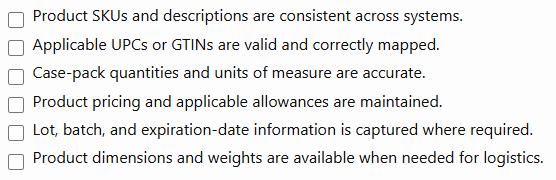
B. EDI connectivity and documents
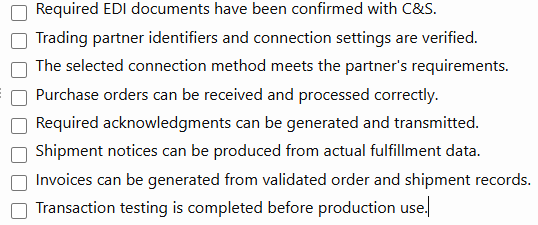
C. Inventory and warehouse operations
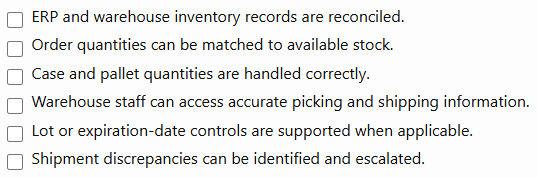
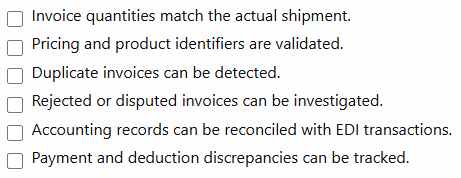
D. Invoicing and financial controls
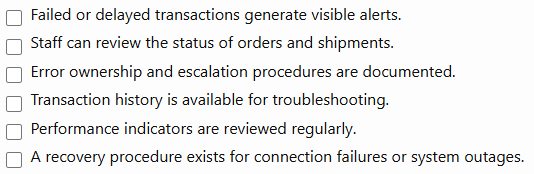
E. Monitoring and exception management
How SBSA Technology Can Support the Workflow
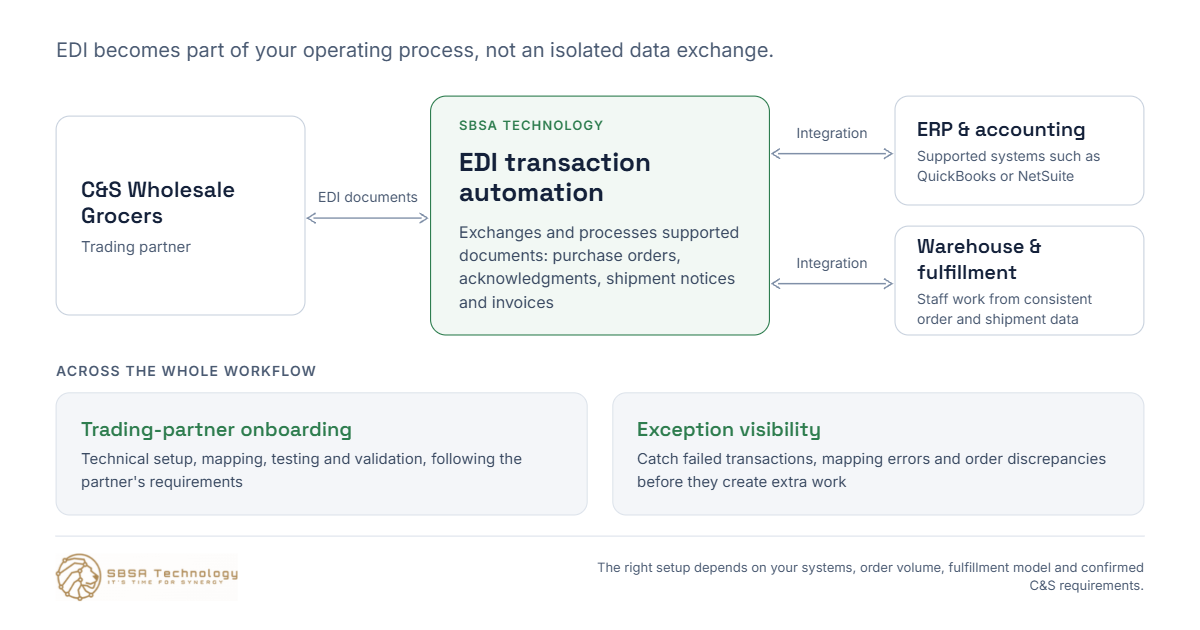
SBSA Technology provides EDI automation and integration capabilities designed to connect trading-partner transactions with business systems.
For a food or CPG vendor, the appropriate solution would depend on the supplier's systems, order volume, fulfillment model, and confirmed C&S requirements.
Potential areas of support include:
EDI transaction automation
Automate the exchange and processing of supported documents, including purchase orders, acknowledgments, shipment notices, and invoices.
ERP and accounting integration
Connect EDI workflows with supported systems such as QuickBooks or NetSuite, helping reduce repeated data entry and improve consistency between operational and financial records.
Warehouse and fulfillment coordination
Integrate order information with supported warehouse workflows so staff can work from consistent order and shipment data.
Exception visibility
Establish processes for identifying failed transactions, mapping errors, and order discrepancies before they create additional operational work.
Trading-partner onboarding
Support the technical setup, mapping, testing, and validation needed to establish an EDI connection, subject to the partner's requirements and testing procedures.
The objective is to make EDI part of the supplier's overall operating process rather than treating it as an isolated data exchange.
Measuring Readiness and Operational Improvement
An EDI project should be evaluated using measurable operational indicators rather than assumptions about savings or performance.
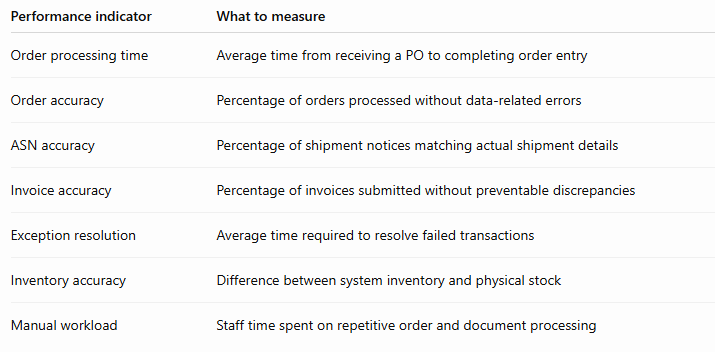
Vendors should establish a baseline before implementing changes and compare results after the new workflow has been operating long enough to produce meaningful data.
No specific percentage improvement is claimed in this case study because verified customer measurements have not been provided.
Recommended Implementation Approach
A structured implementation can help reduce avoidable disruption.
Phase 1: Requirements assessment
Confirm the supplier's C&S trading relationship, required transactions, product data, connection specifications, ERP, and warehouse processes.
Phase 2: Mapping and configuration
Configure the necessary transaction mappings, business rules, product cross-references, and system integrations.
Phase 3: Testing and validation
Test representative purchase orders, acknowledgments, shipments, invoices, and relevant exception scenarios against the confirmed specifications.
Phase 4: Controlled go-live
Coordinate the production launch with the relevant teams, confirm document delivery, and maintain a clear escalation process.
Phase 5: Ongoing monitoring
Review transaction failures, invoice discrepancies, shipment issues, and processing metrics to identify opportunities for improvement.
The implementation schedule should be determined by the scope of integration, the readiness of the supplier's systems, and the trading partner's approval process.
Conclusion
Supplying a major wholesale grocery distributor requires coordination across product data, purchasing, inventory, warehouse operations, shipping, and accounting.
For food and CPG vendors preparing to work with C&S Wholesale Grocers, a structured EDI readiness assessment can help identify gaps before they interfere with day-to-day operations.
SBSA Technology can help suppliers evaluate and automate supported EDI workflows, connect business systems, and establish a more organized process for managing orders, shipments, and invoices.
The goal is straightforward: build a reliable, connected operation that helps your team manage wholesale orders accurately and scale with confidence.
How Ready Is Your Business for C&S Wholesale Grocers?
If your company is preparing to onboard with C&S or reviewing an existing EDI setup, SBSA Technology can help you assess your current workflow and identify potential integration requirements.
Contact SBSA Technology to discuss your EDI and ERP integration needs.
- Book a demo: sbsatech.com/consultancy
- Talk to the team: sbsatech.com/contact
- Explore the platform: sbsatech.com
- More insights: sbsatech.com/blog