
The Baseline Requirements
At a technical level, Amazon expects Vendor Central (1P) suppliers to communicate using the ANSI X12 standard, version 4010 or newer (transaction code "00400"). Vendors located outside North America may instead use EDIFACT.
For transmission, Amazon's preferred method is AS2 (Applicability Statement 2), though it also accepts Amazon-hosted SFTP and traditional Value-Added Networks (VANs).
At minimum, every vendor needs to support four transaction sets:
- 850 – Purchase Order
- 855 – PO Acknowledgment
- 856 – Advance Ship Notice
- 810 – Invoice
Before any of this goes live, Amazon runs every vendor through a self-service certification process inside Vendor Central. There's no shortcut around it. On the connectivity side, vendors typically register under a "ZZ" (Mutually Defined) ISA qualifier with their own assigned sender/receiver identifiers.
Scale is the reason any of this exists. Amazon runs well over 175 U.S. fulfillment centers and serves upward of 310 million customer accounts globally. A supply chain of that size can't run on emailed spreadsheets — it needs machine-readable, standardized data moving automatically between systems.
What's different in 2026: Amazon folded its old Label and ASN chargeback categories into a single "Receive Accuracy" bucket, with billing under the new structure starting January 19, 2026. Separately, the "Not Filled" penalty dropped from 10% of COGS to 5% back in July 2025, even as compliance thresholds elsewhere got stricter. Amazon's Selling Partner API (SP API) is also expanding — a paid tier for third-party developers takes effect January 31, 2026. There's no announced sunset date for EDI itself, but the trend line is obvious: enforcement is getting tighter and Amazon's API ecosystem keeps growing alongside it.
Why Amazon Insists on EDI
Amazon didn't build this requirement to make vendors' lives difficult — it's a function of operating at a scale where manual processes simply break down.
Volume. Amazon's catalog spans hundreds of millions of listings sourced from tens of thousands of Vendor Central suppliers. There's no version of that relationship that works with people manually keying in purchase orders.
Speed. A PO cycle handled by email and phone calls — order, acknowledgment, ship notice, invoice — can easily stretch across several days. Run through EDI, the same cycle closes in minutes, which is what allows Amazon's fulfillment network to keep its delivery promises.
Error reduction. Industry research suggests roughly 60% of B2B transactions run into some kind of disruption caused by data anomalies. Manual re-entry of order data is where quantity mismatches, wrong SKUs, and address errors creep in — and those mistakes are exactly what trigger Amazon's chargeback system. Retail-wide, the average chargeback runs close to $191 per incident.
Forecasting and inventory visibility. EDI gives Amazon a live feed of what vendors can ship and when. That data feeds directly into demand forecasting and fulfillment center planning — without it, Amazon can't position inventory efficiently, which eventually shows up as availability problems for shoppers.
Vendors who treat EDI as core operational infrastructure — rather than a box to check — consistently perform better on compliance scorecards than those who bolt it on as an afterthought.
Vendor Central vs. Seller Central: Two Different Worlds

It's worth being clear about which Amazon program you're actually in, because the integration requirements are completely different.
Vendor Central (1P) is a wholesale relationship — Amazon buys your inventory outright and resells it, sets the retail price, and requires EDI as the mandatory integration method. Core documents include the 850, 855, 856, 810, 846, and 753/754. Data moves in ANSI X12 or EDIFACT format, and once EDI is live, the manual fallback in the portal is gone.
Seller Central (3P) is a marketplace relationship — you sell directly to consumers, keep control of your own pricing, and integrate through the Selling Partner API (SP API) using JSON over REST. Instead of a chargeback framework, Amazon tracks performance metrics and account health, and the seller portal stays available as a manual option regardless of your API setup.
Third-party sellers now represent roughly 60% of paid units moving through Amazon's marketplace, making 3P the larger channel by volume. Even so, Vendor Central remains important for brands that want Amazon as a wholesale buyer, especially in categories where Amazon's purchasing volume matters strategically. It's common today for manufacturers to run a hybrid model — some products through 1P, others through 3P — which means managing both EDI and SP API simultaneously. (Walmart's EDI program follows a similar structure for its own 1P suppliers, if you're weighing multiple retail partners at once.)
Direct Fulfillment: A Hybrid of Its Own
Amazon's Direct Fulfillment program sits in between. You're still technically a Vendor Central supplier, but instead of shipping pallets to a fulfillment center, you ship individual consumer orders straight to the customer, with Amazon handling the front-end customer relationship. This model runs on its own EDI document set and its own compliance rules.
As of 2026, new Direct Fulfillment integrations are set up exclusively through SP API rather than legacy EDI. Existing EDI-based Direct Fulfillment connections keep working, but Amazon's direction is clearly toward API-based dropship integrations going forward.
The Documents That Matter Most
Four transaction sets carry the bulk of the operational and financial risk: the 850, 855, 856, and 810.
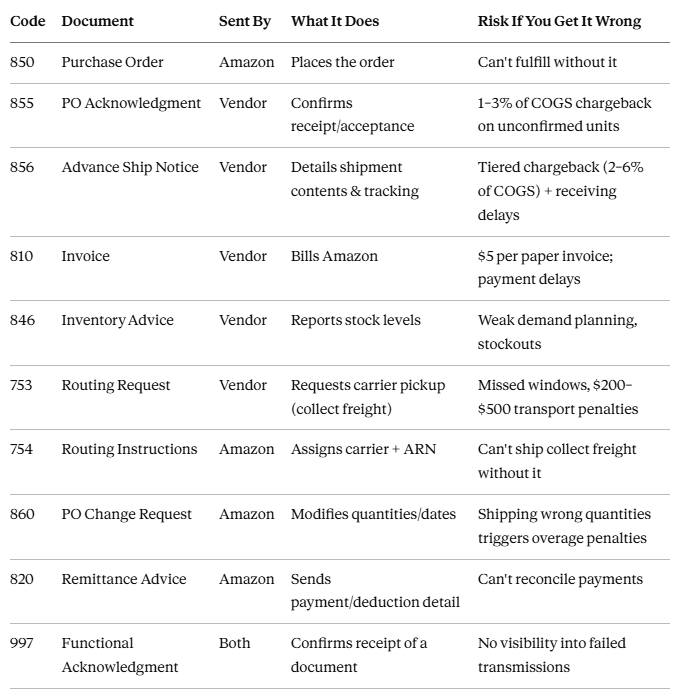
850 — Purchase Order
This is where every transaction begins. Amazon's 850 carries ASINs, your internal SKUs, quantities, pricing, shipping terms, delivery windows, and the destination fulfillment center. How often you receive POs depends largely on how fast your products move. Pay close attention to the ship window in particular — it's the anchor for every on-time compliance calculation that follows.
855 — PO Acknowledgment
You have 48 hours from receiving the 850 to send this back, confirming — line by line — whether each item is accepted, accepted with changes, backordered, or rejected. Miss the window and you're looking at a 1–3% of COGS penalty on unconfirmed units, which adds up fast if you're processing high order volumes.
856 — Advance Ship Notice (ASN)
This is the document Amazon scrutinizes hardest, and the one that generates the most chargebacks. It tells Amazon exactly what's shipping, when it'll arrive, and how it's packed — carton by carton. The structure follows a strict hierarchy:
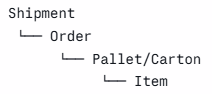
A compliant ASN needs shipment ID, carrier SCAC code, tracking number, bill of lading, Amazon Reference Number (ARN), SSCC or AMZNCC codes per carton, weights and dimensions, product identifiers, quantities, and expiration dates where relevant. It has to reach Amazon before the shipment physically arrives — ideally at least four hours ahead of the truck showing up.
The penalty structure is tiered based on your trailing compliance rate: 2% of COGS if you're above 95% compliant, 4% between 70–95%, and 6% if you fall below 70%. In other words, a bad stretch of ASN performance compounds quickly rather than staying flat.
810 — Invoice
Your electronic bill for goods shipped, due within 24 hours of shipment confirmation. Line items, quantities, and pricing all need to match the original PO. Submit a paper invoice instead and you'll be charged $5 for it — but the bigger risk is a three-way match failure, where the 850, 856, and 810 don't line up with each other, which stalls payment.
The Supporting Cast
- 846 (Inventory Advice): Reports what you have available. For Direct Fulfillment, this needs to go out multiple times a day.
- 753/754 (Routing Request/Instructions): Used for collect freight. The 753 is due by 10am Pacific the day before your ship window closes; Amazon responds with a 754 carrying carrier info and the ARN within 24–48 hours.
- 820 (Remittance Advice): Payment and deduction details from Amazon.
- 860 (PO Change Request): Amazon-initiated changes to quantities or dates.
- 997 (Functional Acknowledgment): A receipt confirming the document arrived — it doesn't mean Amazon agrees with the contents, just that it was received.
Setting Up Amazon EDI: The Process
Standing up an Amazon EDI connection generally takes anywhere from two to eight weeks, depending on the path you choose.
Step 1: Pick Your Approach
You have three broad options, and they differ enormously in cost and speed:
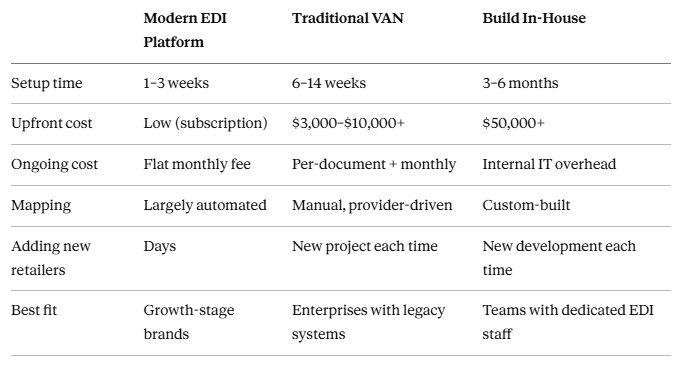
Step 2: Configure the Connection
In Vendor Central, this happens under EDI > Self Service Setup, starting with a General Survey covering:
- Sender/Receiver IDs (ISA Qualifier plus your ID number)
- Connection type — AS2, Amazon-hosted SFTP, or VAN
- Which product identifiers you use (ASIN, UPC, EAN, GTIN, or vendor SKU)
- Test data covering in-stock, discontinued, invalid, and backordered items
After the general survey, you'll complete a separate survey for each document type you're implementing (850, 855, 856, 810, and 846 where applicable).
AS2 requires exchanging security certificates with Amazon's endpoint, configuring encryption and signing, and confirming a successful handshake. Amazon-hosted SFTP involves setting up credentials, file-naming conventions, and a polling schedule. VAN connections require coordinating with your VAN provider on mailbox routing and confirming they support Amazon's required formats.
Step 3: Certification Testing
Once your surveys are submitted, the "Begin Test" option activates. Amazon checks format validity against X12 4010 specs, confirms your sender/receiver IDs match, runs scenario tests (in-stock, discontinued, invalid, backordered), and validates a full order-to-invoice cycle. Errors come back with specific codes so you know exactly what to fix before resubmitting.
A few things that speed up certification: validate your documents against X12 4010 schemas before submitting anything, test all four item scenarios together rather than one at a time, and double-check your SSCC/AMZNCC generation is producing clean, unique codes.
Step 4: Go Live — and Keep Watching
Once every document type passes, "Go Live" becomes available. For the first 30 days, keep a close eye on: 855 timing (within 48 hours), ASN timing relative to carrier arrival, three-way match accuracy between the 850/856/810, and any 997 failures signaling a transmission problem.
EDI compliance isn't a one-time project. Amazon revises its chargeback rules periodically — 2026 alone brought changes in January following on from a July 2025 update — and adds new fulfillment centers that shift routing logic. Build a habit of reviewing compliance metrics weekly.
Direct Fulfillment: A Different Rulebook
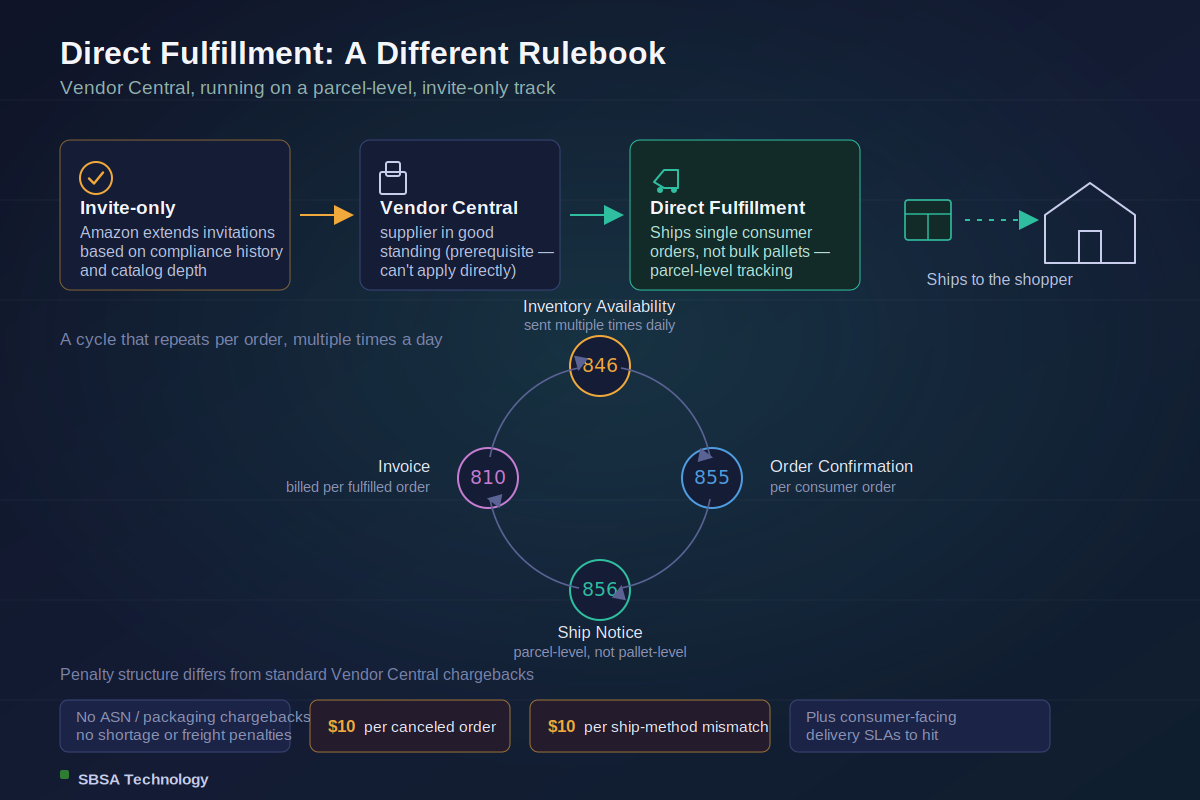 Direct Fulfillment vendors ship individual consumer orders rather than bulk pallets, which means a different document flow built around real-time inventory accuracy.
To qualify, you need to already be a Vendor Central supplier in good standing — Amazon extends invitations based on compliance history and catalog depth; you can't apply for it directly.
The document set looks different too:
- 846 (Inventory Availability): Sent multiple times daily. Only list inventory that's genuinely ready to ship immediately — inaccurate feeds lead directly to canceled consumer orders.
- 855 (Order Confirmation): Confirms or rejects individual consumer orders rather than bulk POs.
- 856 (Ship Notice): Parcel-level, not pallet-level, tracking for each direct-to-consumer shipment.
- 810 (Invoice): Billed per fulfilled order.
Direct Fulfillment also runs a different penalty structure — there's no standard PO/ASN/packaging chargeback framework, no shortage penalties, and no freight allowance deductions. Instead, you're on the hook for a $10 charge per canceled order and $10 for a ship-method mismatch, alongside consumer-facing delivery SLAs.
As noted above, new Direct Fulfillment integrations now run through SP API rather than EDI. One practical tip from vendors already in the program: offering carton-quantity SKUs (5-packs, 10-packs) alongside single units tends to lift sales volume, since bulk buyers gravitate toward those listings.
What Chargebacks Actually Cost
Across Amazon's EDI framework, penalties typically run $5 to $150 per shipment, or 2–6% of cost of goods, with ASN-related violations being both the most frequent and the most expensive category. The framework is tiered, meaning a bad week of compliance doesn't just cost you that week — it can push you into a higher penalty bracket for weeks afterward.
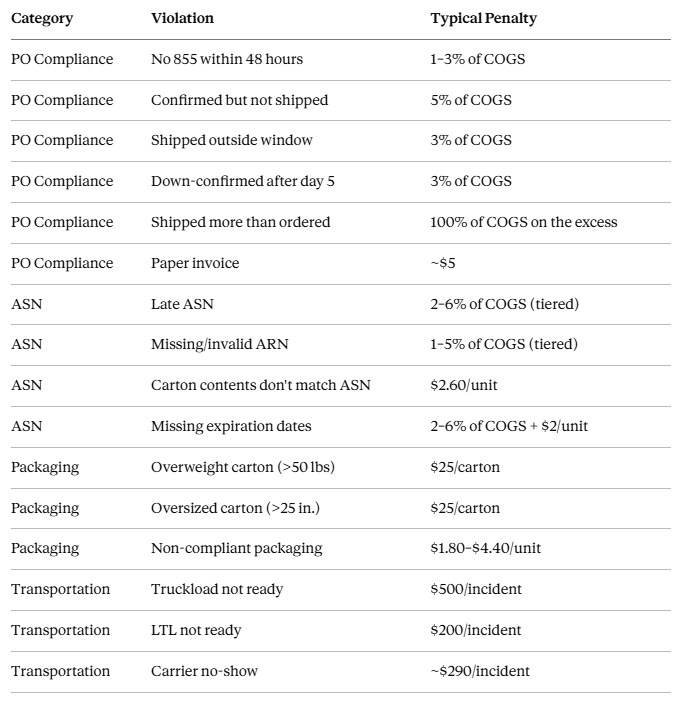
The most common culprits, by frequency:
- Late or missing ASNs — by far the largest source of Amazon chargebacks
- Missed 855 acknowledgment windows
- Invoice-to-PO mismatches, which hold up payment
- Carton content discrepancies ($2.60/unit)
- Oversized or overweight packaging ($25/carton)
One safe harbor worth knowing: PO On-Time Accuracy penalties are waived entirely if your trailing 4-week on-time rate stays above 90%. Drop below that line, and every related subtype — not on time, down-confirmed, not filled — becomes active simultaneously. Consistency, not perfection on any single order, is what protects you here.
The most reliable defense is catching problems before Amazon does: validating ASNs against spec before transmission, enforcing a three-way match between the 850/856/810 before invoicing, generating ASN data straight from warehouse scans rather than manual entry, and tracking your trailing 4-week compliance rate with alerts before you cross a penalty threshold.
A Readiness Checklist
Account & product basics
- Active Vendor Central account
- GS1 Company Prefix and registered GTINs/UPCs
- ASINs assigned and matched to your UPCs
- Verified case pack quantities and units of measure
- Compliant barcodes (min. 1×2 in., black on white)
- Unique identifiers for every size/flavor/variant
Connection setup
- EDI provider selected and contracted
- Internal EDI contact authorized in Vendor Central
- General Survey completed
- Sender/Receiver IDs and connection type configured
- Document-specific surveys completed (850, 855, 856, 810, 846)
Mapping & integration
- ERP/WMS wired for automated PO ingestion
- ASIN-to-SKU cross-reference validated
- FC location codes mapped to ship-to addresses
- SSCC/AMZNCC label logic configured and tested
- Exception handling defined for backorders and discontinued items
Certification
- All document tests passed (855, 856, 810)
- All four item scenarios tested (in-stock, discontinued, invalid, backorder)
- Full order cycle validated end to end
- "Go Live" enabled for all required documents
Go-live readiness
- Team trained on EDI workflows and dashboards
- Ship window process documented
- Routing request process in place (753 by 10am PT)
- Chargeback monitoring cadence established
Ongoing
- Weekly trailing 4-week compliance review
- Weekly ASN accuracy check
- Monthly chargeback dispute review (30-day window)
- Quarterly mapping review for requirement changes
- Annual GS1/ASIN catalog refresh
The Bigger Picture: EDI as Infrastructure, Not Just Compliance
Meeting Amazon's minimum EDI requirements gets you in the door. The vendors pulling ahead in 2026 are the ones treating EDI as part of a broader data strategy — pairing it with API integration, automated error-checking, and analytics that surface problems before they turn into chargebacks. Industry estimates put the global EDI software market at roughly $2.57 billion in 2026, growing at a 12.3% CAGR, which tells you this space is still very much in motion rather than settling into legacy status.
Amazon's own ecosystem reflects this blend: EDI handles transactional documents, while SP API increasingly covers catalog management, analytics, and Direct Fulfillment. Vendors who can move fluidly between both — rather than treating them as separate systems requiring separate teams — tend to adapt faster when Amazon changes its rules, as it did with the January 2026 chargeback consolidation.
For growth-stage brands especially, this kind of visibility used to be reserved for companies with dedicated EDI and compliance teams. That's changing. If your team is evaluating how to modernize its Amazon integration — or extend the same infrastructure to Walmart, Target, Costco, or other trading partners — SBSA Technology can help map out the right approach for your systems and scale.
How SBSA Technology Can Help
Getting Amazon EDI right isn't just about passing certification — it's about staying compliant week after week as Amazon's rules shift underneath you. SBSA Technology works with vendors at every stage of that journey:
- Full-service EDI setup: We handle the Vendor Central General Survey, document-specific surveys, and connection configuration (AS2, SFTP, or VAN) so your team isn't learning Amazon's portal from scratch.
- Certification support: We manage the back-and-forth of Amazon's testing process — format validation, scenario testing, and full order-cycle checks — so you pass on the first attempt instead of cycling through rejected test documents.
- Pre-transmission validation: Our platform checks every 856 against Amazon's carton-level requirements, every 855 against the 48-hour window, and every 810 against the original PO before anything leaves your system, catching the errors that turn into chargebacks.
- Compliance monitoring: We track your trailing 4-week rates across PO accuracy, ASN timeliness, and receive accuracy, with alerts before you cross a penalty threshold — not after.
- Multi-retailer scale: The same integration layer that connects you to Amazon can extend to Walmart, Target, Costco, and other trading partners, so growing your retail footprint doesn't mean rebuilding your EDI stack each time.
- Hybrid EDI + API support: As Amazon shifts more of its ecosystem — like Direct Fulfillment — toward SP API, we help vendors run EDI and API integrations side by side without splitting the work across separate teams or tools.
Whether you're setting up Amazon EDI for the first time or auditing an existing integration that's generating too many chargebacks, SBSA Technology can help you get it right.
Connect with SBSA Technology
Ready to get compliant with Walmart — or want a second opinion on your current EDI setup? SBSA Technology works with retail suppliers, distributors, e-commerce brands, and 3PL providers to automate EDI, order processing, and retailer compliance.
- Book a demo: sbsatech.com/consultancy
- Talk to the team: sbsatech.com/contact
- Explore the platform: sbsatech.com
- More insights: sbsatech.com/blog