
EDI in Plain Terms
EDI replaces the paper and email version of doing business — purchase orders, invoices, shipping notices — with a structured electronic format that both companies' systems can read automatically, with no manual re-keying involved. For a retailer processing thousands of orders across a national network of fulfillment centers, that automation isn't a convenience. It's the only way the order-to-cash cycle keeps moving without someone re-typing data all day.
Why Chewy Requires It
Chewy fulfills a massive volume of pet product orders daily, across a growing network of fulfillment centers and vendor relationships. Manually processing purchase orders, shipment confirmations, and invoices at that scale simply isn't realistic. EDI compliance is how Chewy:
- Keeps purchase order, shipment, and invoice data flowing accurately between its systems and yours
- Cuts out manual data entry and the mismatches that come with it
- Maintains visibility into inventory and order status across its vendor base
- Reduces chargebacks tied to bad data, mislabeled cartons, or missed acknowledgments
First Question: Are You a Wholesale Vendor or a Drop-Ship Vendor?
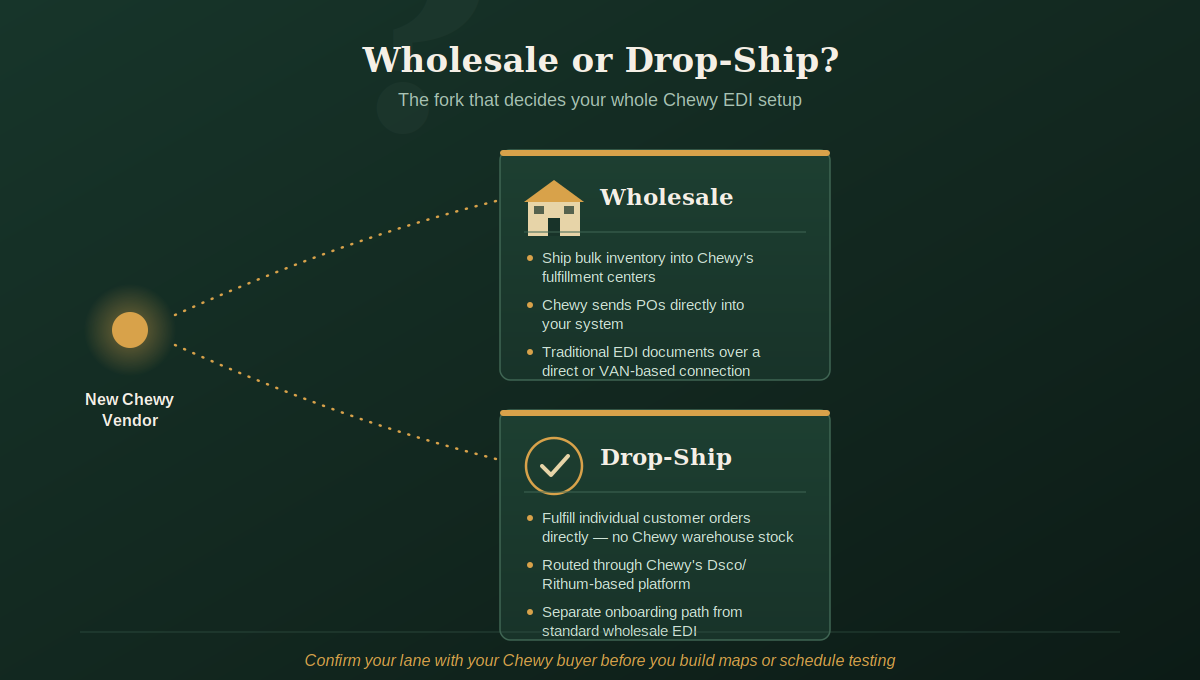 This is the fork in the road that determines almost everything else about your Chewy EDI setup, and it's the detail vendors most often get wrong going in.
- Wholesale vendors ship bulk inventory into Chewy's fulfillment centers. Chewy sends purchase orders directly into your system, and you're working with traditional EDI documents and a direct or VAN-based connection.
- Drop-ship vendors fulfill individual customer orders directly, without inventory sitting in a Chewy warehouse. This flow is typically routed through Chewy's Dsco/Rithum-based platform rather than a standard wholesale EDI connection, and onboarding follows a separate path from wholesale.
Confirm which lane applies to you with your Chewy buyer or vendor manager before you start building maps or scheduling EDI testing — the setup work is different enough that getting it backwards costs you time you don't need to lose.
How Chewy and Its Vendors Connect
Chewy vendors typically connect through AS2, a VAN (Value-Added Network), or SFTP, depending on how your business and your EDI provider are set up. Many suppliers reach Chewy through an established EDI network provider — SPS Commerce and TrueCommerce are both common paths — rather than standing up a direct connection from scratch.
One detail that catches first-time Chewy vendors off guard: Chewy doesn't run every document on the same X12 version. Purchase orders (850s) commonly run on X12 version 5010, while several other transaction sets — including the 856 ASN and 810 invoice — have historically run on version 4010. Confirm the exact version expected for each document with Chewy or your EDI provider before you map anything, since a mismatched version is one of the most common causes of failed testing.
The EDI Documents You'll Actually Use
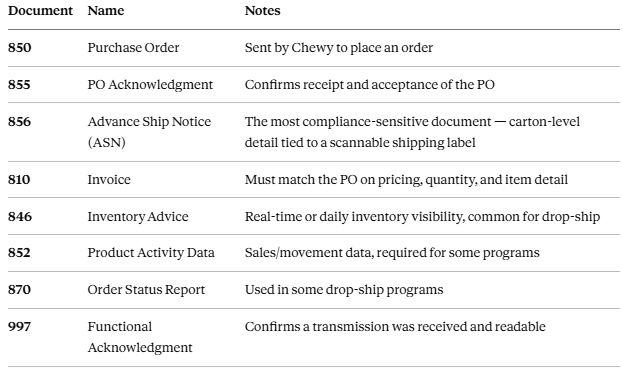
The exact document list depends on whether you're wholesale or drop-ship, but this is the core set Chewy vendors work with:
Labeling and ASN Accuracy: Where Most Compliance Issues Actually Happen
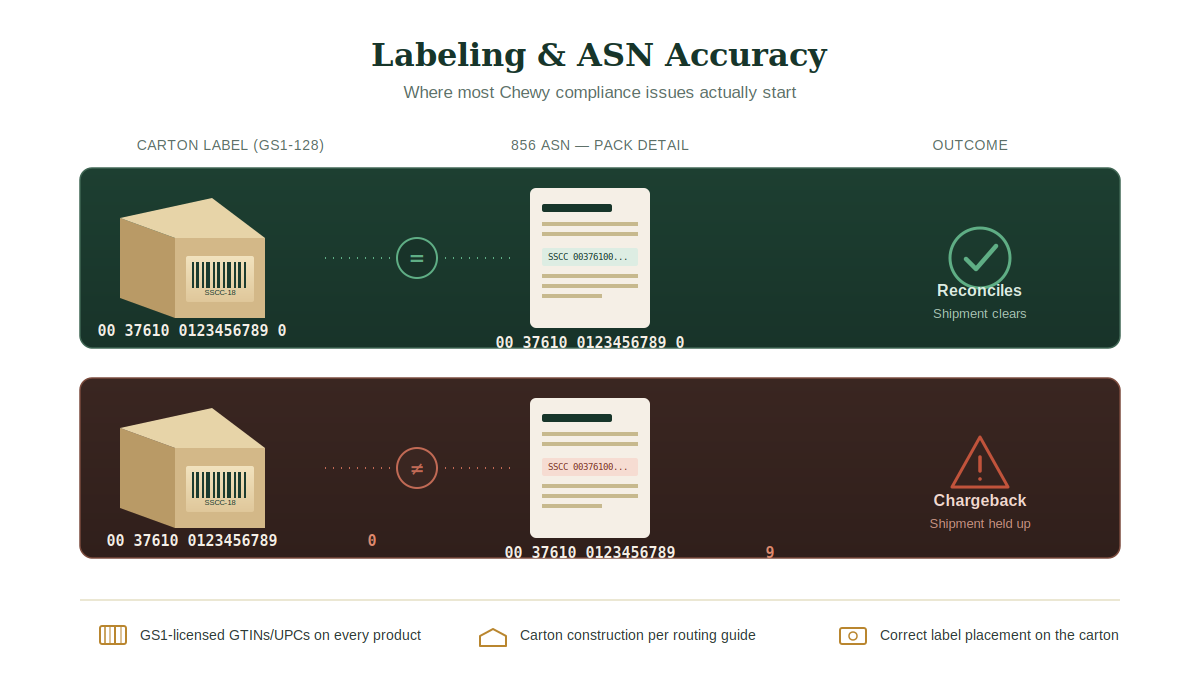 If there's one place vendors run into trouble with Chewy, it's the 856 ASN and the carton labeling that has to match it exactly.
- Cartons need GS1-128 shipping labels carrying a unique SSCC-18 (Serial Shipping Container Code).
- That same SSCC-18 has to appear in the pack-level detail of your 856 — if the number on the label doesn't match what's in the ASN, the shipment doesn't reconcile on Chewy's end, and that's a direct path to a chargeback.
- Products need valid, GS1-licensed GTINs/UPCs, and carton construction and label placement need to follow Chewy's routing guide.
None of this is exotic, but it's exacting. A single mismatched SSCC or a mislabeled carton can hold up a shipment that was otherwise correctly picked and packed.
Getting EDI-Ready: The Onboarding Path
1. Confirm your vendor type. Wholesale and drop-ship follow different onboarding tracks — get this settled with your Chewy contact first.
2. Choose your connection method. AS2, VAN, or SFTP, either direct or through an EDI service provider. If you're going through a VAN or a platform like SPS Commerce, your provider will help gather the technical details Chewy needs to set up the trading partner relationship.
3. Confirm your EDI IDs. Chewy identifies trading partners using specific qualifier and ID combinations in the ISA segment of your transactions. Using the wrong EDI ID is a common — and entirely avoidable — reason transactions fail to route correctly, so confirm the exact ID Chewy expects for your relationship before testing.
4. Complete compliance testing. Chewy uses a third-party testing and certification process for wholesale onboarding. You'll work through test transactions for each required document, with Chewy (or its testing partner) reviewing your output against spec before you're approved to go live.
5. Verify item and vendor setup. As with most retailers, you can't fully test transactions without active item data behind them — confirm your products are set up correctly in Chewy's system in parallel with your EDI testing.
6. Go live and monitor acknowledgments. Once you're certified, functional acknowledgments (997s) and PO acknowledgments (855s) need to go out reliably and promptly. Ongoing compliance is measured, not just onboarding.
Choosing the Right EDI Approach
Whether you build in-house or work with a provider, the job is the same: translate your internal order, shipment, and invoice data into the exact format and version Chewy expects, and do it reliably every time. Given the version differences across document types and the precision required on the ASN, most vendors find it faster and safer to work with an established EDI partner than to build and maintain Chewy's mapping from scratch.
How SBSA Technology Can Help
Getting a Chewy EDI connection right on the first attempt — correct EDI IDs, correct document versions, an ASN that reconciles cleanly against your carton labels — takes more than technical setup. It takes someone who's mapped Chewy's requirements before. SBSA Technology helps vendors plan, configure, and test their Chewy EDI integration end to end, from choosing a connection method through certification, so your first shipments go out clean instead of generating chargebacks you have to chase down later.
Frequently Asked Questions
Does Chewy require EDI from every supplier? Wholesale vendors shipping into Chewy's fulfillment centers need standard EDI. Drop-ship vendors are typically onboarded through Chewy's Dsco/Rithum-based platform instead, which follows its own setup path.
Which EDI documents matter most? The core set is the 850 (PO), 855 (PO acknowledgment), 856 (ASN), 810 (invoice), and 997 (functional acknowledgment). Drop-ship and certain wholesale programs may also require the 846 or 852.
Why do document versions matter so much with Chewy? Chewy doesn't run every transaction set on the same X12 version — mixing this up is one of the most common reasons vendor testing fails. Confirm the version expected for each document before you map anything.
What causes the most compliance issues? Carton labeling and ASN accuracy. The SSCC-18 on your physical shipping label has to match what's transmitted in the 856 exactly, or the shipment won't reconcile.
Do I need a specific EDI software product? No. Chewy doesn't mandate a particular vendor — you need a solution that produces correctly versioned X12 documents and connects over AS2, VAN, or SFTP.
Conclusion
Chewy's EDI requirements aren't a single checklist — they shift depending on whether you're shipping wholesale or fulfilling drop-ship, and the details that trip vendors up (mismatched document versions, an SSCC that doesn't line up between label and ASN) are easy to miss and expensive to fix after the fact. Get the connection type, EDI IDs, and document mapping right during onboarding, and the day-to-day flow of orders, shipments, and invoices runs largely on its own. Skip a step, and you'll be untangling chargebacks instead of fulfilling orders.
Connect with SBSA Technology
Ready to get EDI-compliant with Chewy — or want a second opinion on a connection you already have running? SBSA Technology works with retail suppliers, distributors, e-commerce brands, and 3PL providers to automate EDI, order processing, and retailer compliance.
- Book a demo: sbsatech.com/consultancy
- Talk to the team: sbsatech.com/contact
- Explore the platform: sbsatech.com
- More insights: sbsatech.com/blog