
EDI in Plain Terms
EDI replaces paper purchase orders, faxed invoices, and emailed PDFs with a structured, standardized electronic exchange between your systems and your trading partner's. No re-keying, no lost paperwork — just data moving automatically in a format both sides can read the same way.
Why AAFES Requires It
AAFES — officially the Army & Air Force Exchange Service, known to suppliers as "the Exchange" — is the Department of Defense's largest retailer, operating more than 3,100 facilities across more than 30 countries, 5 U.S. territories, and all 50 states. Running a retail network that size on paper isn't realistic. The Exchange has been explicit that it intends to eliminate paper-based trading altogether in favor of electronic transactions, which means EDI compliance isn't a "nice to have" for your account — it's the mechanism your purchase orders, invoices, and shipment confirmations depend on.
How AAFES and Its Suppliers Connect
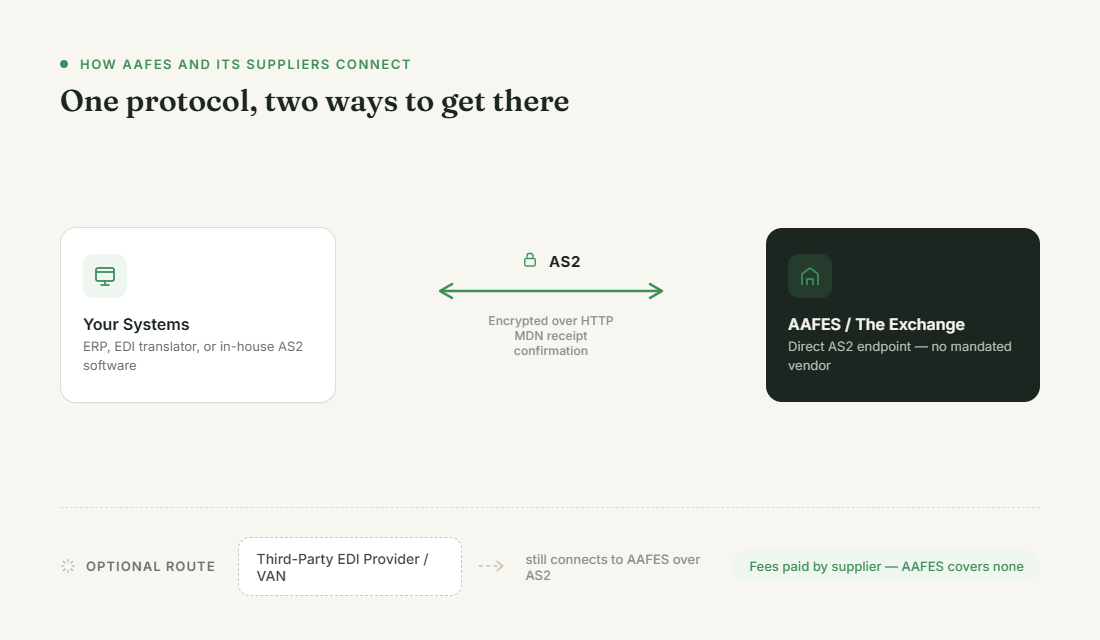 AAFES communicates EDI documents through AS2 (Applicability Statement 2), transmitted over the internet via HTTP — the same secure, certificate-based protocol most major retailers standardize on. Unlike some trading partners, though, AAFES doesn't push you toward a specific vendor to get there.
AAFES doesn't require or recommend a particular EDI provider, and it's able to trade documents directly with your company over AS2 if you have that capability in-house. If you'd rather work through a third-party EDI provider or VAN, that's fine too — but AAFES will not cover any VAN or EDI provider fees, since it already offers direct AS2 connectivity, so those costs land on the supplier either way.
Which EDI Standards Does AAFES Accept?
The Exchange supports ANSI X12, UCS, and VICS EDI standards, and its formal policy language also lists EDIFACT as an accepted format for suppliers who need it. In practice, most domestic vendors will be mapping to X12/VICS, with EDIFACT reserved for international or specialized trading scenarios — similar to how other large retailers segment their standards.
The Documents You'll Actually Exchange
AAFES's Supplier Requirements (Section 3B) spell out the required transaction set: the 810 (inbound invoice), 850 (outbound purchase order), 860 (outbound amendment), 856 (inbound advance ship notice) paired with GS1-128 label documents, 824 (application advice), and 997 (functional acknowledgment).
The 856/GS1-128 pairing is worth flagging on its own — AAFES doesn't just want the ASN, it wants the carton-level barcode label data to match it exactly, and that pairing has become a specific point of enforcement (more on that below).
Getting EDI-Ready: The AAFES Onboarding Path
AAFES doesn't publish a rigid step-by-step like some retailers, but the process suppliers consistently go through looks like this:
1. Complete your Business Terms Agreement (BTA) online. AAFES has moved BTA negotiation entirely into Exchange Partners Online (EPOL), its supplier portal — this now replaces the older paper/email-based agreement process.
2. Stand up your AS2 connection. Whether you're connecting directly or through a provider, you'll need your AS2 identifier, IP address, and digital certificates ready to exchange with AAFES's EDI team.
3. Complete AS2 communication testing. AS2 communication testing is expected to take no longer than 10 business days.
4. Complete EDI data/document testing. If you're building your own mappings, data testing typically runs about 15 business days, validating that your 850s, 856s, 810s, and other documents are structured correctly before anything goes live.
5. Register in EPOL and stay current on policy. EPOL isn't just for onboarding — it's where AAFES pushes ongoing EDI and compliance announcements, so an active login matters well past go-live.
6. Build your carton labeling into your ASN process from day one. Because label and ASN accuracy are now directly tied to compliance charges (below), this isn't something to bolt on after testing — it needs to be part of your process before you ship your first live order.
2026 Is Raising the Stakes on ASN and Label Accuracy
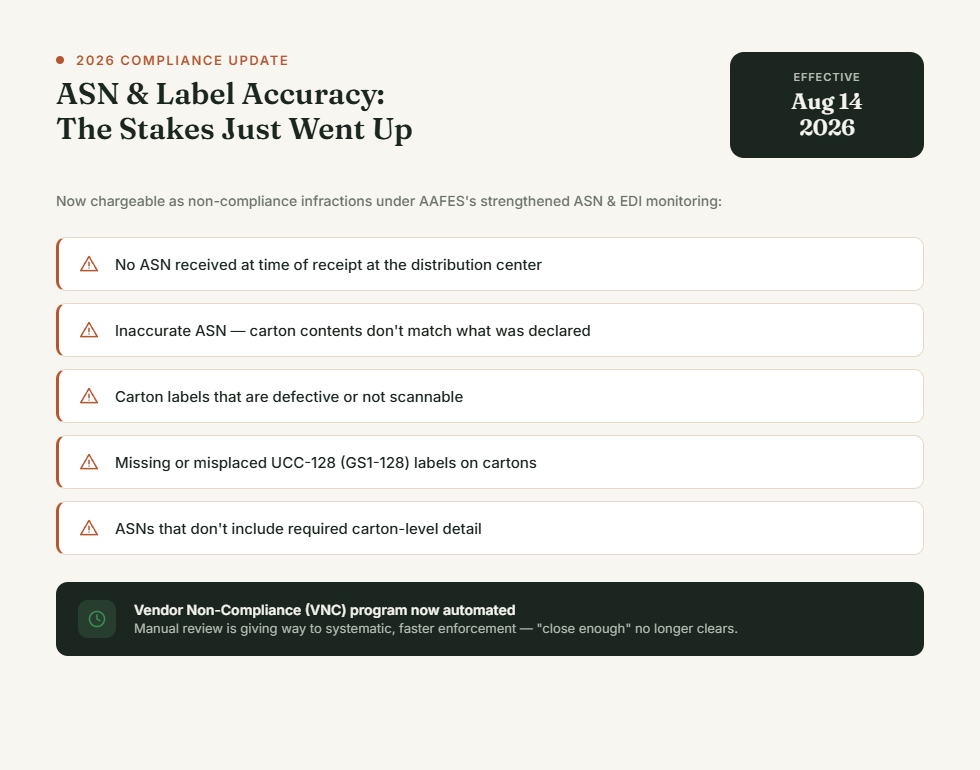 This is the part suppliers can't afford to miss this year. Effective August 14, 2026, AAFES began assessing non-compliance charges for ASN and EDI-related infractions as part of a broader push to strengthen ASN and EDI compliance monitoring for improved receiving accuracy and supply chain visibility. The specific infractions now chargeable include:
- No ASN received at the time of receipt at the distribution center
- Inaccurate ASN where carton contents don't match what was declared
- Carton labels that are defective or not scannable
- Missing or misplaced UCC-128 (GS1-128) labels on cartons
- ASNs that don't include required carton-level detail
On top of that, AAFES automated its broader Vendor Non-Compliance (VNC) program in early 2026 to speed up how infractions are identified and billed — meaning slower, more forgiving manual review is giving way to systematic enforcement. If your ASN and label data has been "close enough" up to now, 2026 is the year that stops being sufficient.
Choosing the Right Translation Approach
Whatever route you take — in-house mapping, a VAN, or a managed EDI provider — the job is the same: reliably convert your internal PO, invoice, and shipment data into the X12/VICS or EDIFACT structure AAFES expects, and translate what comes back the other direction. Given that AAFES ties real money (via non-compliance charges) to ASN and label accuracy specifically, the quality of that mapping now has a direct financial consequence, not just an operational one.
How SBSA Technology Can Help
Standing up a compliant AS2 connection, getting your 856/GS1-128 pairing right, and passing AAFES's testing windows on the first attempt takes more than a generic EDI setup — it takes a partner who knows AAFES's specific document requirements and its 2026 compliance enforcement changes. SBSA Technology helps suppliers configure, test, and validate their AAFES EDI integration end to end, so ASN accuracy and label compliance are built in from your first live shipment rather than fixed after a chargeback.
Frequently Asked Questions
Does AAFES require EDI from every supplier? Yes — the Exchange's stated policy is to eliminate paper-based trading in favor of electronic transactions via X12, VICS, or EDIFACT. Non-EDI vendors do have limited fallback options for invoicing through EPOL, but core PO and shipment transactions are expected electronically.
Do I need a specific EDI software or VAN? No. AAFES doesn't require or recommend a specific provider and can connect directly via AS2, though any VAN or provider fees are the supplier's responsibility.
How long does testing take? AS2 communication testing is generally expected to be complete within 10 business days, and EDI data testing within 15 business days for suppliers building their own mappings.
What changed for 2026? AAFES began actively assessing non-compliance charges tied to ASN accuracy and carton labeling starting August 2026, and automated its Vendor Non-Compliance program earlier in the year to enforce it faster.
Conclusion
AAFES's EDI requirements were never just a technical checkbox, but 2026 has made that clearer than ever — the Exchange is now billing for the ASN and label mistakes it used to absorb quietly. Get your AS2 connection, document mapping, and carton-label accuracy right before you go live, and the day-to-day flow of POs, ASNs, and invoices runs the way it's supposed to. Treat it as an afterthought, and you'll be paying for it — literally — on every shipment that doesn't scan clean.
Connect with SBSA Technology
Ready to get AAFES-compliant, or want a second opinion on your current EDI and ASN setup before the next compliance review?
- Book a demo: sbsatech.com/consultancy
- Talk to the team: sbsatech.com/contact
- Explore the platform: sbsatech.com
- More insights: sbsatech.com/blog