
Wayfair Isn't an Open Marketplace
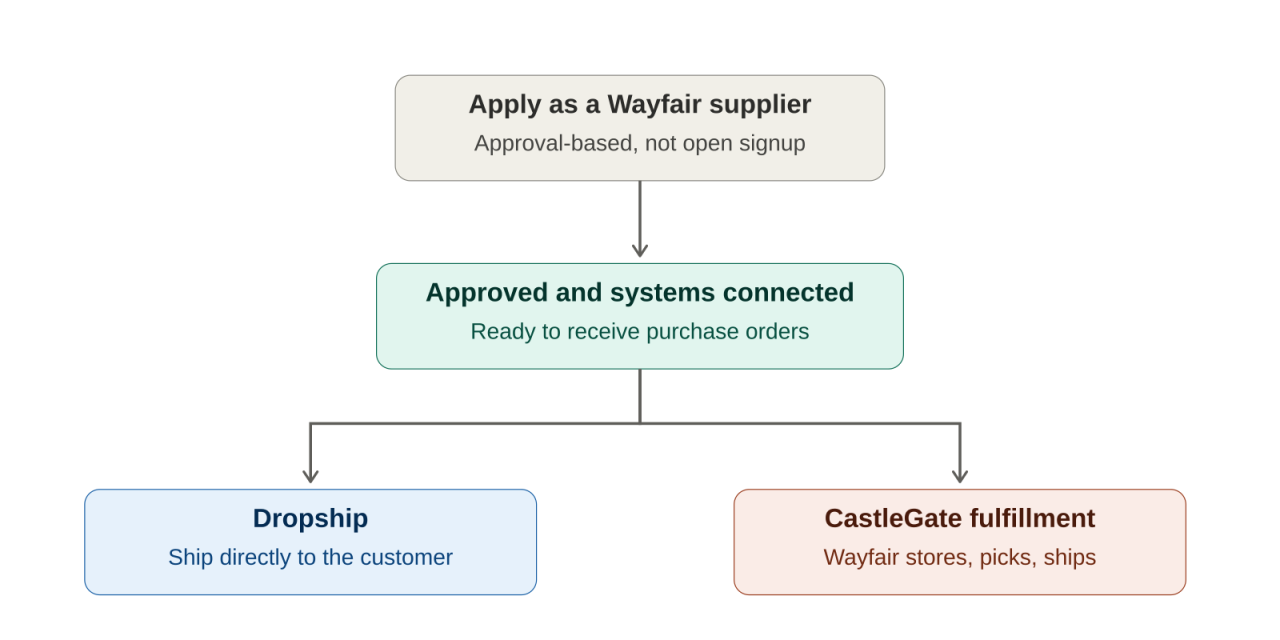
Unlike Amazon or Walmart Marketplace, you can't simply create a seller account, upload a product feed, and start fulfilling orders on Wayfair. Wayfair runs a vetted supplier network. Businesses go through an approval process, get matched against operational requirements, and are expected to integrate their systems with Wayfair's before orders start flowing.
Once approved, suppliers generally operate under one of two fulfillment models.
Dropship: Ship Directly to the Customer
This is the most common arrangement. Wayfair transmits purchase orders to the supplier, and the supplier ships product straight to the end customer. Because volumes can be significant, Wayfair expects dropship suppliers to automate their data exchange rather than process orders by hand. That typically means using EDI or API to handle:
- Purchase orders (EDI 850)
- Inventory availability (EDI 846)
- Shipment confirmations, or Advance Ship Notices (EDI 856)
- Invoices (EDI 810)
CastleGate: Wayfair Handles Fulfillment
CastleGate is Wayfair's own warehousing and logistics arm. Instead of shipping each order individually, suppliers send bulk inventory — pallets or cartons — into CastleGate facilities, and Wayfair takes over storage, picking, packing, and last-mile delivery. This model still relies on EDI or API connections, but adds extra requirements around labeling and shipment routing that suppliers need to get right before goods arrive at the warehouse.
A common misconception: suppliers often assume Wayfair's physical retail stores (including its AllModern and Joss & Main banners) require a separate onboarding process or a distinct system integration. They don't. You integrate once, and Wayfair manages the internal allocation of your inventory across its online store, CastleGate, and any retail locations.
Three Ways to Connect with Wayfair
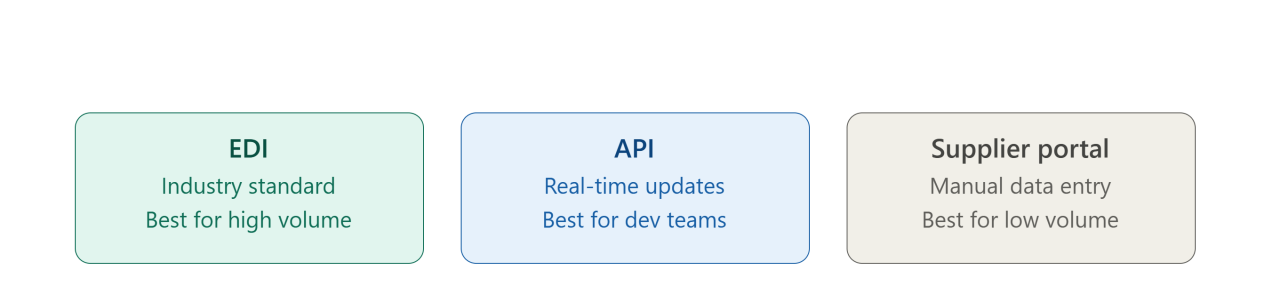
Wayfair gives suppliers three options for exchanging data. Each has different technical requirements and trade-offs.
1. EDI — Still the Industry Standard
EDI (Electronic Data Interchange) remains the most widely used and most mature way to connect with Wayfair, and it's the method most suppliers end up choosing. Wayfair's EDI program covers the standard retail transaction set:
- EDI 850 – Purchase Order
- EDI 855 – Purchase Order Acknowledgment
- EDI 856 – Advance Ship Notice
- EDI 810 – Invoice
- EDI 846 – Inventory Inquiry/Advice
EDI has stuck around for a reason. It gives suppliers a proven, standardized way to automate order processing at high volume, with fewer manual touchpoints and fewer opportunities for error. Invoice reconciliation tends to move faster too, since the data structure is consistent and predictable on both sides.
At its core, EDI is a standardized method for exchanging business documents — purchase orders, invoices, shipping notices, and inventory updates — electronically, using an agreed-upon data format so that two different companies' systems can understand each other automatically. In North America, that format is typically ANSI X12. European and Asian suppliers who don't work in X12 will find that Wayfair also supports EDIFACT, the standard more commonly used outside North America.
2. API — The Faster-Growing Option
Wayfair's Supplier API has matured considerably over the past couple of years and now supports a broad set of functions, including:
- Submitting and updating product data
- Managing inventory levels
- Pulling in new orders
- Confirming shipments
- Updating pricing
API integration tends to suit suppliers with in-house development resources or a modern ERP/OMS stack that can support real-time data exchange. The trade-off is that setting up an API connection is more technically demanding than EDI and generally requires dedicated developer time — either on your team or a partner's.
An API, in simple terms, is a defined set of rules that lets two separate pieces of software talk to each other and exchange data programmatically, without a human in the loop.
3. Supplier Portal — Fine for Small Volume, Not for Scale
Wayfair also maintains a manual web portal, but it's really meant for very small suppliers, short-term onboarding situations, or handling occasional exceptions. It isn't built for suppliers processing meaningful order volume and shouldn't be treated as a long-term integration strategy.
Getting Started: The Basic Steps
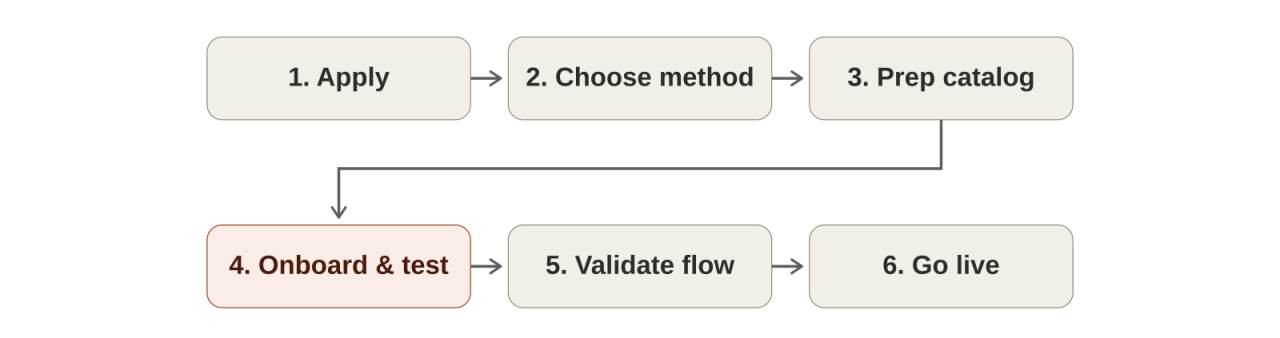
- Apply for Wayfair's supplier program
- Decide on your integration method — EDI or API
- Prepare and organize your product catalog
- Go through Wayfair's technical onboarding and testing process
- Validate order flow end-to-end
- Go live and begin receiving purchase orders
The steps look simple on paper, but the technical onboarding stage is where most suppliers without EDI experience get stuck — mapping data correctly, meeting Wayfair's testing requirements, and troubleshooting connection issues can stretch a straightforward project into a multi-month effort.
How SBSA Technology Can Help
Getting connected to Wayfair — or any major retail trading partner — shouldn't require you to build an in-house EDI or API team from scratch. That's where SBSA Technology comes in.
End-to-end EDI setup for Wayfair. We handle the full document set Wayfair requires — 850 purchase orders, 855 acknowledgments, 856 shipment notices, 810 invoices, and 846 inventory updates — and manage the translation between EDI, XML, and JSON so your internal systems never have to deal with raw EDI formatting.
ERP and business system connectivity. Whether you're running SAP, Microsoft Dynamics, NetSuite, JD Edwards, Salesforce, or a custom-built system, we build the integration layer that connects your existing tools directly to Wayfair's order and inventory workflows — no rip-and-replace required.
API integration, if that's your preferred route. For suppliers who want to connect via Wayfair's Supplier API instead of traditional EDI, we build and maintain the connectors, automate product, inventory, and order data flow, and keep an eye on performance so issues get caught before they affect your operations.
Support for both Dropship and CastleGate. We help you meet the specific requirements of whichever fulfillment model you're using — from ASN accuracy and labeling compliance to inventory synchronization across multiple warehouse locations.
Faster time to go-live. Suppliers who try to manage Wayfair onboarding entirely in-house often find the process drags on for months. Working with SBSA Technology, most suppliers can expect to be live and processing orders in a matter of weeks rather than months.
Ongoing monitoring, not a one-time setup. Once you're live, our managed service keeps watch over your EDI transactions, API calls, and inventory sync to catch processing errors, rejections, or sync discrepancies early — before they turn into missed orders or chargebacks.
Frequently Asked Questions
Do I need EDI to sell on Wayfair? In practice, yes. Most suppliers are expected to use EDI or API for automated order processing — the manual portal is not designed for ongoing, high-volume use.
Which EDI documents does Wayfair require? Typically the 850 (Purchase Order), 855 (Order Acknowledgment), 856 (Shipping Notice), and 810 (Invoice), with 846 (Inventory) often included as well.
Can I use the API instead of EDI? Yes. Wayfair's Supplier API is a fully supported alternative, though it's best suited to companies with development resources or an integration partner to manage the technical build.
How long does onboarding usually take? It varies with the complexity of your systems — anywhere from a few weeks to several months if handled entirely in-house. Working with a managed integration partner can bring that down significantly.
What exactly is CastleGate? CastleGate is Wayfair's own fulfillment network. Suppliers ship inventory in bulk to CastleGate warehouses, and Wayfair takes over storage, picking, and delivery from there.
Is Wayfair open to any seller? No — Wayfair operates a closed, approval-based supplier network rather than an open marketplace model.
Conclusion
Wayfair's business keeps expanding across online retail, CastleGate fulfillment, and physical stores, but the fundamentals of becoming a successful supplier haven't changed: strong, automated system integration matters as much as your product catalog does. EDI remains the most established and widely supported path for most suppliers, while API integration is gaining ground quickly among businesses with the technical resources to support it.
If you're preparing to onboard as a Wayfair supplier — or looking to modernize an order process that's still too manual — SBSA Technology can help you get a reliable EDI or API integration in place, built around your existing systems and ready to scale with your business.
Connect with SBSA Technology
Ready to get compliant with Wayfair — or want a second opinion on your current EDI setup? SBSA Technology works with retail suppliers, distributors, e-commerce brands, and 3PL providers to automate EDI, order processing, and retailer compliance.
- Book a demo: sbsatech.com/consultancy
- Talk to the team: sbsatech.com/contact
- Explore the platform: sbsatech.com
- More insights: sbsatech.com/blog