
What Home Depot EDI Actually Means
At its core, EDI is the computer-to-computer exchange of standard business documents in place of phone calls, faxes, or emailed spreadsheets. For Home Depot, that means suppliers send and receive documents like purchase orders, shipment notices, and invoices in a structured ANSI X12 format that both sides' systems can read automatically.
The benefit for Home Depot is obvious: fewer manual touches, fewer data-entry errors, and real-time visibility into what's moving through its network. For suppliers, the payoff is speed and lower processing costs — but only once the connection is properly built and tested.
Why EDI Is Mandatory, Not Optional
 Home Depot's product assortment runs into the tens of thousands of SKUs per store, spanning categories from lumber and appliances to plumbing and décor. Coordinating replenishment at that scale requires every trading partner to be feeding data into the same structured pipeline. A supplier still relying on manual order entry becomes a bottleneck the retailer's systems simply aren't built to accommodate.
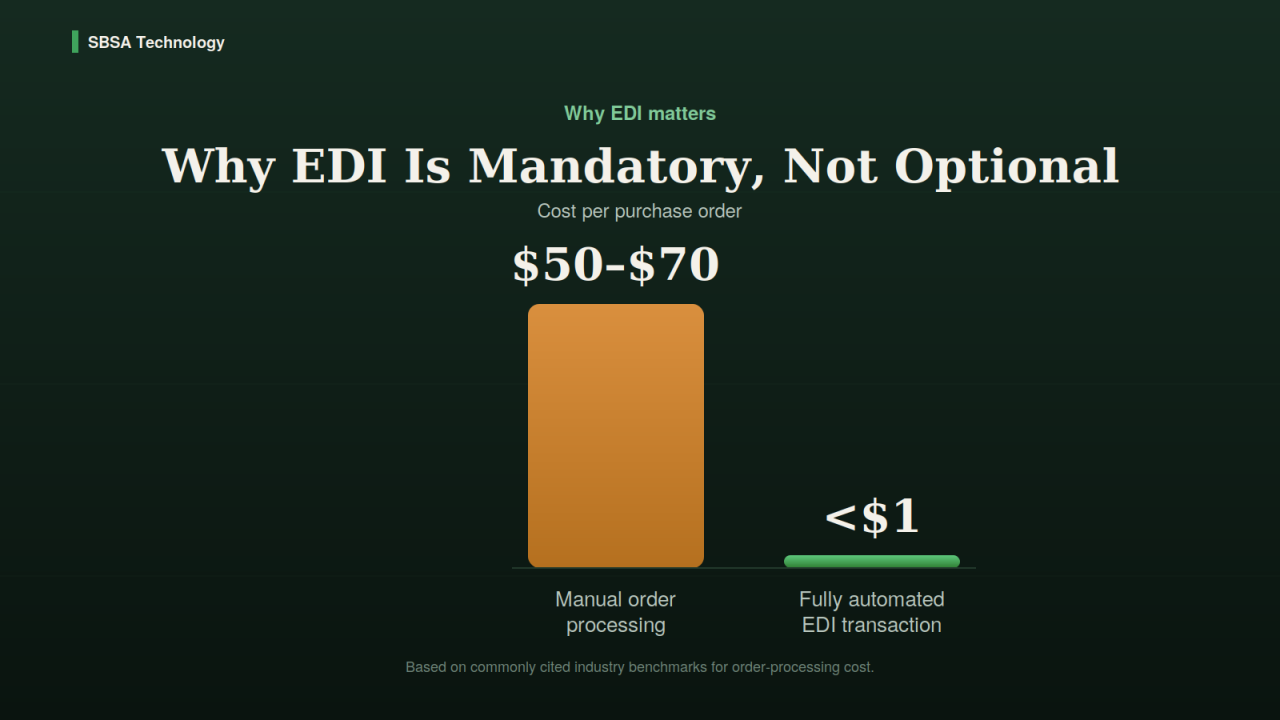
There's also a hard cost argument. Industry estimates commonly put manual order processing at somewhere north of $50–$70 per transaction, compared to well under $1 per transaction once EDI is fully automated. For a supplier processing dozens or hundreds of purchase orders a month, that gap adds up quickly — and that's before counting the chargebacks that come with non-compliance.
The Core EDI Documents Home Depot Requires
Your exact document list depends on how you fulfill orders — through Home Depot's distribution centers, direct-to-store delivery, or the dropship/direct fulfillment program for online orders. Regardless of model, a few transaction sets are non-negotiable.
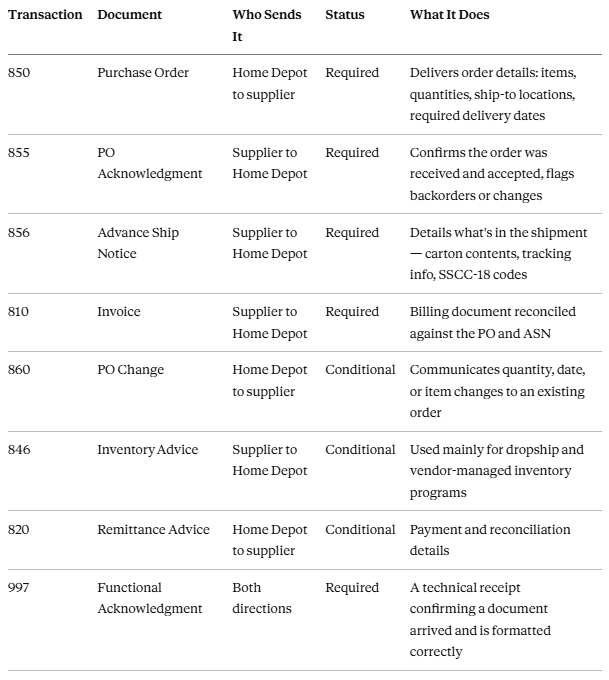
That last one — the 997 — is easy to overlook but important. It's the digital "got it" that both systems exchange after every transmission. Skip it, and Home Depot's system may treat your order as undelivered, which can stall fulfillment before it even starts.
Systems Suppliers Need to Know
EDI doesn't operate in a vacuum at Home Depot. Several internal platforms shape how compliance actually plays out day to day:
- Supplier Hub — the central portal for onboarding, compliance scorecards, product data submission, and order status tracking. Setup instructions and testing requirements come through here.
- InFor Nexus — used primarily by import suppliers for shipment visibility, milestone tracking, and exception alerts across global logistics.
- Replenishment systems — Home Depot's internal demand planning tools generate purchase orders using store-level sales data and forecasting, and some suppliers get visibility into that data.
- Product Information Management (PIM) — where suppliers submit item attributes, imagery, and compliance documentation. Incomplete PIM data can keep a product from ever going live, regardless of how clean your EDI setup is.
The practical takeaway: a technically flawless ASN can still trigger a receiving problem at the DC if the underlying product data doesn't match what's in PIM. Compliance is a system-of-systems problem, not just an EDI problem.
Technical Requirements for the EDI Connection Itself
Home Depot expects documents in ANSI X12 format, version 4010 or later, transmitted through one of two accepted channels:
- AS2, a direct, internet-based connection method, or
- An approved Value Added Network (VAN) — providers like SPS Commerce, TrueCommerce, or OpenText are commonly used, provided they're on Home Depot's approved list.
A few details that trip suppliers up during setup:
- Envelope data. The ISA and GS header segments need the exact qualifier and ID values Home Depot assigns during onboarding. Mismatched envelope data is one of the most common causes of a rejected transmission.
- Certification testing. Every new trading partner runs through a formal testing cycle before going live — no exceptions. Home Depot's EDI team validates test documents against its implementation guides and won't activate a production connection until everything passes.
- Timing. ASNs are expected close to the moment of shipment, and invoice data has to line up with the corresponding PO and ASN. Documents that arrive late or out of sequence can trigger compliance flags even if the data itself is accurate.
GS1 Barcode and Labeling Requirements
Home Depot's receiving process leans heavily on scan-based verification, which means GS1 barcode compliance isn't optional at any level of the packaging hierarchy.
- UPC/GTIN — every item needs a valid GS1-assigned UPC matching what's registered in Home Depot's product system.
- ITF-14 — case-level barcodes for any case packs shipped to a distribution center.
- SSCC-18 — a unique serial code for every carton and pallet, linking the physical unit to the corresponding ASN data so DC staff can scan and verify contents automatically.
- GS1-128 labels — the label format required on every shipping unit, carrying the SSCC-18, PO number, and ship-to details in both barcode and human-readable form, printed to at least Grade C quality.
If you're not already a registered GS1 member, budget one to two weeks to get a company prefix assigned — it's a prerequisite for generating any of the above.
Advance Ship Notice (EDI 856): Where Most Errors Happen
 The ASN is arguably the highest-stakes document in the relationship, because it drives scan-based receiving. Home Depot's DC staff scan the SSCC-18 on each carton, and the system checks it against the ASN data transmitted before the truck even arrives. When that data is wrong, missing, or late, receiving slows down and chargebacks follow.
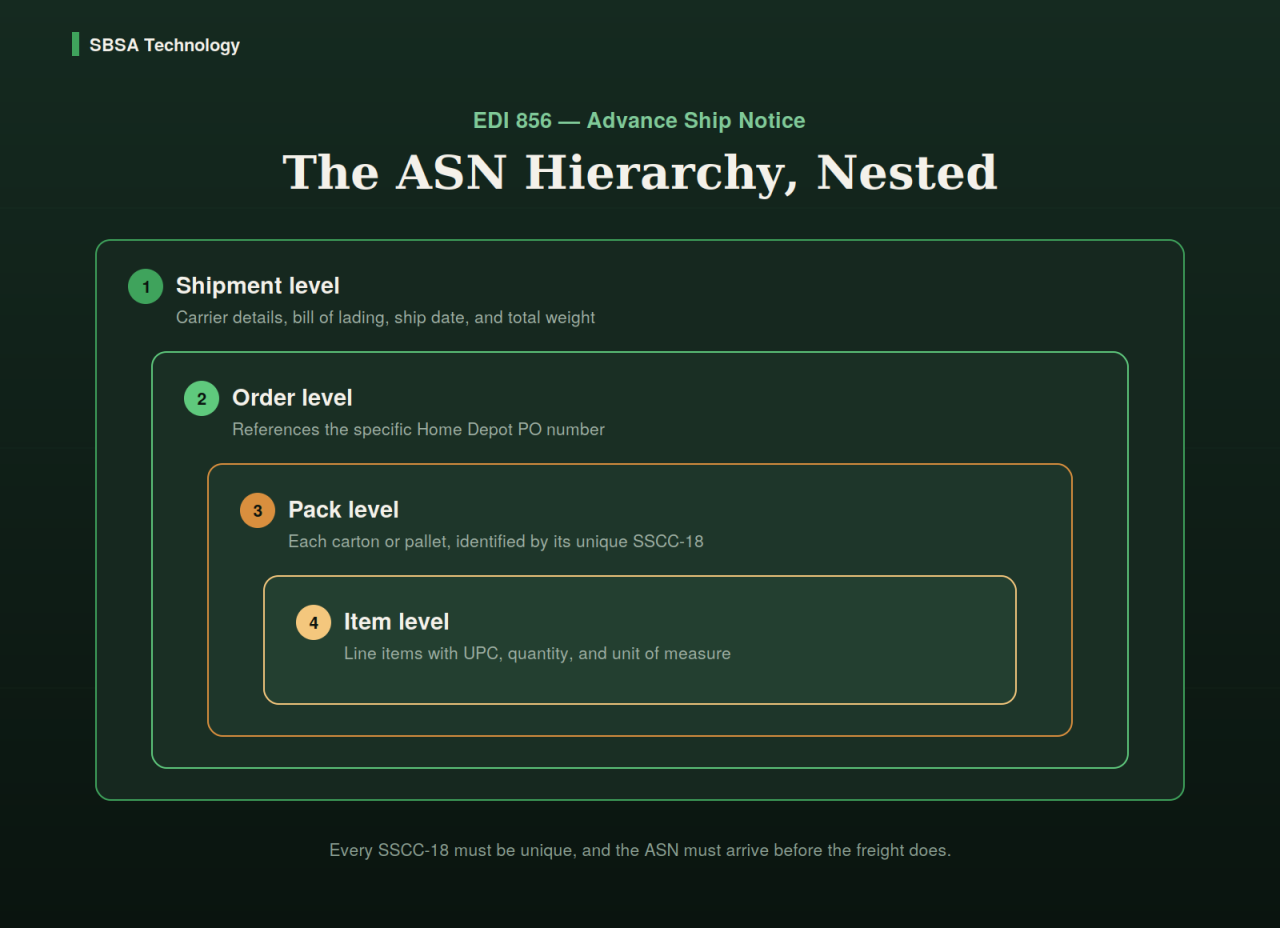
The ASN itself is built as a nested hierarchy:
- Shipment level — carrier details, bill of lading, ship date, total weight.
- Order level — the specific PO number the shipment fulfills.
- Pack level — each carton or pallet, identified by its unique SSCC-18.
- Item level — the individual line items, UPCs, and quantities inside each pack.
A few rules matter more than others: SSCC-18s can never repeat within a shipment, the ASN needs to reach Home Depot before the freight arrives at the DC, and the item data has to match the original PO exactly — even a one-unit quantity mismatch can cause a receiving exception.
Chargebacks: What They Cost and Why They Happen
Home Depot's compliance program penalizes errors across labeling, shipment accuracy, ASN timing, and delivery windows, and the deductions come straight out of remittance — often without much warning.
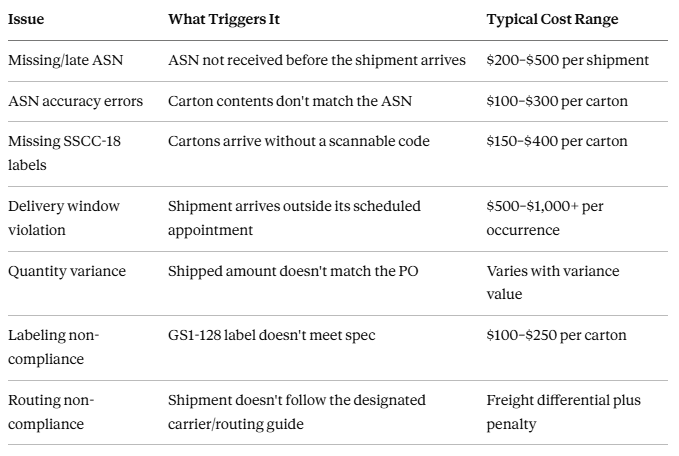
The math gets ugly fast. A supplier shipping even 50 purchase orders a month with a modest error rate can end up losing thousands of dollars monthly — money that's almost entirely avoidable with the right process controls in place before goods ever leave the warehouse.
Getting Set Up: A Four-Phase Process
1. Vendor onboarding. Get approved as a Home Depot supplier, sign the trading partner agreement, and receive your vendor number along with ISA/GS qualifiers and implementation guides. This is also the point to confirm your GS1 prefix is active.
2. Technical configuration. Build trading partner maps for each required document, set up your AS2 connection or VAN routing, and connect the whole thing to your order management, warehouse, and accounting systems.
3. Testing and certification. Expect at least two or three rounds of back-and-forth as Home Depot's EDI team validates your test transmissions. Common early mistakes include incorrect qualifiers, missing segments, and ASN hierarchy errors — nothing unusual, but each round takes time to turn around.
4. Go-live and monitoring. Once certified, live purchase orders start flowing and you're expected to respond with compliant acknowledgments, ASNs, and invoices on every transaction. This is where ongoing monitoring — catching failed transmissions and ASN discrepancies before they become chargebacks — becomes the real work.
Depending on internal resources and how quickly corrections get turned around during testing, the whole process typically runs anywhere from a month to a few months.
A Quick Compliance Checklist
Before onboarding
- Approved Home Depot vendor number in hand
- GS1 Company Prefix registered and active
- UPCs/GTINs assigned for every item
- Implementation guides reviewed for each required document
Technical setup
- AS2 or VAN connection configured with Home Depot's routing
- ISA/GS envelope set with assigned qualifiers
- Maps built for 850, 855, 856, 810, and 997
- Automatic 997 acknowledgments configured
- SSCC-18 generation and GS1-128 label printing tested
Testing
- Test 855, 856, and 810 transmitted and approved
- 997s flowing correctly in both directions
- Production connection certified by Home Depot
Go-live
- Warehouse trained on label placement and scanning
- ASN generation tied to shipment confirmation
- Invoicing tied to PO/ASN data to avoid mismatches
- Chargeback monitoring and reconciliation process in place
Frequently Asked Questions
What EDI standard does Home Depot require? ANSI X12, version 4010 or later, transmitted via AS2 or an approved VAN, following Home Depot's published implementation guides.
How long does setup usually take? Anywhere from roughly a month to several months, depending mostly on how quickly testing corrections get resolved and how experienced your internal or partner EDI team is.
What causes most chargebacks? ASN-related errors — late transmission, mismatched carton contents, duplicate or missing SSCC-18 codes, and quantity discrepancies — are consistently the leading cause.
Is SSCC-18 labeling required on every carton? Yes. Every carton and pallet needs a unique SSCC-18 on a GS1-128 compliant label, with no exceptions for smaller shipments.
AS2 or a VAN — which is better? Both are accepted. AS2 avoids per-document VAN fees but requires more direct technical management; a VAN is often simpler if you're already trading with multiple retailers through one.
What happens if an ASN doesn't arrive in time? The shipment may get processed as a "blind receive," where DC staff manually verify every carton without electronic data to check against — slower, more error-prone, and usually accompanied by a chargeback.
Does the dropship program have different requirements? Yes. Direct fulfillment suppliers typically need EDI 846 inventory updates, faster ASN turnaround, and sometimes different labeling or routing rules, all outlined during dropship-specific onboarding.
How SBSA Technology Can Help
Getting Home Depot EDI right the first time is mostly about having the right infrastructure and support behind you — not just checking boxes on a compliance list. That's where SBSA Technology comes in.
- Faster onboarding. Our team manages the mapping, testing, and certification cycle directly with Home Depot's EDI team, so you're not stuck troubleshooting envelope qualifiers or hierarchy errors on your own.
- Built-in GS1 compliance. SBSA generates GS1-128 labels with SSCC-18 barcodes automatically as part of the shipment workflow, so labeling errors don't become chargebacks.
- Automated ASN accuracy. ASNs are generated straight from your shipment and order data, which keeps carton contents, quantities, and PO references in sync — the single biggest source of Home Depot chargebacks.
- One platform, every retailer. If Home Depot is one of several retail partners you manage, SBSA connects your EDI, order management, and warehouse systems into a single workflow instead of a patchwork of one-off retailer integrations.
- Real people, real support. Our support team works alongside you through testing and go-live, and stays available afterward for the exceptions and edge cases that inevitably come up once you're live.
Suppliers who move to SBSA typically cut onboarding time significantly compared to legacy EDI providers, while also reducing the manual monitoring needed to catch problems before they become deductions on a remittance statement.
The Bottom Line
Home Depot's EDI requirements are detailed, and the margin for error is thin — a mismatched barcode or a late ASN can turn into a chargeback before you've even noticed a problem. But none of it is unmanageable once the connection is built correctly and tested thoroughly. Getting the technical setup right the first time, staying on top of GS1 labeling standards, and building in automated checks before shipments go out are the difference between EDI being a quiet background process and a recurring drain on your margins.
Let's Talk EDI
Whether you're preparing for your first shipment to Home Depot or auditing an existing setup that keeps generating chargebacks, SBSA Technology partners with suppliers, distributors, e-commerce brands, and 3PL providers to take the manual work out of EDI, order flow, and retailer compliance.
- See it in action: sbsatech.com/consultancy
- Reach out to our team: sbsatech.com/contact
- Learn more about the platform: sbsatech.com
- Browse more guides like this one: sbsatech.com/blog