
EDI in Plain Terms
EDI is the electronic replacement for paper-based business documents. Instead of faxing a purchase order or emailing a PDF invoice, EDI lets two companies' computer systems exchange that same information in a structured, standardized format — automatically, with no manual re-keying.
For a retailer the size of Macy's, EDI isn't a nice-to-have. It's the backbone of how the company processes orders, tracks shipments, and issues payments across its wholesale, private-brand, and e-commerce drop-ship channels. Automating this exchange cuts down on typos and mismatched data, speeds up the order-to-cash cycle, and gives both sides real-time visibility into what's moving through the supply chain. Companies that set up this kind of ongoing electronic exchange are known as trading partners.
Why Macy's Requires It
Macy's, Inc. runs Macy's and Bloomingdale's stores, plus their e-commerce sites, across a shared vendor infrastructure that spans thousands of SKUs and vendor relationships. Coordinating that volume manually isn't realistic. EDI compliance is non-negotiable because it:
- Keeps purchase order, shipment, and invoice data flowing accurately between Macy's systems and yours
- Removes manual data entry, and the chargebacks that come with errors in it
- Gives Macy's — and you — real-time visibility into inventory and order status across its channels
- Builds the operational track record needed for a long-term retail partnership
Unlike some retailers that treat EDI as a soft guideline, Macy's ties it directly to money: mis-formatted or late EDI documents, mislabeled cartons, and missed ASNs all show up as deductions against your invoice under Macy's formal chargeback schedule.
How Macy's and Its Suppliers Connect
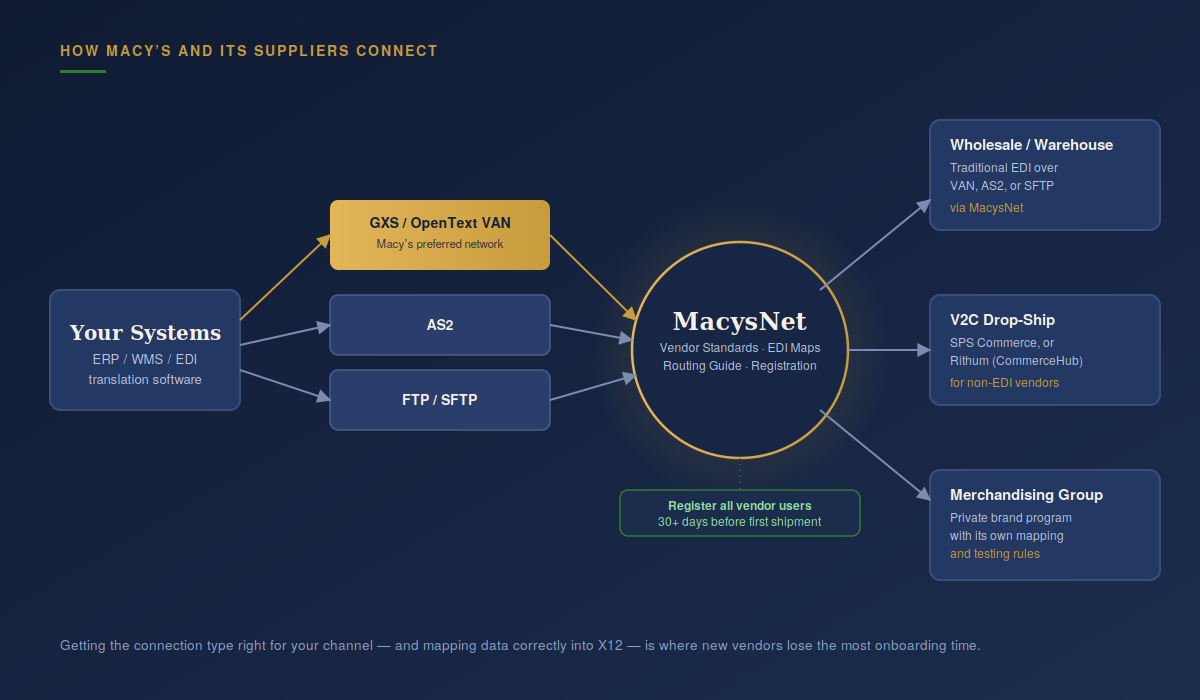 Macy's vendor community runs on MacysNet (macysnet.com), the vendor portal that hosts the Vendor Standards Manual, EDI mapping guides, the routing guide, and account registration. Every vendor-facing employee handling shipping or accounting is expected to register there — Macy's recommends doing this at least 30 days before your first shipment.
On the connectivity side, Macy's has historically designated GXS (now part of OpenText) as its preferred EDI network, and documents are generally expected to move directly between your network and Macy's without an interconnecting VAN. That said, Macy's mapping guides also support connections over AS2, FTP, and SFTP, so the right setup depends on which channel you're onboarding into:
- Traditional wholesale/warehouse — standard EDI over VAN, AS2, or SFTP through MacysNet
- Vendor Direct to Consumer (V2C) drop-ship — onboards through SPS Commerce or, for non-EDI vendors, a browser-based portal like Rithum (formerly CommerceHub)
- Macy's Merchandising Group (private brand) — its own set of mapping and testing requirements
Getting the connection type right for your channel — and mapping your data correctly into X12 format — is one of the more common places new vendors lose time during onboarding.
Which EDI Format Does Macy's Require?
Macy's standardizes on ANSI X12, specifically the VICS (Voluntary Inter-industry Commerce Standards) subset used broadly across general merchandise retail. Current guides are published on X12 version 5010, though Macy's mapping documentation still references legacy 4010/4030/4050 versions for certain transaction sets — always confirm the version your buyer or the current mapping guide specifies before you build your maps, since using the wrong version is a common source of failed testing.
The Two Building Blocks of EDI: Translation and Transmission
Translation comes first. Your internal purchase order, invoice, or ASN — whatever format your ERP or accounting system produces — gets converted into a standardized EDI document that Macy's systems can read, regardless of what software generated it.
Transmission comes next. That translated document is sent securely to Macy's, over whichever connection method your channel requires (VAN, AS2, or SFTP), ensuring it arrives at Macy's systems intact and without manual intervention.
Together, these two steps are what make automated, chargeback-free order-to-payment cycles possible — and where the details (correct qualifiers, correct SCAC codes, correct UPC/GTIN alignment) matter most.
Step-by-Step: Becoming an EDI-Ready Macy's Supplier
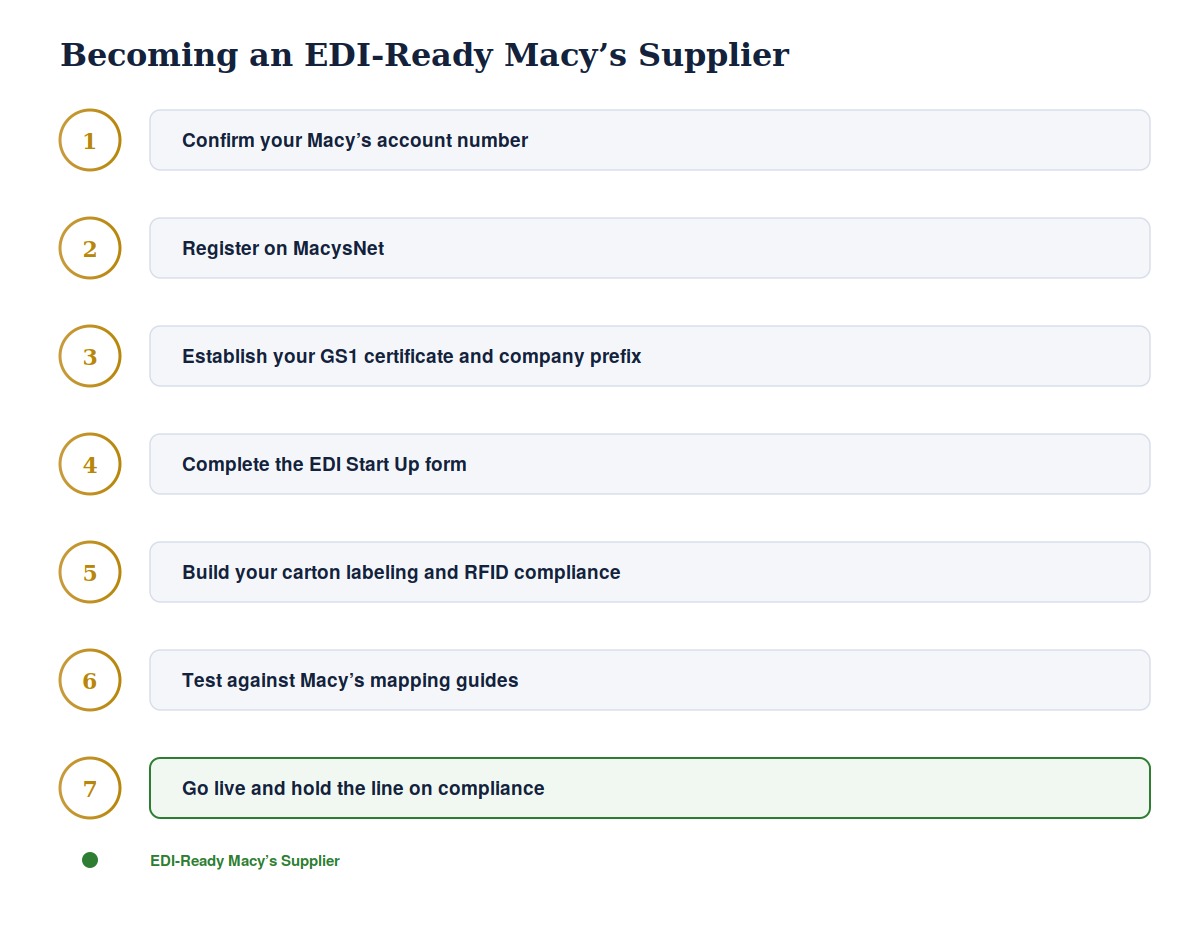 Macy's onboarding path is more document-heavy than some retailers', because it layers GS1 identification, RFID compliance, and portal registration on top of the EDI setup itself.
1. Confirm your Macy's account number. This is issued to your Accounts Receivable/Credit contact when your vendor account is set up. Macy's will only release it to company-domain email addresses — not generic accounts like Gmail.
2. Register on MacysNet. Every employee involved in shipping or accounting should register, ideally at least 30 days before your first shipment. This is where you'll access the Vendor Standards Manual, EDI mapping guides, and the routing guide.
3. Establish your GS1 certificate and company prefix. You can't be set up as a Macy's vendor without one. New vendors — and vendors changing EDI technology — need to contact Macy's EC Technology Department directly about their technical setup.
4. Complete the EDI Start Up form. This is submitted to Macy's EDI Department and requires your Trading Partner IDs (TPIDs), which are assigned per Macy's retail entity and found in the mapping guides. This kicks off testing for the 810, 820, 850, and 856 transaction sets, plus your GS1-128 (UCC-128) carton label.
5. Build your carton labeling and RFID compliance. Macy's requires GS1-128 labels with SSCC-18 on every carton, reconciled to the 856 at the UPC/GTIN level. On top of that, Macy's mandates item-level passive UHF EPC Gen2 RFID tags from a pre-approved vendor list for specific replenishment categories — confirm current category scope on MacysNet before you print a single ticket.
6. Test against Macy's mapping guides. Testing runs through MacysNet and, depending on your channel, through GXS/OpenText or SPS Commerce for drop-ship. Every EDI document must trade at the UPC/GTIN/EAN selling-unit level — Macy's does not accept multiple UPCs on a single selling unit or secondary barcodes.
7. Go live and hold the line on compliance. Once active, your 856 must carry the carrier's 4-character SCAC code, your 997 acknowledgments need to go out reliably, and your ongoing performance — on-time delivery, inventory accuracy, EDI compliance — gets tracked through MacysNet dashboards and vendor business reviews.
The EDI Documents You'll Actually Use
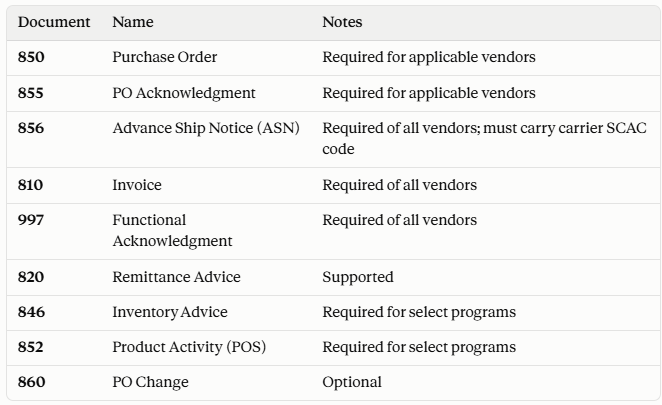
The exact set you'll trade depends on your program (wholesale vs. V2C drop-ship vs. private brand), but the 850, 856, 810, and 997 form the core of nearly every Macy's vendor relationship.
Choosing the Right EDI Translation Approach
Whatever tool you use, its job is the same: take your internal data — whatever format it's stored in — and reliably convert it into the X12 VICS structure Macy's expects, and vice versa on the way back in. Because Macy's layers GS1 barcode compliance and item-level RFID on top of standard EDI, the quality of your mapping has a direct, dollar-for-dollar impact on chargeback exposure once you're live.
How SBSA Technology Can Help
Standing up a compliant Macy's EDI connection — GS1 registration, MacysNet setup, correct X12 VICS mapping, RFID tagging, and GS1-128 labeling — involves more moving pieces than most retailer onboardings, and getting any one of them wrong shows up as a chargeback on your very first shipments. SBSA Technology helps suppliers plan, configure, and test their Macy's EDI integration end to end, from the EDI Start Up form through mapping validation, so you're not troubleshooting compliance issues after you're already live.
Frequently Asked Questions
Does Macy's require EDI from every supplier?
Yes. Core documents — the 850, 856, 810, and 997 — must be exchanged electronically as a condition of doing ongoing business, whether you sell through traditional wholesale or Macy's V2C drop-ship program.
Which EDI documents matter most?
The 850 (PO), 856 (ASN), 810 (invoice), and 997 (functional acknowledgment) are required of essentially every vendor. Depending on your program, you may also need the 855, 820, 846, or 852.
Does Macy's require RFID tagging?
Yes, for specific replenishment categories — Macy's mandates item-level passive UHF EPC Gen2 tags from a pre-approved tag list. Confirm which categories currently apply through MacysNet, since scope has expanded over time.
Do I need a specific software product or VAN?
No specific software is mandated, but GXS (OpenText) is Macy's preferred VAN, and mapping guides also support AS2 and SFTP connections. The right choice depends on which Macy's channel (wholesale, V2C, or private brand) you're onboarding into.
How is EDI compliance enforced?
Through Macy's formal chargeback schedule in the Vendor Standards Manual — errors in ASN accuracy, label formatting, routing, and late shipments are all assessed as deductions against your payment.
Conclusion
Macy's EDI requirements go further than most retailers': beyond standard X12 VICS document trading, vendors have to get GS1 registration, MacysNet setup, carton labeling, and item-level RFID right before their first shipment ever moves. Do the groundwork up front — account registration, GS1 prefix, EDI Start Up form, and mapping tests — and the day-to-day flow of purchase orders, ASNs, and invoices becomes largely automatic. Skip a step, and you'll be fielding chargebacks on shipments you thought were compliant.
Connect with SBSA Technology
Ready to get compliant with Macy's — or want a second opinion on your current EDI setup? SBSA Technology works with retail suppliers, distributors, e-commerce brands, and 3PL providers to automate EDI, order processing, and retailer compliance.
- Book a demo: sbsatech.com/consultancy
- Talk to the team: sbsatech.com/contact
- Explore the platform: sbsatech.com
- More insights: sbsatech.com/blog