
Why Lowe's Cares So Much About EDI
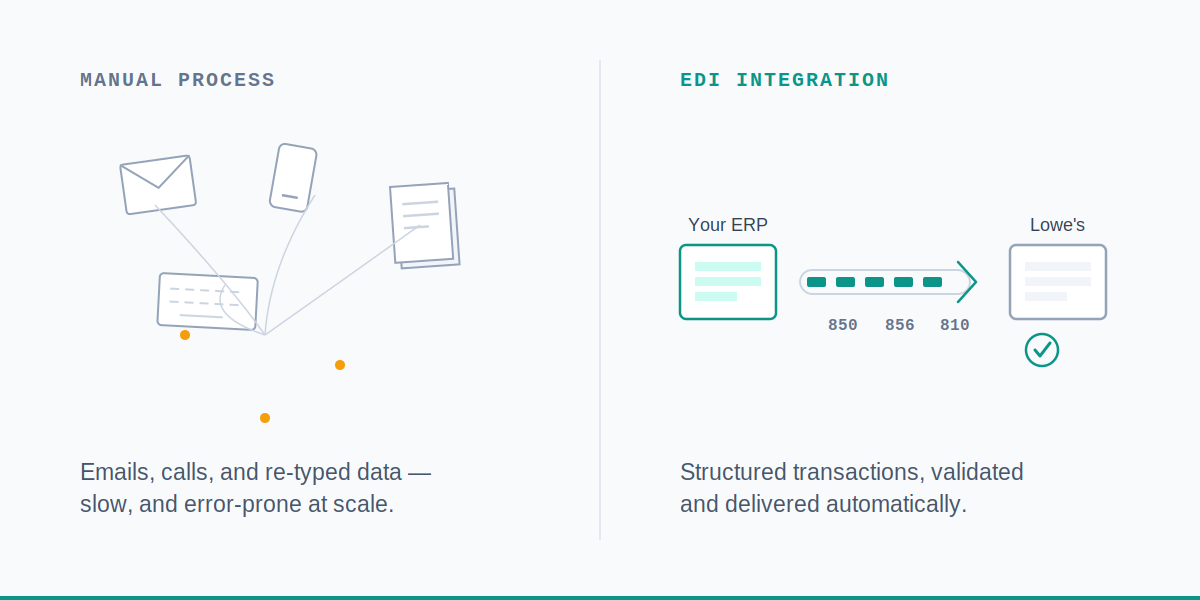
Lowe's distribution network moves an enormous volume of purchase orders, shipments, and invoices every day. Manually keying in that data isn't feasible at scale, and it isn't reliable either. EDI replaces email attachments and phone calls with structured, machine-readable transactions that flow directly between computer systems — Lowe's and yours.
For Lowe's, this means predictable, error-free data arriving in a format their receiving and payment systems can process automatically. For suppliers, compliance is the price of admission: miss a required field, send a document late, or mislabel a shipment, and Lowe's systems (or its dock staff) will reject it.
The Core Documents You'll Exchange
Lowe's EDI program is built around the ANSI X12 standard, a common framework used across North American retail. A handful of transaction sets make up the backbone of a typical order cycle:
- Purchase Order (850): Lowe's sends this to place an order. It's the trigger for everything downstream.
- Purchase Order Acknowledgment (855): Your confirmation that you received the order and intend to fulfill it as specified — or your notice of any changes.
- Advance Ship Notice (856): Sent before or as your shipment leaves your facility, describing exactly what's in the shipment and how it's packed — down to the carton and pallet level.
- Invoice (810): Your bill for the completed order, submitted after shipment.
Each of these has to conform precisely to Lowe's implementation guidelines. A missing segment or an incorrectly formatted field in an 856, for instance, can be enough to stop a shipment from being properly received at a distribution center — even if the physical goods arrive on time.
The ASN: Where Most Compliance Problems Start
If there's one document that causes the most headaches, it's the 856 Advance Ship Notice. Lowe's distribution centers rely on the ASN to plan labor, allocate dock space, and process inbound freight quickly — often without opening every box to verify contents. That only works if the data is accurate.
Two things matter most here:
- Packaging hierarchy accuracy. The ASN needs to correctly reflect how items are packed into cartons and how those cartons are loaded onto pallets — not an approximation, the actual structure.
- Label-to-data matching. The SSCC-18 barcode on your physical shipping labels has to match the data you transmitted in the ASN exactly. A mismatch between the label and the electronic record is one of the most common reasons freight gets turned away at receiving.
If you work with a third-party logistics provider for fulfillment, make sure they have visibility into your ASN data — they're often the ones physically generating and applying the labels, and a disconnect between your EDI system and their warehouse operations is an easy way to fail compliance without anyone noticing until the chargeback arrives.
Choosing How You Connect: AS2 vs. VAN
Before any of these documents can move, you need an approved communication channel with Lowe's. Two options dominate:
AS2 (Applicability Statement 2) is a direct, point-to-point connection that transmits data securely over the internet in near real time. It requires your team (or your integration partner) to manage AS2 software, but once set up, ongoing per-transaction costs are typically lower — making it a good fit for higher-volume suppliers.
A Value Added Network (VAN) acts as an intermediary, receiving your documents and forwarding them to Lowe's on a store-and-forward basis. It's generally simpler to get running, since the VAN provider handles most of the technical maintenance, though it usually comes with per-transaction or monthly fees. This tends to suit smaller suppliers or those without dedicated EDI infrastructure.
Neither is objectively "better" — the right choice depends on transaction volume, in-house IT capacity, and how much control you want over the connection itself.
Connecting EDI to Your ERP
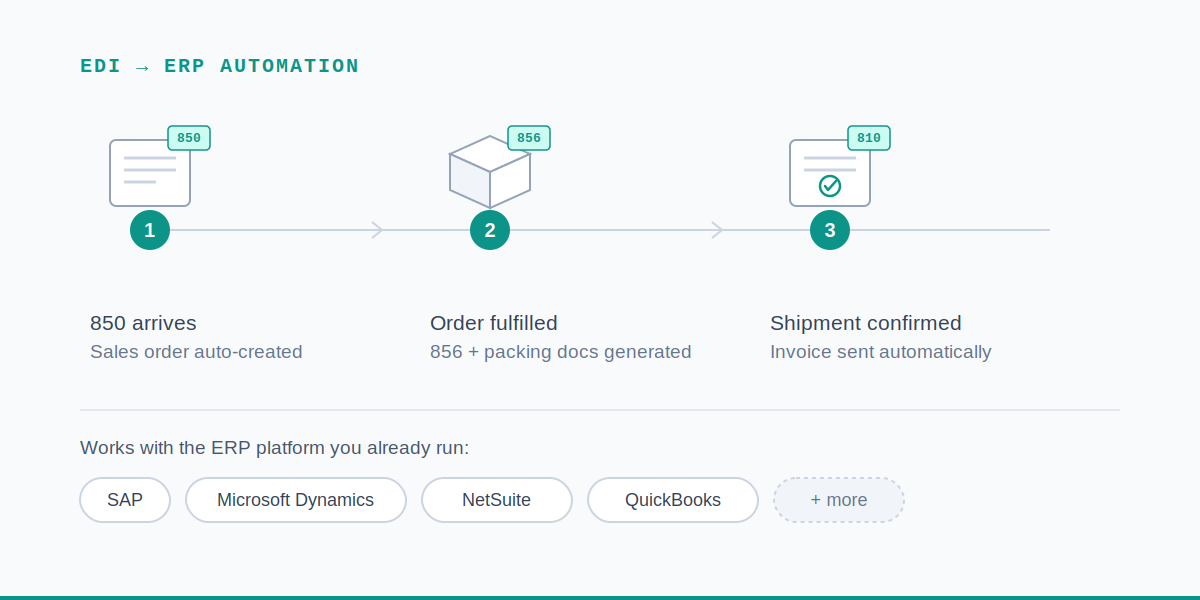
Receiving compliant EDI documents is only half the job. The real efficiency gain comes when those documents flow directly into your Enterprise Resource Planning (ERP) system without anyone re-typing data.
In a well-built setup:
- An incoming 850 automatically creates a sales order in your ERP.
- Order fulfillment triggers generation of the 856 and any required packing documentation.
- Shipment confirmation and invoicing (810) happen automatically once the ASN is accepted.
This kind of tight integration is achievable with most major ERP platforms — SAP, Microsoft Dynamics, NetSuite, QuickBooks, and others — but it requires mapping Lowe's specific transaction requirements into your system's data model correctly the first time. Done well, it removes manual data entry almost entirely from the order-to-cash cycle.
Common Ways Suppliers Fall Out of Compliance
A few recurring issues account for most of the compliance problems suppliers run into:
- Outdated EDI version support. Lowe's periodically revises its routing guides and X12 version requirements. If your translator software hasn't been updated to match, documents that used to pass validation will start failing.
- Invoicing ahead of shipment confirmation. Sending an 810 invoice before the corresponding 856 has been accepted is a common trigger for chargebacks — the sequence matters.
- 3PL blind spots. When a logistics partner handles physical fulfillment but doesn't have accurate visibility into your EDI data, labels and ASNs can drift out of sync.
- Manual patchwork instead of full integration. Suppliers who bolt EDI onto their existing process rather than integrating it into their ERP tend to accumulate errors over time as order volume grows.
Getting It Right
Lowe's compliance isn't a one-time checkbox — it's an ongoing operational discipline that touches your order management, warehouse processes, and IT systems together. Suppliers who invest in a properly mapped, fully automated EDI integration typically see faster order processing, fewer chargebacks, and far less staff time spent chasing down data errors.
If you're setting up a new connection with Lowe's or troubleshooting an existing one that isn't performing the way it should, SBSA Technology can help you map the requirements, choose the right connection method, and get your EDI data flowing cleanly into your ERP — so compliance becomes something your systems handle automatically, not something your team has to manage by hand.
How SBSA Technology Can Help
Getting Lowe's EDI right on your own is doable — but it's easy to underestimate the number of moving pieces: transaction set mapping, label-to-ASN matching, protocol setup, ERP connectivity, and ongoing monitoring as Lowe's updates its requirements. SBSA Technology handles that complexity end to end:
- Compliance mapping: We map your data to Lowe's exact 850, 855, 856, and 810 specifications, so documents pass validation the first time — not after a round of rejected transmissions.
- Connection setup: Whether AS2 or a VAN is the better fit for your volume and infrastructure, we handle the technical setup and ongoing maintenance of the connection itself.
- ASN and label accuracy: We build the packaging hierarchy and barcode logic into your ASN generation so your SSCC-18 labels match your electronic records every time — closing the gap that causes most dock rejections.
- ERP integration: We connect Lowe's EDI data directly into your ERP — SAP, NetSuite, Microsoft Dynamics, QuickBooks, and others — so orders, shipments, and invoices flow automatically without manual re-entry.
- 3PL coordination: If a logistics partner handles your fulfillment, we make sure their labeling and shipment data stay in sync with what's transmitted to Lowe's.
- Ongoing monitoring: As Lowe's revises routing guides or X12 versions, we keep your integration current so you're not caught off guard by a compliance failure.
The goal isn't just passing your initial onboarding test — it's building an integration that stays compliant as your order volume and business systems grow.
Quick FAQ
What EDI documents does Lowe's require? At minimum, suppliers need to support the 850 (Purchase Order), 855 (PO Acknowledgment), 856 (Advance Ship Notice), and 810 (Invoice), transmitted via AS2 or an approved VAN.
What's the biggest cause of ASN-related rejections? A mismatch between the SSCC-18 barcode on the physical shipping label and the data submitted in the 856 ASN.
AS2 or VAN — which should I choose? It depends on your volume and IT resources. AS2 suits higher-volume suppliers with the infrastructure to manage direct connections; a VAN suits suppliers who want a simpler, managed setup.
Can EDI integrate directly with my ERP? Yes — this is standard practice and is achievable with most major ERP platforms when the transaction sets are mapped correctly to your system.
What happens if I'm not compliant? Typical consequences include chargebacks, delayed payments, and in repeated cases, being restricted from receiving new purchase orders.
Connect with SBSA Technology
Ready to get compliant with Lowe's — or want a second opinion on your current EDI setup? SBSA Technology works with retail suppliers, distributors, e-commerce brands, and 3PL providers to automate EDI, order processing, and retailer compliance.
- Book a demo: sbsatech.com/consultancy
- Talk to the team: sbsatech.com/contact
- Explore the platform: sbsatech.com
- More insights: sbsatech.com/blog