
For retail vendors supplying major retailers, having enough inventory is only part of the fulfillment challenge. Businesses must also determine which warehouse should fulfill each order, how much stock to reserve, and how to meet retailer shipping deadlines without disrupting other orders.
When inventory is distributed across multiple warehouses, poor allocation decisions can lead to overselling, unnecessary stock transfers, split shipments, increased freight costs, and late deliveries.
A structured inventory allocation strategy helps vendors assign available stock to the right orders based on inventory availability, delivery requirements, warehouse capacity, and fulfillment costs.
In this guide, we explain how multi-warehouse inventory allocation works, the rules retail vendors should establish, and how connected business systems can support more reliable order fulfillment.
What Is Multi-Warehouse Inventory Allocation?
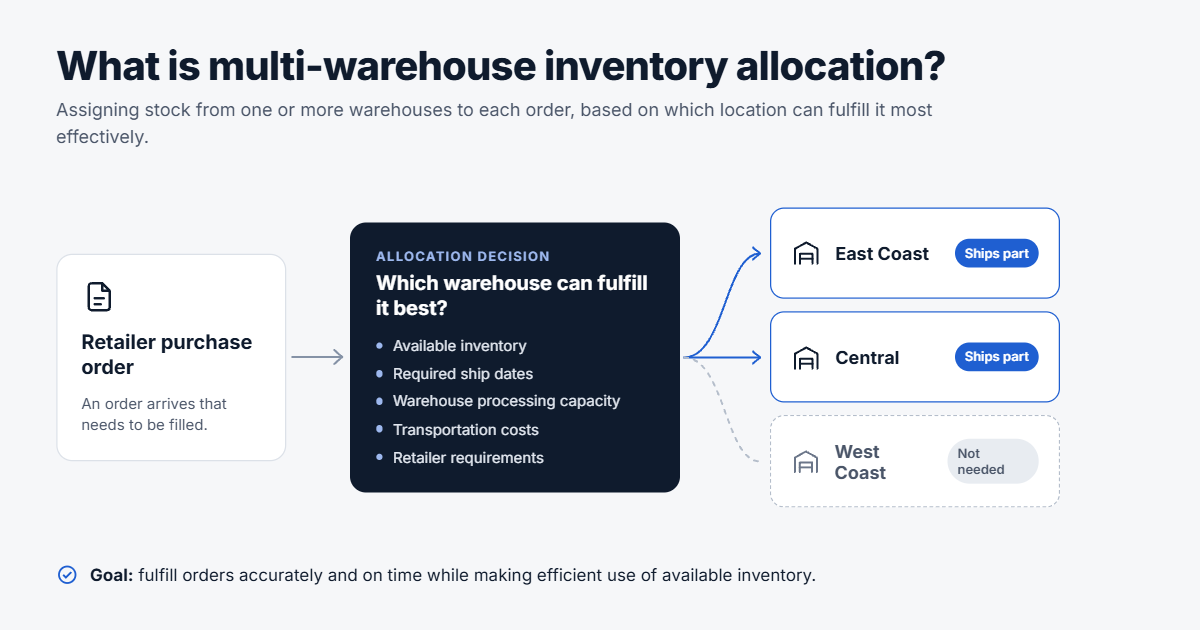 Multi-warehouse inventory allocation is the process of assigning available inventory at one or more warehouse locations to specific customer or retailer orders.
Rather than treating all stock as interchangeable, businesses evaluate the inventory available at each location and determine which warehouse can fulfill an order most effectively.
For example, a supplier may store products in three distribution centers:
-
East Coast warehouse
-
Central warehouse
-
West Coast warehouse
When a retailer submits a purchase order, the supplier must decide whether to fulfill it from one warehouse or distribute the order across multiple locations.
The decision depends on several factors, including available inventory, required ship dates, warehouse processing capacity, transportation costs, and retailer-specific fulfillment requirements.
The objective is to fulfill orders accurately and on time while making efficient use of available inventory.
Why Inventory Allocation Matters for Retail Vendors
Retail vendors often manage multiple purchase orders, retailer requirements, and warehouse locations simultaneously. Without clear allocation rules, individual departments may make decisions that create problems elsewhere in the fulfillment process.
1. Preventing Inventory Double-Booking
Inventory double-booking occurs when the same units are committed to more than one order.
For example, a warehouse may have 200 units physically on hand, but 150 units are already reserved for existing orders. If the inventory system does not account for those reservations, another order may be assigned stock that is no longer available.
Clear reservation rules help ensure that committed inventory is not promised to additional customers.
2. Meeting Retailer Shipping Deadlines
Some retailer orders must be shipped within specific windows. Selecting a warehouse solely because it has the largest stock quantity may create delays if that location cannot process or ship the order on time.
Allocation decisions should consider the required ship date, warehouse processing time, carrier availability, and any applicable routing requirements.
3. Controlling Fulfillment Costs
Shipping an order from a distant warehouse can increase transportation costs. Splitting one order across multiple locations may also create additional handling, packaging, and freight expenses.
A good allocation strategy balances fulfillment cost with service commitments instead of automatically choosing the cheapest warehouse.
4. Maintaining Retailer Compliance
Incorrect allocation can lead to partial shipments, missed ship windows, inaccurate shipment documentation, and other fulfillment problems.
By considering retailer requirements before assigning inventory, vendors can reduce avoidable operational errors and the risk of compliance deductions.
6 Inventory Allocation Rules Every Retail Vendor Should Establish
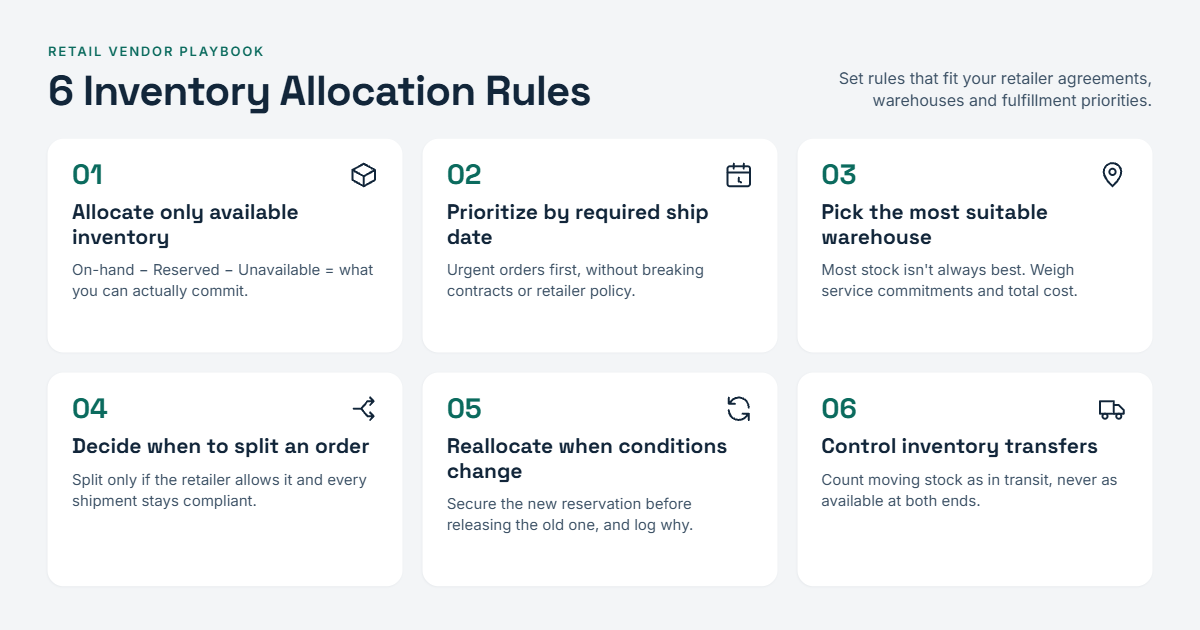
There is no single allocation rule that works for every business. Vendors should establish rules that reflect their retailer agreements, warehouse capabilities, product characteristics, and fulfillment priorities.
Rule 1: Allocate Only Available Inventory
The first rule is to distinguish physical inventory from inventory that can actually be committed to new orders.
A useful starting calculation is:
Available inventory = On-hand inventory − Reserved inventory − Unavailable inventory
Unavailable inventory may include damaged products, quarantined stock, or quantities awaiting inspection.
Consider this example:
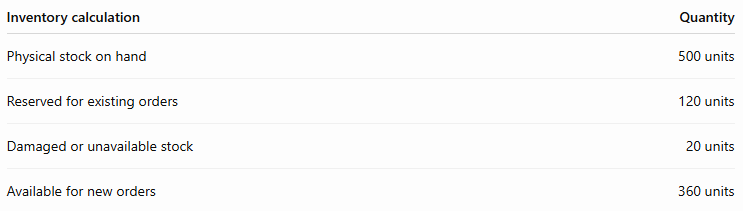
Although the warehouse physically holds 500 units, only 360 are available for new commitments.
Expected inbound stock should be treated separately unless the business has a reliable process for confirming its arrival and release for fulfillment.
Best practice: Require allocation decisions to use a consistent available-inventory calculation across relevant systems.
Rule 2: Prioritize Orders by Required Ship Date
Orders should be allocated with their fulfillment commitments in mind.
For example, a retailer order that must ship tomorrow may require immediate attention, while another order with a later ship date may allow additional flexibility.
Allocation rules should consider:
-
Retailer-required ship dates
-
Warehouse picking and packing time
-
Carrier pickup schedules
-
Delivery appointments, where applicable
-
Order processing status
-
Retailer-specific shipping requirements
Priority rules should be documented so that urgent orders are handled consistently rather than relying on informal decisions.
However, vendors should not automatically prioritize the earliest deadline if doing so would violate another contractual commitment or an approved retailer allocation policy.
Rule 3: Select the Most Suitable Warehouse
The warehouse with the most inventory is not necessarily the best location to fulfill an order.
A vendor should evaluate whether each candidate warehouse can meet the order's requirements.
| Allocation factor | What to evaluate |
|---|---|
| Inventory availability | Does the warehouse have enough uncommitted stock? |
| Processing capacity | Can the warehouse pick and pack the order on time? |
| Shipping distance | How does the location affect transit time and freight costs? |
| Retailer requirements | Is the location eligible and able to follow the required routing instructions? |
| Product availability | Are the required SKUs available in the correct condition? |
| Operational constraints | Are there warehouse closures, carrier limitations, or other restrictions? |
For example, a West Coast warehouse might have sufficient inventory for an order destined for California, while an East Coast warehouse holds more stock overall. If both locations meet the retailer's requirements, the West Coast location may be the more efficient choice.
The final decision should reflect both service commitments and total fulfillment cost.
Rule 4: Decide When to Split an Order
Sometimes no single warehouse has enough available stock to fulfill an entire order.
In that situation, the vendor must decide whether to split the order across multiple warehouses, transfer inventory, or use another approved fulfillment option.
Suppose a retailer orders 300 units of a product:
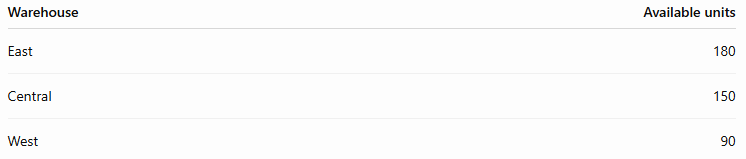
The East warehouse cannot fulfill the entire order by itself.
One possible allocation is 180 units from East and 120 from Central. However, this should only be used if the retailer permits split fulfillment and both locations can meet the applicable shipping requirements.
Before splitting an order, evaluate:
-
Whether partial shipments are allowed
-
Whether the retailer requires a single shipment or delivery appointment
-
The additional freight and handling costs
-
Whether each shipment needs separate carton and shipment documentation
-
Whether the split could create delivery or compliance problems
If split shipments are not permitted, the vendor may need to transfer stock, wait for replenishment if the deadline allows, or escalate the exception for an approved resolution.
Rule 5: Reallocate Inventory When Conditions Change
An allocation decision may become invalid after an order is assigned to a warehouse.
For example, inventory may be damaged during picking, a receiving delay may affect replenishment, or a warehouse may experience unexpected capacity constraints.
Vendors should establish a controlled reallocation process.
A practical workflow is:
-
Identify the order that can no longer be fulfilled as planned.
-
Confirm the actual available inventory at alternative locations.
-
Evaluate delivery commitments and retailer restrictions.
-
Select an eligible alternative warehouse or escalation path.
-
Release the original reservation and create the new reservation through a controlled process.
-
Update the relevant order and fulfillment records.
-
Notify the responsible team if the original shipping commitment is at risk.
The inventory should not be released from the original location until the reassignment process is controlled well enough to prevent another order from claiming the same units.
Best practice: Record why inventory was reallocated so the business can identify recurring shortages, warehouse capacity issues, and inaccurate inventory records.
Rule 6: Maintain Clear Rules for Inventory Transfers
Moving stock between warehouses can help resolve shortages, but transfers introduce additional costs and timing considerations.
Before initiating a transfer, vendors should determine whether the inventory can arrive, be received, and be made available before the order's fulfillment deadline.
A transfer decision should consider:
-
Transfer cost and expected transit time
-
Inventory availability at the sending warehouse
-
Receiving capacity at the destination warehouse
-
Time needed for inspection and inventory release
-
The urgency of the customer or retailer order
-
Whether the transfer creates shortages for other commitments
Transfers should be recorded as inventory in transit rather than being counted as immediately available at both locations.
This prevents the same units from being treated as available at the origin and destination simultaneously.
How to Build a Multi-Warehouse Allocation Workflow
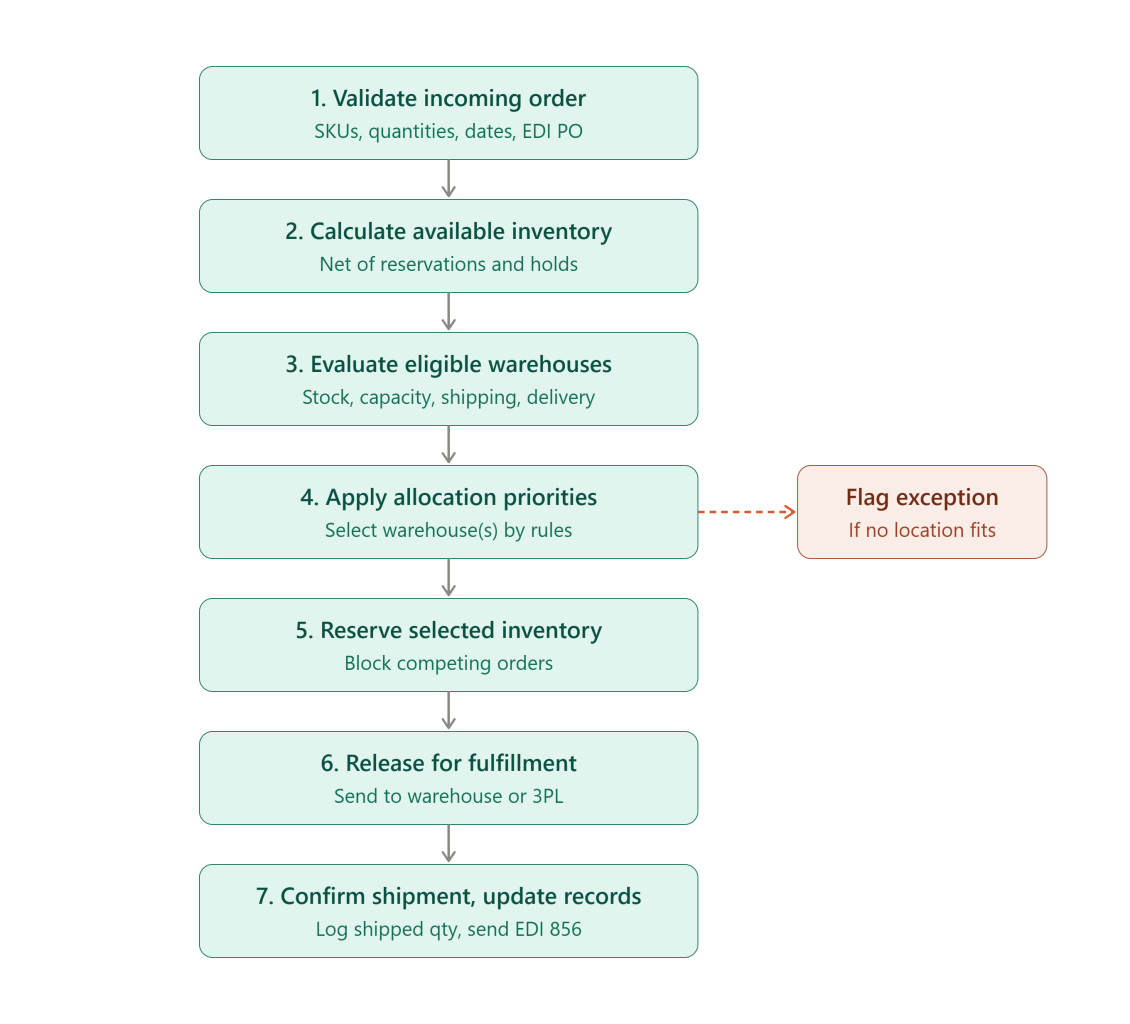
Once the allocation rules are defined, vendors should establish a repeatable process for handling new orders.
Step 1: Validate the Incoming Order
Confirm the order details, required SKUs, quantities, requested ship dates, and applicable retailer requirements.
For EDI-based orders, this may involve processing the purchase order and validating it against the vendor's internal order and product records.
Step 2: Calculate Available Inventory
Review inventory across eligible warehouse locations.
The calculation should account for reservations, unavailable stock, and any other inventory restrictions that apply to the business.
Step 3: Evaluate Eligible Warehouses
Determine which locations can fulfill the order based on stock availability, processing capacity, shipping requirements, and expected delivery performance.
Step 4: Apply Allocation Priorities
Use the company's defined rules to select the preferred warehouse or combination of warehouses.
If no location can fulfill the order as required, flag the exception rather than committing inventory that is not available.
Step 5: Reserve the Selected Inventory
Reserve the required quantities against the chosen warehouse or warehouses.
The reservation process should prevent competing orders from claiming the same inventory and should include controls for cancellations, changes, and reassignment.
Step 6: Release the Order for Fulfillment
Send the confirmed fulfillment instructions to the appropriate warehouse or 3PL system, depending on the business's integration setup.
The warehouse then performs the required picking, packing, and shipping activities.
Step 7: Confirm Shipment and Update Records
Record the actual shipped quantities and update relevant inventory and order records.
For supported EDI workflows, shipment information may also be communicated to the retailer through an Advance Ship Notice (EDI 856), in accordance with the retailer's requirements.
This closes the loop between allocation decisions and actual warehouse execution.
How ERP, WMS, and EDI Support Inventory Allocation
Multi-warehouse allocation depends on accurate information and coordination between the systems involved in ordering and fulfillment.
ERP Systems
An Enterprise Resource Planning (ERP) system can provide business records related to products, orders, purchasing, and inventory, depending on the implementation.
For vendors managing multiple warehouses, it is important to establish how inventory quantities, order commitments, and warehouse locations are represented in the ERP.
Warehouse Management Systems
A Warehouse Management System (WMS) supports warehouse-level activities such as receiving, putaway, picking, packing, and shipping.
Warehouse execution updates can help other systems understand whether inventory remains available or has already been committed or shipped.
Electronic Data Interchange
EDI enables the exchange of standardized business documents between trading partners.
Relevant transactions may include:
-
EDI 850 — Purchase Order: Communicates a retailer's order.
-
EDI 855 — Purchase Order Acknowledgment: Communicates the vendor's response to the order.
-
EDI 856 — Advance Ship Notice: Communicates shipment details.
-
EDI 846 — Inventory Inquiry/Advice: Communicates inventory information when supported by the trading-partner relationship.
-
EDI 940 — Warehouse Shipping Order: Can communicate shipping instructions to a participating warehouse.
-
EDI 945 — Warehouse Shipping Advice: Can communicate shipping information from a participating warehouse.
These transactions support different parts of the order and fulfillment process. They do not automatically determine the best warehouse or guarantee real-time inventory synchronization.
That functionality depends on the connected systems, business rules, and integration design.
Common Inventory Allocation Mistakes to Avoid
Retail vendors should watch for these frequent mistakes:
-
Allocating based on physical stock alone: This ignores inventory already committed to other orders.
-
Choosing a warehouse based only on distance: The nearest location may not have the necessary stock or capacity.
-
Ignoring retailer restrictions: A split shipment or alternate location may not be permitted.
-
Counting inventory in transit as available at both locations: This can create duplicate commitments.
-
Releasing reservations without controlled reassignment: This risks double-booking inventory.
-
Relying on delayed warehouse updates: Stock may appear available after it has already been picked or shipped.
-
Failing to monitor exceptions: Recurring allocation problems remain unresolved when nobody tracks their causes.
A documented allocation policy, supported by accurate records and clear exception ownership, helps prevent these problems from becoming recurring operational issues.
How SBSA Technology Can Support Retail Order and Fulfillment Workflows
Managing multiple warehouses requires coordination between retailer orders, business systems, and fulfillment operations.
SBSA Technology provides EDI and retail operations software designed to help businesses exchange and process retailer transactions and connect supported operational systems.
Depending on the implementation and integration scope, these connected workflows can help vendors coordinate purchase orders, acknowledgments, shipment information, invoices, and related business records.
For companies evaluating their multi-warehouse processes, an important first step is to determine how their ERP, WMS, and 3PL systems share inventory and order updates.
Vendors should confirm whether their current setup supports the specific warehouse-level functions they need, including allocation rules, stock reservation, inventory updates, and exception handling. These capabilities depend on the systems and configuration involved and should not be assumed to be included in every EDI integration.
By identifying gaps in their existing workflows, suppliers can better determine where integration improvements may reduce manual work and strengthen coordination between order processing and fulfillment.
To learn more about SBSA Technology's EDI and retail operations solutions, visit SBSA Technology.
Conclusion
Effective multi-warehouse inventory allocation is about more than distributing stock across locations. It requires consistent decisions about which orders receive inventory, where those orders should be fulfilled, and how the business responds when conditions change.
By establishing clear allocation rules, reserving inventory accurately, evaluating split shipments carefully, and coordinating ERP, WMS, 3PL, and EDI workflows, retail vendors can reduce preventable fulfillment problems and improve their ability to meet retailer commitments.
A well-defined allocation process also gives operations teams better visibility into recurring shortages, warehouse constraints, and opportunities to improve inventory utilization.
Looking to improve your retail order and EDI workflows?
Explore SBSA Technology to learn how connected retail transactions and operational systems can help support a more coordinated fulfillment process.
- Book a demo: sbsatech.com/consultancy
- Talk to the team: sbsatech.com/contact
- Explore the platform: sbsatech.com
- More insights: sbsatech.com/blog