
The Common Challenge Across Suppliers and Vendors
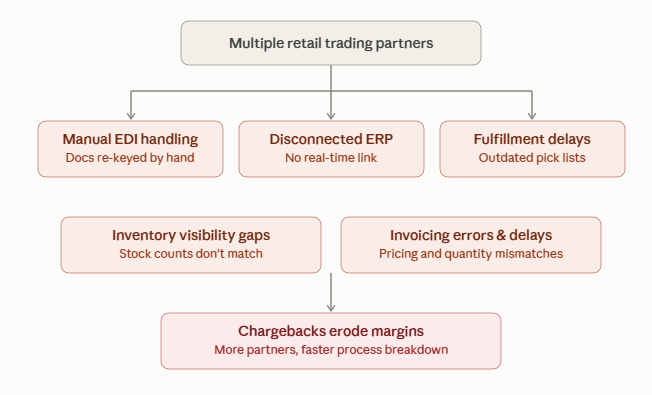
Regardless of industry or product category, retail suppliers working with multiple trading partners tend to hit the same operational wall:
- Manual EDI handling — Purchase orders (850s), shipment notices (856s), and invoices (810s) are re-keyed by hand from retailer portals into internal systems, consuming staff hours daily and introducing constant risk of error.
- Disconnected ERP systems — The ERP operates as a silo, with no real-time link to incoming order data, leaving inventory counts and financials frequently out of sync with actual operations.
- Fulfillment delays — Warehouse and shipping teams work from outdated pick lists because order information lags behind real retailer demand.
- Inventory visibility gaps — Internal stock levels don't match what trading partners see, leading to overselling, stockouts, and compliance penalties.
- Invoicing errors and delays — Manually generated invoices frequently mismatch shipped quantities or agreed pricing, triggering chargebacks and slowing down payment cycles.
For any vendor supporting multiple retail partners, missed EDI deadlines or shipping discrepancies routinely result in chargebacks that erode margins — and the more partners a supplier onboards, the faster these manual processes break down.
The Solution: SBSA Technology's Integrated EDI & ERP Platform
SBSA Technology designs and implements end-to-end automation that connects every stage of the order-to-cash cycle, built to apply across supplier types, product categories, and trading-partner networks. The approach rests on four pillars:
1. Automated EDI Processing
SBSA Technology deploys a fully automated EDI engine that ingests and translates trading-partner transactions — purchase orders (850), functional acknowledgments (997), advance ship notices (856), and invoices (810) — directly into the vendor's business systems, eliminating manual re-keying. Built-in validation rules catch formatting and compliance issues before transactions reach the retailer, reducing chargebacks regardless of how many trading partners are connected.
2. Seamless ERP Integration
Rather than treating EDI as a bolt-on, SBSA Technology connects the EDI engine directly into the vendor's existing ERP — whatever platform it runs on — so incoming orders, pricing, and product data flow automatically into the core system of record. This gives sales, finance, and operations teams a single, trusted source of truth, no matter the size or complexity of the business.
3. Real-Time Fulfillment and Inventory Synchronization
SBSA Technology's platform synchronizes warehouse and fulfillment data with both the ERP and retailer-facing systems in real time. As orders are picked, packed, and shipped, inventory counts update automatically across every connected channel — closing the gap between what a supplier has on hand and what its trading partners see as available, across any number of warehouses or fulfillment nodes.
4. Automated Invoicing
Once shipments are confirmed, SBSA Technology's system auto-generates EDI 810 invoices that match shipped quantities and negotiated pricing exactly, transmitting them directly to trading partners without manual intervention. This accelerates payment cycles and virtually eliminates invoice-related disputes, a benefit that compounds as a vendor's partner network grows.
Implementation Approach
SBSA Technology rolls out its solution in structured phases designed to minimize disruption to live operations — an approach that adapts to a vendor's specific trading-partner mix, product complexity, and system landscape:
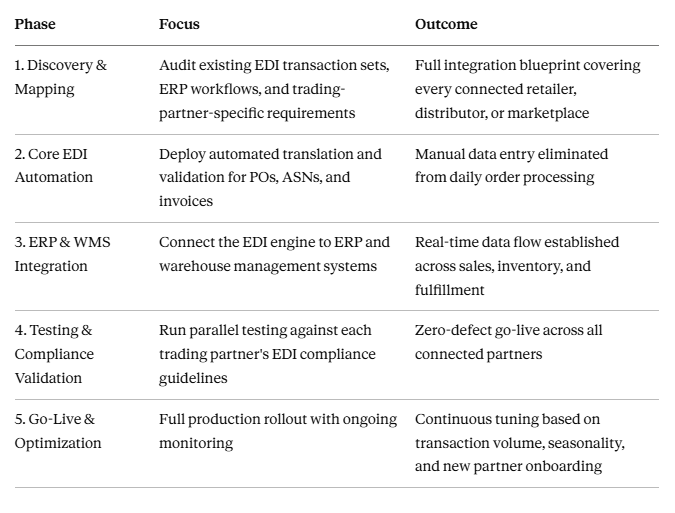
This phased model scales in both directions — it works for a supplier with a handful of retail partners and a lean back office, and for a large vendor managing hundreds of trading relationships across multiple ERPs and warehouses.
Results Suppliers and Vendors Typically See
Across engagements, vendors working with SBSA Technology consistently report outcomes like:
- Up to 90% reduction in manual order-processing time, freeing staff for higher-value account management work
- Significant reduction in chargebacks related to EDI compliance and shipping discrepancies
- 99%+ inventory accuracy across ERP, warehouse, and trading-partner-facing systems
- Same-day invoicing on shipments, shortening average payment cycles
- Faster trading-partner onboarding, with new retailers or distributors added in days rather than months
- Scalable operations that support growth in order volume and partner count without a proportional increase in back-office headcount
Why This Matters for Any Supplier or Vendor
The specific product category changes — apparel, home goods, food and beverage, electronics, industrial supply — but the underlying operational problem is the same: growth outpaces manual processes, and disconnected systems create errors, delays, and compliance risk. SBSA Technology's value lies in connecting the full order-to-cash lifecycle — EDI, ERP, fulfillment, inventory, and invoicing — into a single automated flow, rather than solving each piece in isolation.
For any retail supplier or vendor facing manual processes, disconnected systems, or mounting compliance pressure, this case study reflects the kind of transformation SBSA Technology is built to deliver: fewer errors, faster cycles, and an operations team free to focus on growth instead of data entry.