
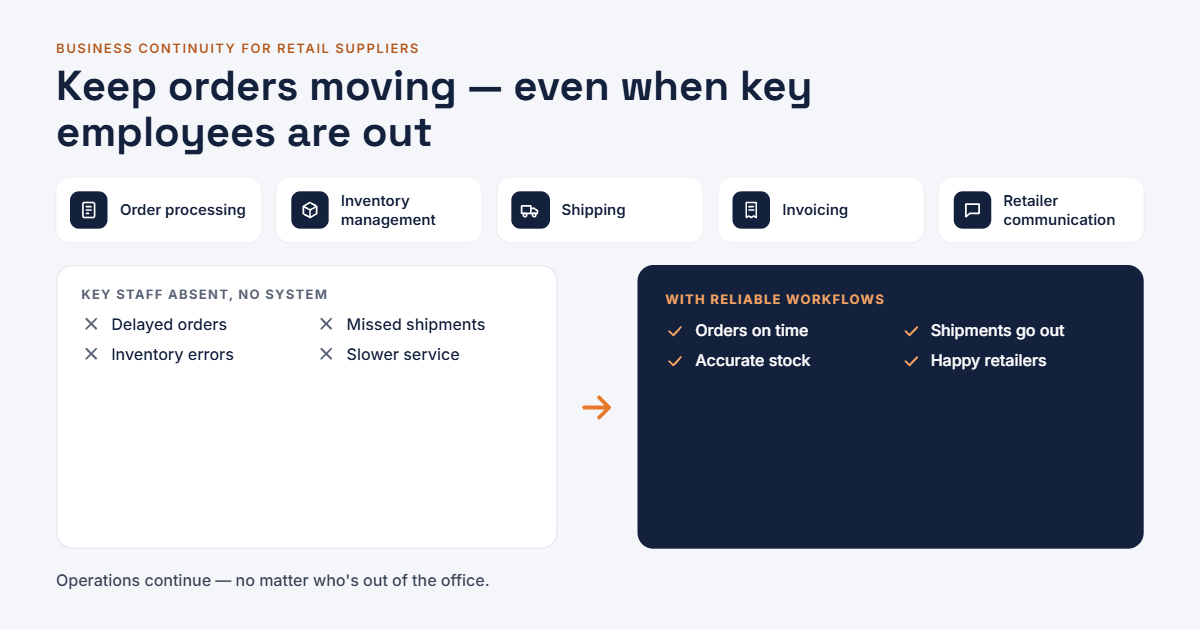
Running a retail supply business requires coordination across multiple departments, including order processing, inventory management, shipping, invoicing, and retailer communication. However, when key employees are absent due to illness, vacations, or unexpected circumstances, these daily operations can quickly become challenging.
Without proper systems and processes, businesses may experience delayed orders, missed shipments, inventory errors, and slower customer service. Retail suppliers need reliable workflows that allow their operations to continue even when specific employees are unavailable.
Here are several ways suppliers can maintain business continuity and minimize operational disruptions.
1. Standardize Daily Business Processes
When important tasks depend on only one employee, their absence can create operational bottlenecks. Standardizing workflows helps ensure that other team members can take over responsibilities when necessary.
Suppliers should document procedures for:
-
Processing purchase orders and sales orders.
-
Managing inventory updates.
-
Preparing shipments and ASNs.
-
Handling retailer requirements.
-
Creating and submitting invoices.
Having clear procedures makes it easier for employees to understand their responsibilities and maintain consistent operations.
2. Automate Repetitive Administrative Tasks
Manual processes often require employees to perform repetitive tasks throughout the day. When someone responsible for these activities becomes unavailable, work can accumulate quickly.
EDI automation and integrated business systems can reduce dependence on manual data entry by automatically processing purchase orders, sending order acknowledgments, generating advance shipment notices, and transmitting invoices.
This allows suppliers to maintain important workflows with less manual intervention.
3. Make Business Information Accessible Across Departments
Employees should not be the only source of information about orders, inventory, shipments, or retailer requirements.
When important information is stored in individual spreadsheets, emails, or personal files, other employees may struggle to access what they need.
Using centralized systems allows authorized team members to access important operational information, review order statuses, monitor inventory, and coordinate activities without depending on a single employee.
4. Cross-Train Employees for Critical Responsibilities
Technology can automate many tasks, but employees still need to understand how business operations work.
Cross-training allows multiple employees to handle essential responsibilities when someone is unavailable.
For example, an employee responsible for order processing can train another team member to review purchase orders, check order requirements, and monitor processing statuses.
This reduces operational dependency on individual employees and helps maintain productivity during unexpected absences.
5. Monitor Orders, Inventory, and Shipments in Real Time
A lack of visibility can make employee absences even more disruptive. Without reliable tracking, businesses may overlook pending orders, inventory shortages, or upcoming shipment deadlines.
Suppliers should use systems that provide visibility into:
-
Incoming retailer purchase orders.
-
Pending and completed shipments.
-
Current inventory levels.
-
Order fulfillment progress.
-
Invoice processing and submission statuses.
With better visibility, available employees can quickly identify priorities and address potential problems before they affect retailer relationships.
6. Reduce Dependence on Manual Communication
When business updates depend heavily on individual employees sending emails or making phone calls, important information can easily be delayed.
Automated notifications, system updates, and centralized communication records help ensure that relevant departments stay informed.
For example, when an order is processed or a shipment is completed, the appropriate information can be updated within the system, allowing other team members to monitor progress.
How SBSA Technology Can Help
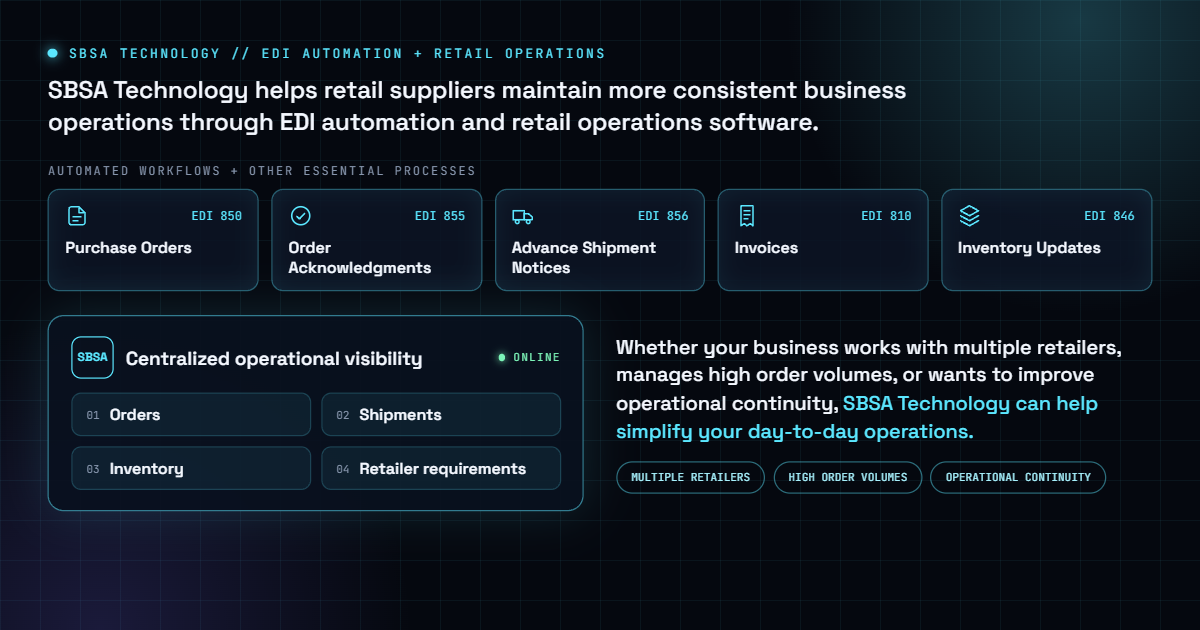
SBSA Technology helps retail suppliers maintain more consistent business operations through EDI automation and retail operations software.
By automating purchase orders, order acknowledgments, advance shipment notices, invoices, inventory updates, and other essential workflows, SBSA helps reduce manual administrative work and dependence on individual employees.
With centralized operational visibility and integrated business processes, suppliers can manage orders, shipments, inventory, and retailer requirements more efficiently, even when key team members are unavailable.
Whether your business works with multiple retailers, manages high order volumes, or wants to improve operational continuity, SBSA Technology can help simplify your day-to-day operations.
Ready to keep your retail operations running without depending on individual employees? Contact SBSA Technology to discover how our EDI automation and retail operations solutions can help your business maintain productivity and operational continuity.
- Book a demo: sbsatech.com/consultancy
- Talk to the team: sbsatech.com/contact
- Explore the platform: sbsatech.com
- More insights: sbsatech.com/blog