
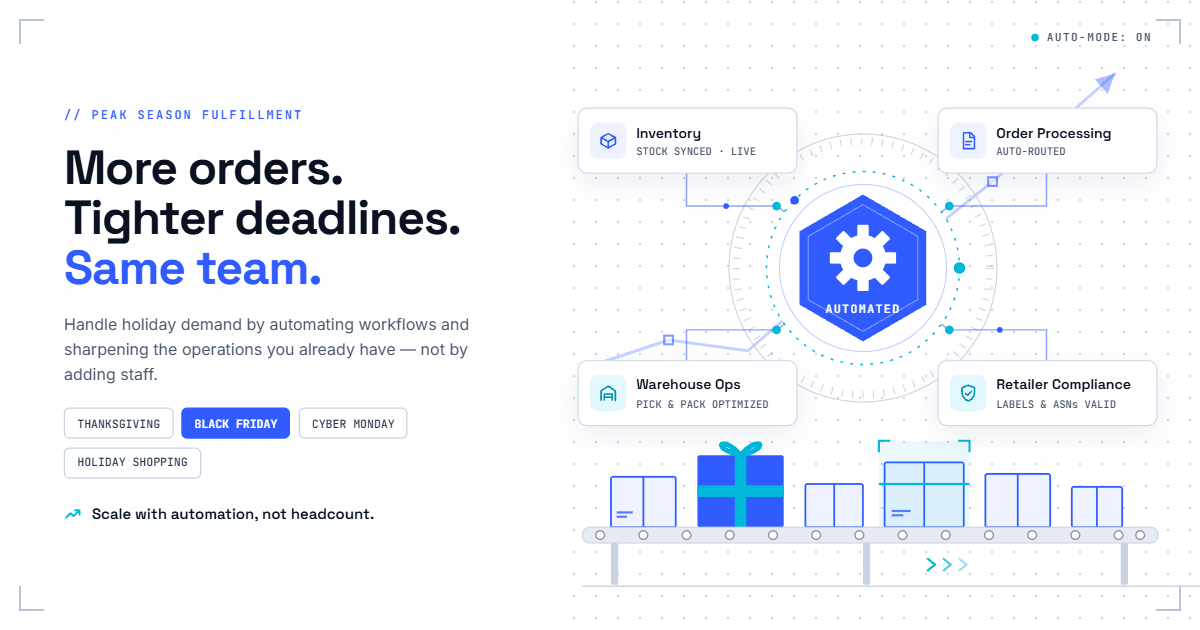
 Peak seasons such as Black Friday, Cyber Monday, Thanksgiving, and the holiday shopping period bring increased orders and tighter fulfillment deadlines for retail suppliers. While higher demand creates opportunities for growth, it can also put pressure on inventory management, order processing, warehouse operations, and retailer compliance.
Instead of increasing staff or investing in additional resources, suppliers can handle seasonal demand more efficiently by automating workflows and improving their existing operations.
Automate Order Processing
Manually entering and processing purchase orders becomes more time-consuming when order volumes increase. EDI automation allows suppliers to receive purchase orders, send acknowledgments, and process transactions directly through their business systems.
Automating these tasks reduces repetitive data entry, minimizes errors, and helps teams process more orders without significantly increasing administrative workload.
Improve Inventory Visibility
Accurate inventory information is essential during peak seasons. Suppliers need to know which products are available, which orders are pending, and when inventory needs replenishment.
Real-time inventory synchronization helps prevent overselling, stock discrepancies, and delayed fulfillment. It also allows suppliers to manage available stock more effectively across multiple retail channels.
Streamline Warehouse and Fulfillment Operations
Higher order volumes can create warehouse bottlenecks, especially when picking, packing, labeling, and shipping are handled manually.
Using automated fulfillment workflows helps suppliers process shipments faster, generate shipping labels, manage packing information, and prepare Advance Ship Notices (ASNs).
These improvements help maximize existing warehouse resources while reducing unnecessary manual work.
Prevent Retailer Compliance Errors and Chargebacks
Retailers often enforce strict requirements for shipping, labeling, packaging, and documentation. During peak seasons, even small mistakes can result in shipment delays, rejected transactions, or costly chargebacks.
Automated compliance checks help suppliers identify missing or incorrect information before orders are shipped, reducing avoidable expenses and improving retailer relationships.
Reduce Manual Administrative Work
Instead of hiring additional employees to handle repetitive tasks, suppliers can use automation to manage routine business processes.
Automating order entry, shipment notifications, invoicing, and inventory updates allows existing employees to focus on more important operational responsibilities.
This helps businesses manage increased demand without proportionally increasing labor and administrative costs.
Use Integrated Business Systems
Disconnected systems often create duplicate work and inconsistent information between sales, inventory, accounting, and warehouse operations.
Integrating EDI with ERP, accounting, and warehouse management systems allows information to move between departments more efficiently. Suppliers can reduce manual data transfers, improve accuracy, and maintain better control over their operations.
How SBSA Technology Can Help
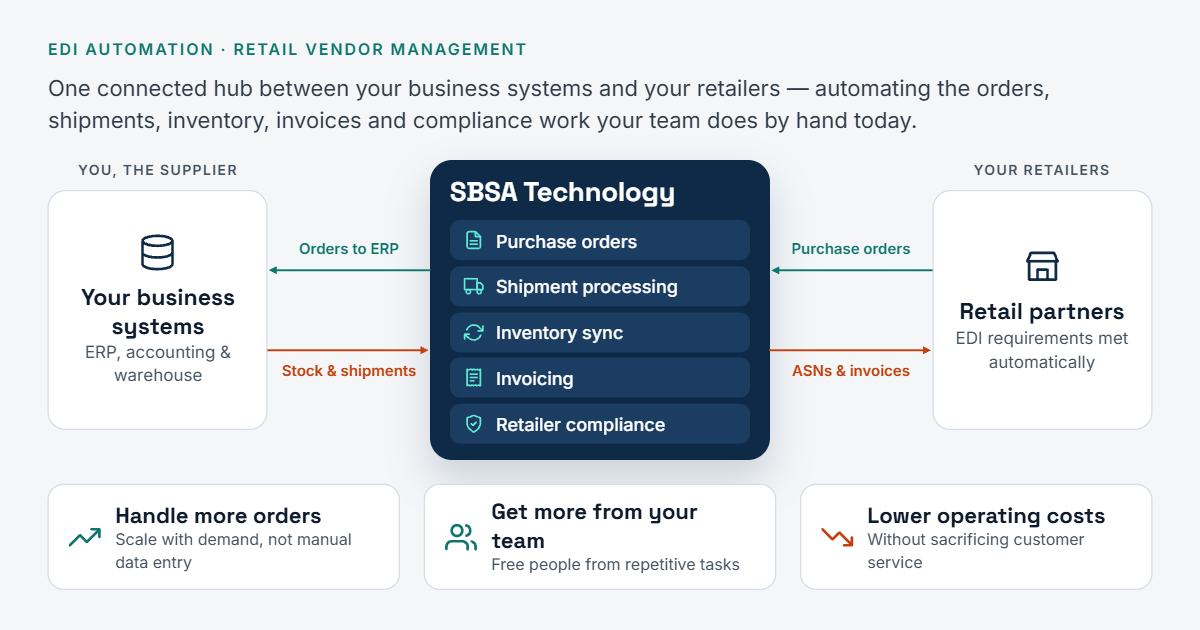 SBSA Technology helps retail suppliers streamline their operations through EDI automation and retail vendor management solutions.
With SBSA Technology, suppliers can automate purchase orders, shipment processing, inventory synchronization, invoicing, and retailer compliance workflows. Its integrations with business systems help reduce repetitive tasks and improve operational visibility.
By automating essential processes, suppliers can handle higher order volumes, make better use of existing resources, and reduce unnecessary operational expenses without sacrificing efficiency or customer service.
Final Thoughts
Peak season demand does not have to mean higher operational costs. By automating business processes, improving inventory visibility, and streamlining fulfillment operations, retail suppliers can manage increased orders more efficiently.
Investing in the right automation solutions helps businesses prepare for seasonal demand, maintain retailer compliance, and support long-term growth without constantly expanding their workforce.
Looking to automate your EDI transactions? Contact SBSA Technology to learn how our EDI solutions can support your business.
- Book a demo: sbsatech.com/consultancy
- Talk to the team: sbsatech.com/contact
- Explore the platform: sbsatech.com
- More insights: sbsatech.com/blog