
EDI in Plain Terms
EDI replaces paper and email-based business documents with structured electronic ones. Instead of PacSun emailing you a PDF purchase order and your team re-keying it into your ERP, both companies' systems exchange the same data in a standardized format, automatically and without manual entry.
For a specialty retailer like PacSun, which runs hundreds of stores alongside a fast-moving e-commerce business, EDI keeps orders, shipments, and payments moving on schedule. It reduces data-entry errors, shortens the order-to-cash cycle, and gives both sides clear visibility into what's been ordered, shipped, and billed. Companies that exchange documents this way are called trading partners.
Why PacSun Requires It
PacSun's assortment is trend-driven and seasonal. Styles turn over quickly, drops are time-sensitive, and product has to hit distribution centers and stores ready for the floor. Manual order handling can't keep pace with that. PacSun relies on EDI because it:
- Keeps order and shipment data accurate between PacSun's systems and yours
- Eliminates re-keying errors that lead to wrong quantities, sizes, or colors
- Gives PacSun's buyers and DC teams advance visibility into incoming freight
- Supports sell-through tracking so replenishment decisions are based on real data
- Reduces compliance issues like ASN mismatches and late deliveries that trigger chargebacks
How PacSun and Its Suppliers Connect
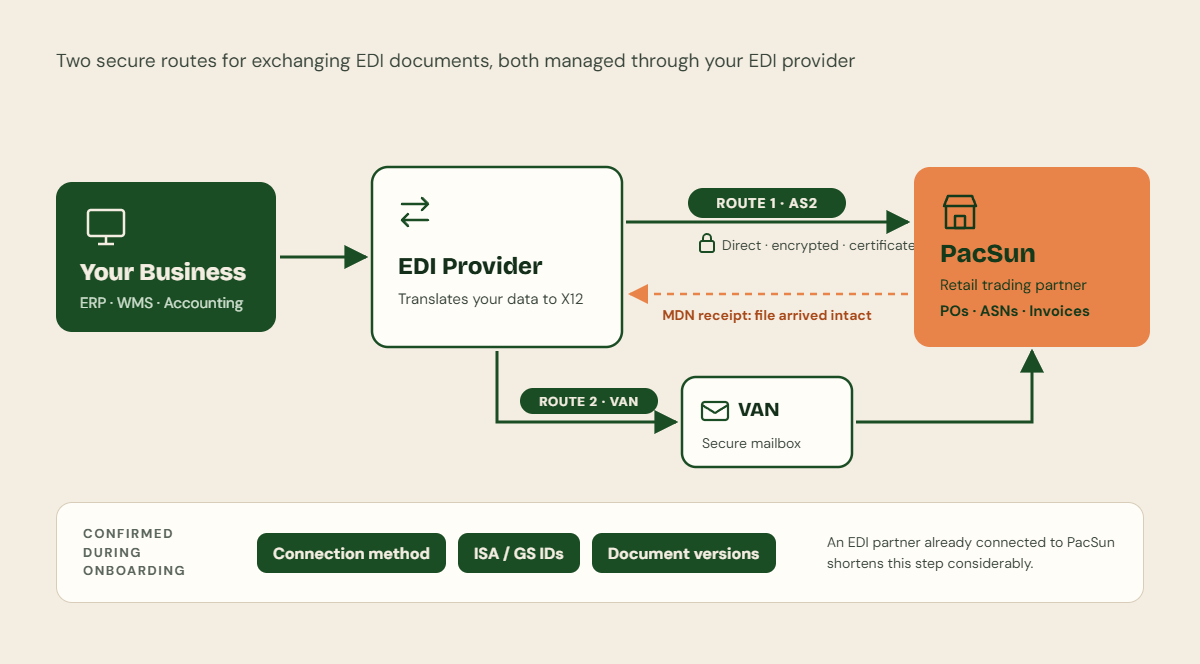 PacSun suppliers typically connect through an EDI provider using a secure communication method such as AS2 or a VAN (Value Added Network). AS2 transmits documents directly and securely over the internet using encryption and digital certificates, with MDNs (Message Disposition Notifications) confirming each file arrived intact. A VAN acts as a secure mailbox service between you and PacSun.
Your exact connection method, identifiers (ISA/GS IDs), and document versions are confirmed during onboarding. Working with an established EDI partner that already connects to PacSun shortens this step considerably.
Which EDI Formats Does PacSun Use?
PacSun trades using ANSI ASC X12, the standard used across North American retail. Like most apparel and department-store retailers, its documents follow retail industry conventions (often called VICS), which govern how orders, ship notices, and invoices are structured for general merchandise.
For apparel suppliers, the details matter. Your item data must carry accurate UPCs down to the size and color level, because PacSun's orders, ASNs, and invoices all reference products at the SKU level. A style that's correct in your ERP but missing a size-level UPC will cause problems across every document downstream.
The Two Building Blocks of EDI: Translation and Transmission
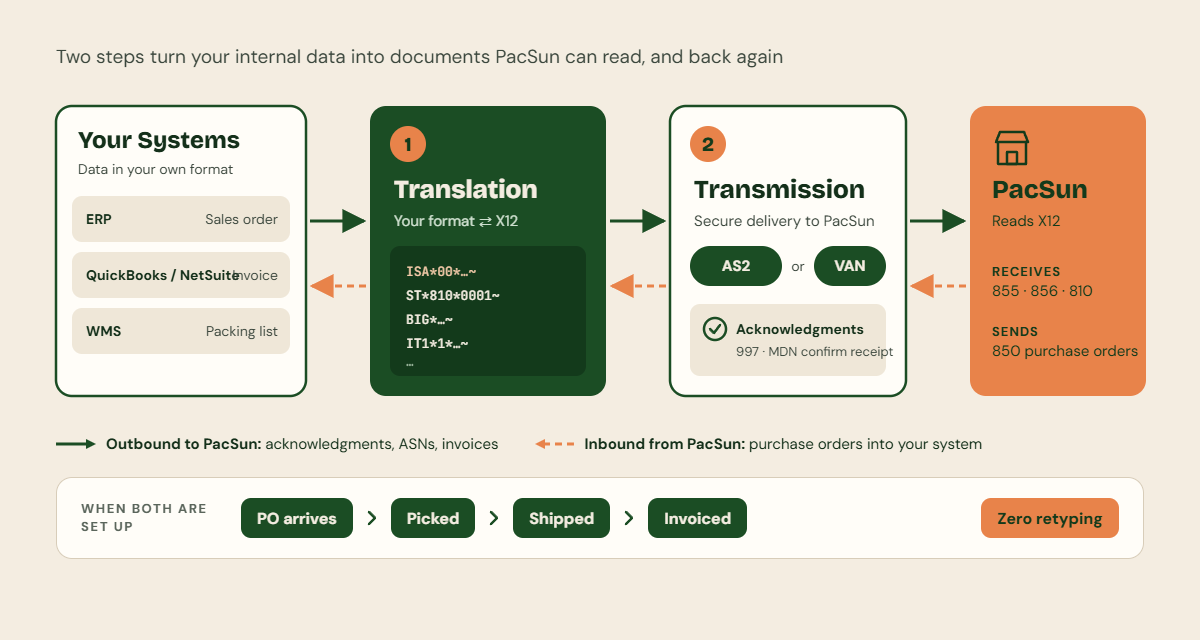 Translation converts your internal data (a sales order in your ERP, an invoice in QuickBooks or NetSuite, a packing list from your WMS) into the X12 format PacSun expects. It works in reverse too, turning PacSun's inbound purchase orders into orders your system can read.
Transmission securely delivers those translated documents between you and PacSun over AS2 or a VAN, with acknowledgments confirming receipt.
When both are set up correctly, a PacSun PO can flow into your system, get picked and shipped, and be invoiced without anyone retyping a single line.
Step-by-Step: Becoming an EDI-Ready PacSun Supplier
1. Get your vendor setup confirmed. Before EDI work begins, make sure your vendor account is established with PacSun and you have access to their vendor requirements, including the EDI specifications, routing guide, and ticketing and labeling standards.
2. Clean up your item data. Confirm every style, color, and size has a valid GS1 UPC and that product details match what PacSun's buyer has on file. Item data errors are one of the most common causes of EDI failures during testing.
3. Choose your EDI solution and connection method. Select an EDI platform that supports PacSun's document set and connect via AS2 or VAN. Share your identifiers and connection details with PacSun's EDI team.
4. Map your documents to PacSun's specifications. Each retailer has its own implementation guidelines for required segments and fields. Your 850, 855, 856, and 810 need to be mapped to PacSun's version, not a generic template.
5. Complete testing. PacSun will validate test documents before approving you for production. Expect back-and-forth on formatting, identifiers, and ASN structure. The ASN is usually where most corrections happen.
6. Set up GS1-128 carton labels. Each carton needs a GS1-128 (UCC-128) label with a unique SSCC-18 that matches the carton-level detail in your ASN. If the label and ASN don't match, receiving at the DC breaks down.
7. Go live and monitor. Once approved, send acknowledgments promptly, transmit ASNs on time, and watch for rejected documents or chargeback notices so you can correct issues before they repeat.
The EDI Documents You'll Actually Use
The exact set can vary by program, so confirm your required list with PacSun during onboarding. These are the documents most commonly associated with PacSun suppliers:
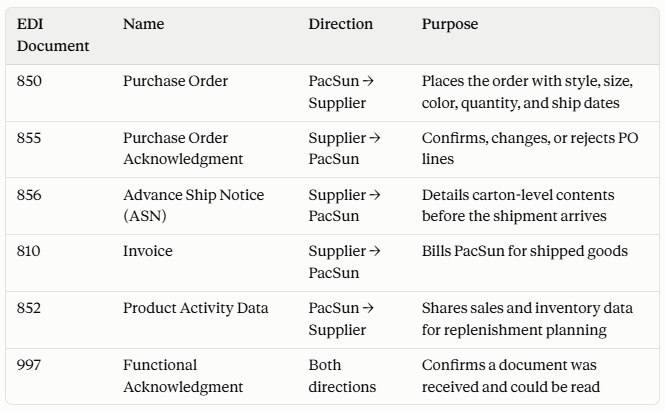
Depending on your relationship, you may also exchange an 846 (Inventory Inquiry/Advice), 832 (Price/Sales Catalog), or 870 (Order Status Report).
Beyond EDI: Apparel-Specific Compliance
PacSun compliance doesn't stop at the documents. Apparel suppliers also need to meet requirements for price ticketing, size stickers, hanger-ready preparation, folding and packing standards, and on-time delivery. Common chargeback triggers include ticketing errors, hanger issues, late shipments, and ASN failures. Your EDI system and your warehouse process need to work together so that what's in the ASN, on the label, and inside the carton all match.
A Note on PacSun Dropship
Beyond its wholesale program, PacSun has used dropship to test new brands without holding inventory. Dropship suppliers ship directly to PacSun's customers, so the requirements shift toward inventory feeds, order routing, and shipment confirmations with tracking. If you're entering through dropship, confirm which platform and data format your program uses, since it may differ from the traditional EDI flow.
Choosing the Right EDI Translation Approach
Whether you use a web-based EDI portal or a fully integrated solution connected to your ERP, the goal is the same: accurate, on-time documents that match PacSun's specifications. For growing brands, integration matters most. When your EDI platform connects directly to your ERP, WMS, and shipping tools, POs create sales orders automatically, ASNs and labels are generated from actual pack data, and invoices go out without manual entry.
How SBSA Technology Can Help
Getting PacSun-ready means coordinating item data, document mapping, connectivity, labeling, and testing, often while you're also preparing product for your first ship window. SBSA Technology helps apparel and lifestyle brands set up their PacSun EDI integration end to end, from AS2 or VAN connectivity and document mapping through testing, GS1-128 label generation, and ERP integration with platforms like QuickBooks and NetSuite. The result is a setup where POs, ASNs, and invoices flow automatically, and compliance issues are caught before they become chargebacks.
Frequently Asked Questions
Does PacSun require EDI from its suppliers?
Yes. Wholesale suppliers are expected to exchange core documents like purchase orders, ship notices, and invoices electronically. Confirm your specific requirements with PacSun during vendor setup.
Which EDI documents does PacSun use?
The core set typically includes the 850, 855, 856, 810, and 852, along with 997 functional acknowledgments. Some suppliers may also exchange the 846, 832, or 870.
How long does PacSun EDI onboarding take?
It depends on how ready your item data and systems are. With an experienced EDI provider and clean data, setup and testing can move quickly. Starting early is important so testing doesn't push back your first ship date.
Do I need a specific EDI software vendor?
No particular vendor is required. You need a solution that produces documents matching PacSun's X12 specifications and connects through a supported communication method.
What causes the most PacSun compliance issues?
ASN errors, labels that don't match ASN data, ticketing mistakes, and late deliveries are among the most common. Most of these can be prevented by integrating your EDI with your warehouse and shipping process.
Conclusion
PacSun's customers expect the latest styles on the floor and online right when they drop, and PacSun's supply chain is built to deliver that. Your EDI setup is what connects your brand to that system. Take the time to clean up item data, map documents to PacSun's specs, and align your labels with your ASNs, and your orders will move from PO to payment without constant manual intervention.
Connect with SBSA Technology
Preparing to sell into PacSun, or need a second look at your current EDI setup? SBSA Technology works with apparel brands, retail suppliers, distributors, e-commerce brands, and 3PL providers to automate EDI, order processing, and retailer compliance.
- Book a demo: sbsatech.com/consultancy
- Talk to the team: sbsatech.com/contact
- Explore the platform: sbsatech.com
- More insights: sbsatech.com/blog