
The Challenge
For many growing manufacturers, distributors, wholesalers, and retail vendors, inventory management begins with spreadsheets.
While spreadsheets can work for a small operation, they become increasingly difficult to manage as order volume grows and businesses begin selling through multiple retail channels. Inventory information may be stored in separate spreadsheets, ERP systems, warehouse platforms, e-commerce platforms, and retailer portals.
This creates a common problem: the inventory available in one system may not match what is actually available in another.
A retailer may see outdated inventory levels, while the vendor's warehouse has already received new stock. At the same time, orders may continue arriving through EDI, creating additional manual work for the operations team.
The result can include:
- Overselling and stockouts
- Manual inventory updates
- Inaccurate available-to-sell quantities
- Delayed retailer updates
- Increased order-processing workload
- Poor visibility across sales channels
- Customer-service issues
- Compliance and fulfillment problems
The business needed a more reliable way to keep inventory synchronized across its retail ecosystem.
The Solution
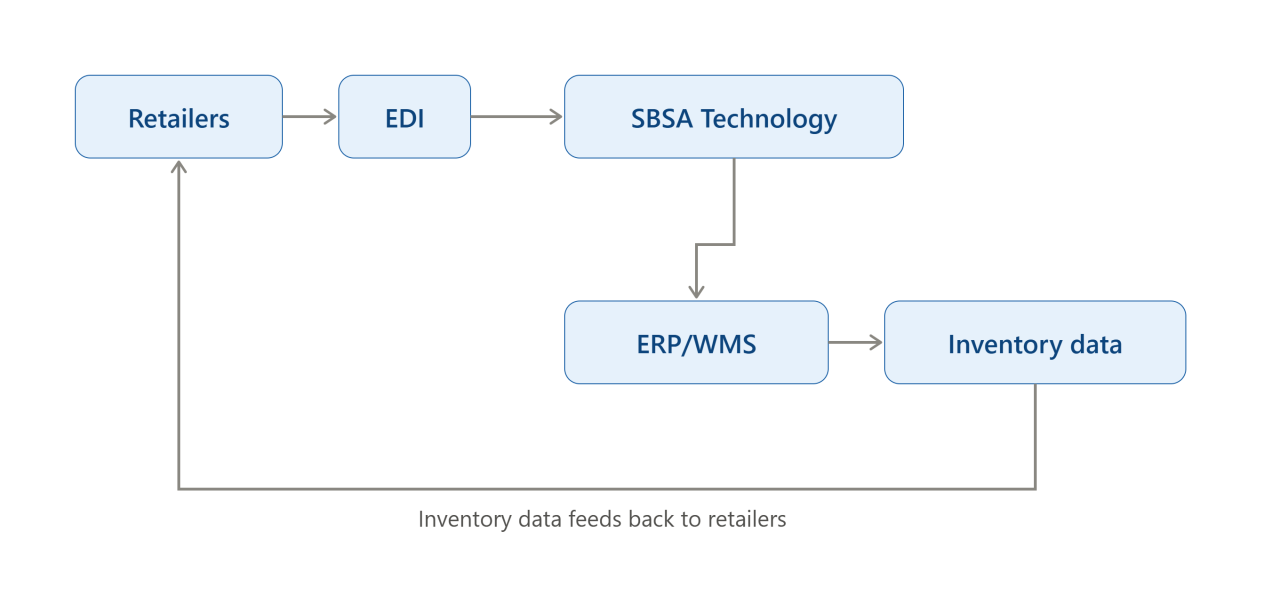
SBSA Technology replaced the spreadsheet-driven inventory process with an automated retail inventory synchronization workflow.
Instead of relying on employees to manually update and distribute inventory information, SBSA connects the systems involved in the order and fulfillment process and automates the movement of inventory data.
The workflow can connect:
Retailers → EDI → SBSA Technology → ERP/WMS → Inventory Data
and synchronize updated inventory information back to the appropriate retail channels.
SBSA's platform can integrate retail EDI transactions with business systems and automate the processes surrounding orders, inventory, shipping, invoicing, and fulfillment.
This creates a centralized workflow where inventory information can move between systems with significantly less manual intervention.
How the Automated Workflow Works
1. Retail Orders Enter the System
Purchase orders and other retail transactions are received electronically through EDI.
Instead of employees manually monitoring retailer portals and entering orders into spreadsheets, SBSA automatically processes the incoming transactions.
2. Inventory Is Connected to the Business System
SBSA integrates with the vendor's ERP, warehouse, or other inventory-management systems to access current inventory information.
This creates a more reliable source of inventory data than maintaining separate spreadsheets.
3. Inventory Data Is Synchronized
Inventory quantities can be automatically exchanged between connected systems according to the vendor's workflow and retailer requirements.
When inventory changes because of sales, shipments, receipts, or other transactions, the updated information can flow through the integration rather than requiring employees to manually update multiple spreadsheets.
4. Retailers Receive Updated Information
The appropriate inventory information can then be transmitted to retail partners through the required integration or EDI workflow.
This helps retailers work with more accurate inventory information and gives vendors greater visibility into what is being communicated to their trading partners.
5. Fulfillment and Invoicing Continue Automatically
Inventory synchronization becomes part of a broader automated retail workflow.
Orders can progress through acknowledgment, fulfillment, shipment/ASN processing, and invoicing without requiring employees to repeatedly re-enter the same information across different systems.
Before SBSA Technology
Manual Spreadsheet-Based Process
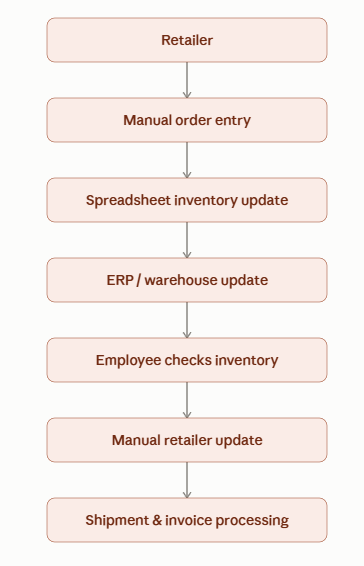
Common Problems
- Multiple versions of inventory data
- Manual data entry
- Delayed updates
- Higher risk of human error
- Limited real-time visibility
- Increased administrative workload
After SBSA Technology
Automated Inventory Synchronization
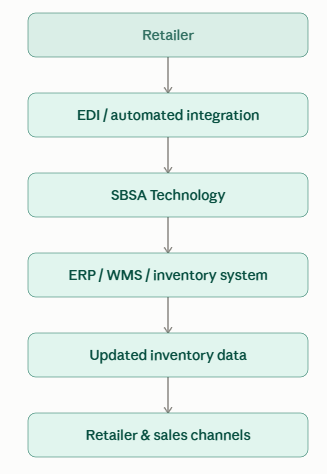
At the same time, order, shipment, ASN, and invoice information can continue moving through the connected retail workflow.
The Business Impact
By moving away from spreadsheet-dependent inventory management, the vendor can establish a more scalable and connected operational process.
Greater Inventory Visibility
Teams can access inventory information from connected systems rather than relying on multiple manually maintained spreadsheets.
Less Manual Work
Employees spend less time copying inventory quantities, updating spreadsheets, and entering the same information into multiple platforms.
Reduced Risk of Inventory Errors
Automation reduces the opportunities for incorrect quantities, outdated spreadsheets, and duplicate data entry.
Faster Retail Updates
Inventory information can move through automated integrations instead of waiting for employees to complete manual updates.
Better Retail Fulfillment
Accurate inventory information supports better order planning and helps vendors respond to retailer demand more effectively.
Scalable Operations
As order volume and the number of retail trading partners increase, automation provides a stronger foundation than adding more manual spreadsheet processes.
Why Automation Matters
Spreadsheets are useful tools, but they were not designed to serve as the central system for complex, multi-channel retail operations.
When inventory data must be updated across retailers, ERP systems, warehouses, and e-commerce channels, manual processes can quickly become a bottleneck.
SBSA Technology helps turn disconnected inventory processes into an automated flow of information.
Is Your Business Still Managing Retail Operations with Spreadsheets?
If your team is spending hours:
- Updating inventory spreadsheets
- Entering retailer orders manually
- Moving data between systems
- Creating shipping documents
- Reconciling inventory
- Managing retailer compliance
- Fixing EDI errors
…it may be time to automate.
SBSA Technology can help connect the systems behind your retail business.
Retail EDI. Order Processing. Inventory Synchronization. Fulfillment. Invoicing. Retail Compliance.