
As retail businesses grow, managing purchase orders, shipments, inventory, and invoices manually can quickly become a major operational bottleneck.
One growing retail supplier was experiencing exactly this challenge. Retail purchase orders were arriving through EDI, but employees still had to manually review orders, enter information into their business system, prepare shipment documentation, and make sure invoices were sent correctly.
The company needed a way to connect its retailer transactions directly with its existing ERP/WMS workflow without replacing the systems its team already depended on.
SBSA Technology implemented an automated EDI-to-ERP/WMS workflow that connected incoming retailer orders with fulfillment operations and automated the critical documents generated throughout the order-to-cash process.
The result was a more connected operation with less manual data entry, faster order processing, improved visibility, and fewer opportunities for costly fulfillment and compliance errors.
The Challenge: Too Many Manual Steps
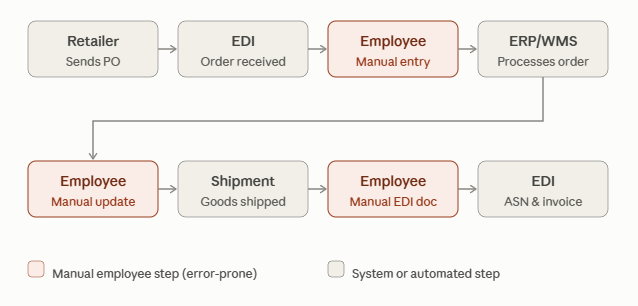
The supplier was already using an ERP/WMS environment to manage its daily operations.
However, the systems were not fully connected to its retailer EDI workflow.
The process looked something like this:
Retailer → EDI → Employee → ERP/WMS → Employee → Shipment → Employee → EDI
Every additional manual step created another opportunity for:
- Data-entry mistakes
- Delayed order processing
- Incorrect quantities
- Missing shipment information
- Delayed ASNs
- Invoice discrepancies
- Retailer compliance issues
- Unnecessary administrative work
As order volume increased, the company realized that its existing process would become increasingly difficult to scale.
The problem was not simply EDI.
The bigger problem was the gap between EDI and operations.
The Turning Point
The company needed more than an EDI provider that could simply transmit documents.
It needed the retailer's information to move automatically into the systems its employees were already using.
The goal was straightforward:
When a retailer sends an order, the business should not have to re-enter that order manually.
SBSA Technology designed an automated workflow that connected the retailer's EDI transactions with the company's ERP/WMS environment.
The SBSA Technology Solution
SBSA connected the supplier's retail EDI environment with its operational systems.
The new workflow was structured around the complete order lifecycle.
Step 1: Retailer Sends the Purchase Order
The retailer sends an EDI 850 Purchase Order.
SBSA receives the transaction through the appropriate EDI communication channel, validates the document, and translates the information into the supplier's operational format.
Step 2: Purchase Order Enters the ERP/WMS
Instead of an employee manually creating the order, SBSA automatically transfers the order information into the connected ERP/WMS system.
Customer information, products, quantities, shipping details, and other required information can be mapped according to the supplier's workflow.
This eliminates the need to repeatedly copy information from one system into another.
Step 3: The Warehouse Processes the Order
The warehouse team continues using its existing operational workflow.
Employees can pick, pack, and prepare the order without having to manually create separate EDI documents.
The technology works behind the scenes while the warehouse continues doing what it already does best: fulfilling orders.
Step 4: Shipment Information Triggers the ASN
Once the shipment information becomes available, SBSA can use the fulfillment data to generate the required EDI 856 Advance Ship Notice.
Instead of creating an ASN manually, shipment information is transferred automatically into the retailer's required format.
This helps reduce delays and data discrepancies.
Step 5: Invoice Is Generated Automatically
After shipment, SBSA can generate the appropriate invoice transaction using the available order and shipment information.
The EDI 810 Invoice is then transmitted to the retailer according to its requirements.
The process becomes:
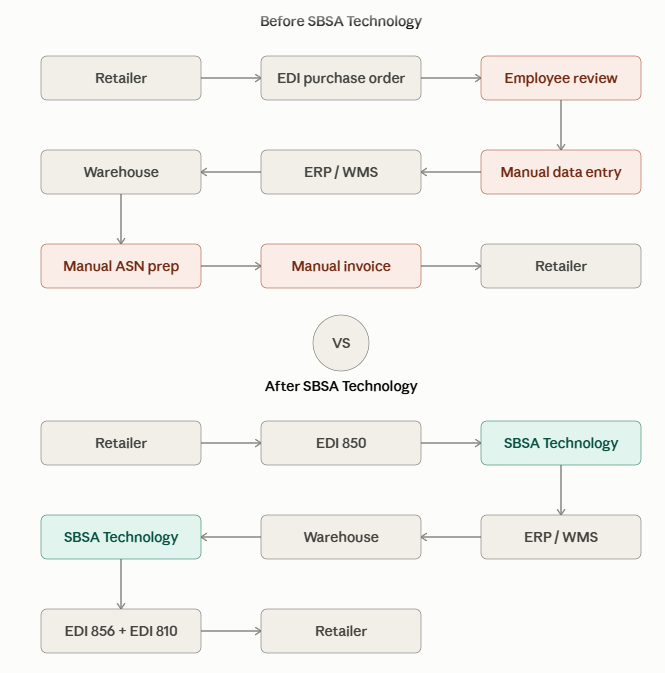
Order → Fulfillment → Shipment → ASN → Invoice
without requiring employees to repeatedly move information between disconnected systems.
Before SBSA Technology and After SBSA Technology
Manual Retail Order Workflow vs Automated Retail Order Workflow
Operational Improvements
The implementation helped transform the supplier's workflow from a collection of manual tasks into a connected retail operations process.
1. Less Manual Data Entry
Employees no longer need to repeatedly re-enter information from retailer purchase orders into internal systems.
2. Faster Order Processing
Orders can move from retailer receipt to internal processing without waiting for someone to manually create the next transaction.
3. Better Data Accuracy
Automated data mapping reduces the risk of employees entering incorrect quantities, customer information, product information, or shipment details.
4. Faster ASN Processing
Shipment information can flow directly into the EDI workflow, helping the supplier meet retailer requirements more consistently.
5. More Reliable Invoicing
Invoices are generated from connected operational information instead of relying on separate manual processes.
6. Improved Visibility
The supplier gains a clearer view of the status of its EDI transactions and order workflow.
The Business Impact
The most important improvement was not simply reducing the number of clicks employees had to make.
The company created a more scalable operating model.
Before automation, increasing order volume meant increasing administrative work.
After automation, the company could process additional orders without increasing manual EDI work at the same rate.
This created an important advantage:
Growth no longer had to mean more repetitive administrative work.
Why This Matters for Retail Vendors
Many retail vendors think of EDI as a document-exchange requirement.
But EDI becomes much more valuable when it is connected directly to the systems responsible for inventory, fulfillment, shipping, and accounting.
A retailer does not simply send an 850.
That purchase order starts an operational chain:
Purchase Order → Order Processing → Inventory → Picking → Packing → Shipping → ASN → Invoice
If those systems are disconnected, employees become the integration layer.
That creates unnecessary cost and risk.
SBSA Technology helps eliminate that gap by connecting EDI with the operational systems that retailers and suppliers already depend on.
Could Your Retail Operation Be Automated?
If your team is currently:
- Manually entering retailer purchase orders
- Copying orders into an ERP or WMS
- Creating ASNs manually
- Entering shipment information into multiple systems
- Preparing retailer invoices separately
- Updating inventory manually
- Checking EDI transactions one by one
there may be an opportunity to automate your workflow.
SBSA Technology can help connect your retailer EDI transactions with your ERP, WMS, fulfillment, inventory, and invoicing processes.
The goal is simple:
Receive the order once. Process it automatically. Ship it accurately. Send the required documents on time.
That's what modern retail automation should look like.
Retail vendors don't need more disconnected systems.
They need their systems to work together.
By connecting EDI with ERP/WMS and fulfillment operations, SBSA Technology helps transform retail transactions from manual administrative tasks into an automated operational workflow.
For growing suppliers, this can mean fewer manual processes, better accuracy, faster fulfillment, improved retailer compliance, and a platform that can scale with the business.
SBSA Technology — Connecting EDI, ERP, WMS, fulfillment, and retail operations into one connected workflow.