
EDI in Plain Terms
EDI (Electronic Data Interchange) is the electronic replacement for paper business documents. Instead of emailing a PDF purchase order or re-keying an invoice into a portal, EDI lets your ERP or order system exchange the same information with Northern Tool's systems automatically, in a structured, standardized format.
For a multi-channel retailer, EDI connects buying, receiving, fulfillment, and accounts payable. It removes manual entry, cuts mismatched data, speeds up the order-to-cash cycle, and gives both sides real-time visibility into what's moving. Companies that set up this kind of ongoing exchange are called trading partners.
Why Northern Tool Requires It
Northern Tool has been building its vendor EDI program for a long time. Back in 2005, the company announced plans to electronically integrate more than 700 suppliers using SPS Commerce's Community Enablement service, connecting them to its internal Oracle (formerly JD Edwards) systems. The goal was better control and visibility of incoming orders and strong customer service on drop-ship orders.
Its network has grown since then. In 2023, Northern Tool opened a shared fulfillment center in Las Vegas with third-party logistics provider Stord to cut shipping costs and delivery times for customers in the western U.S. More locations and fulfillment paths make accurate, automated data exchange even more important. For vendors, EDI compliance:
- Keeps purchase orders, shipments, and invoices matched across Northern Tool's store, DC, and e-commerce channels
- Removes manual entry and the errors, delays, and chargebacks that come with it
- Gives Northern Tool timely inventory and shipment visibility so customers see accurate availability
- Builds the operational trust needed to grow your assortment with the retailer
Four Order Models You Need to Support
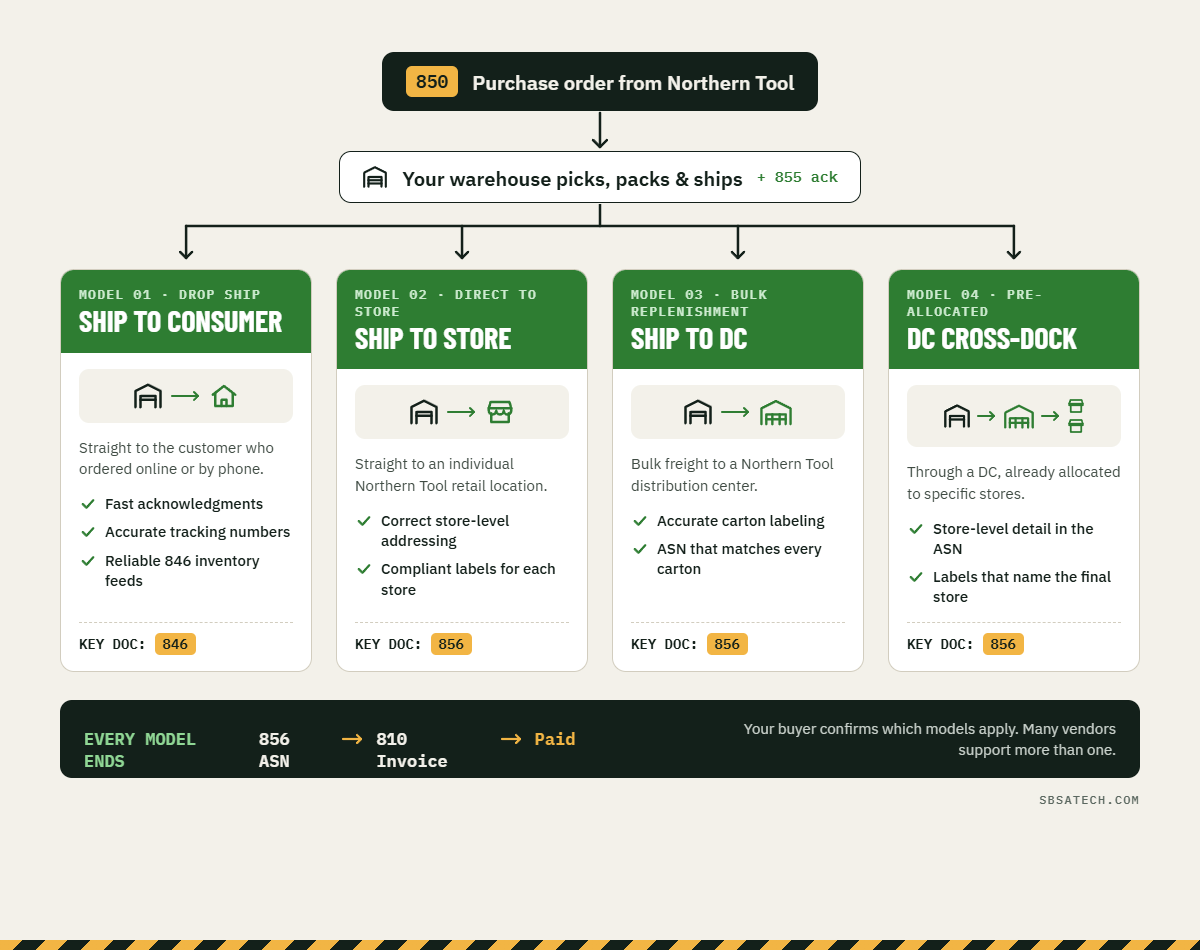 Northern Tool is not a single-channel retailer, and its EDI program reflects that. Its vendor program was built around four order management models: Ship to Consumer, Ship to Store, Ship to DC, and Ship to DC Cross-Dock.
- Ship to Consumer (drop ship): You ship directly to the end customer who ordered online or by phone. These orders need fast acknowledgments, accurate tracking, and reliable inventory feeds.
- Ship to Store: Product goes straight to an individual retail location, so store-level addressing and labeling must be correct.
- Ship to DC: Bulk replenishment to a Northern Tool distribution center, where carton labeling and ASN accuracy drive receiving speed.
- Ship to DC Cross-Dock: Freight arrives at a DC already allocated to specific stores, so your ASN and labels must carry store-level detail through the DC.
Your buyer will confirm which models apply to your program. Many vendors support more than one.
How Northern Tool and Its Vendors Connect
Suppliers usually connect to Northern Tool through an EDI network or VAN, or through a direct internet connection such as AS2. Northern Tool doesn't publicly publish one mandated protocol for all vendors, so confirm the connection method in your onboarding packet. Several EDI providers advertise AS2 support for Northern Tool connections; for example, The EDI Exchange promotes a Northern Tool EDI AS2 solution.
Whatever the connection, it has to be secure, reliable, and monitored. It should include delivery confirmations such as 997 functional acknowledgments or AS2 MDNs, so both sides know each document arrived intact. Vendors also manage parts of the relationship through the NTE Supplier Portal, so make sure the right people on your team have access.
Which EDI Standards Does Northern Tool Use?
Northern Tool's EDI transactions are built on ANSI ASC X12, the standard used by most North American retailers. Publicly available specification guides for Northern Tool's X12 documents note that vendors should contact Northern Tool directly for the official EDI specifications.
Like most retailers, Northern Tool layers its own rules on top of the base X12 standard. These cover which segments are mandatory, which qualifiers it expects, and how items, locations, and order types are identified. A generic X12 map is rarely enough. Your maps need to follow Northern Tool's specific implementation guides.
The Two Building Blocks of EDI: Translation and Transmission
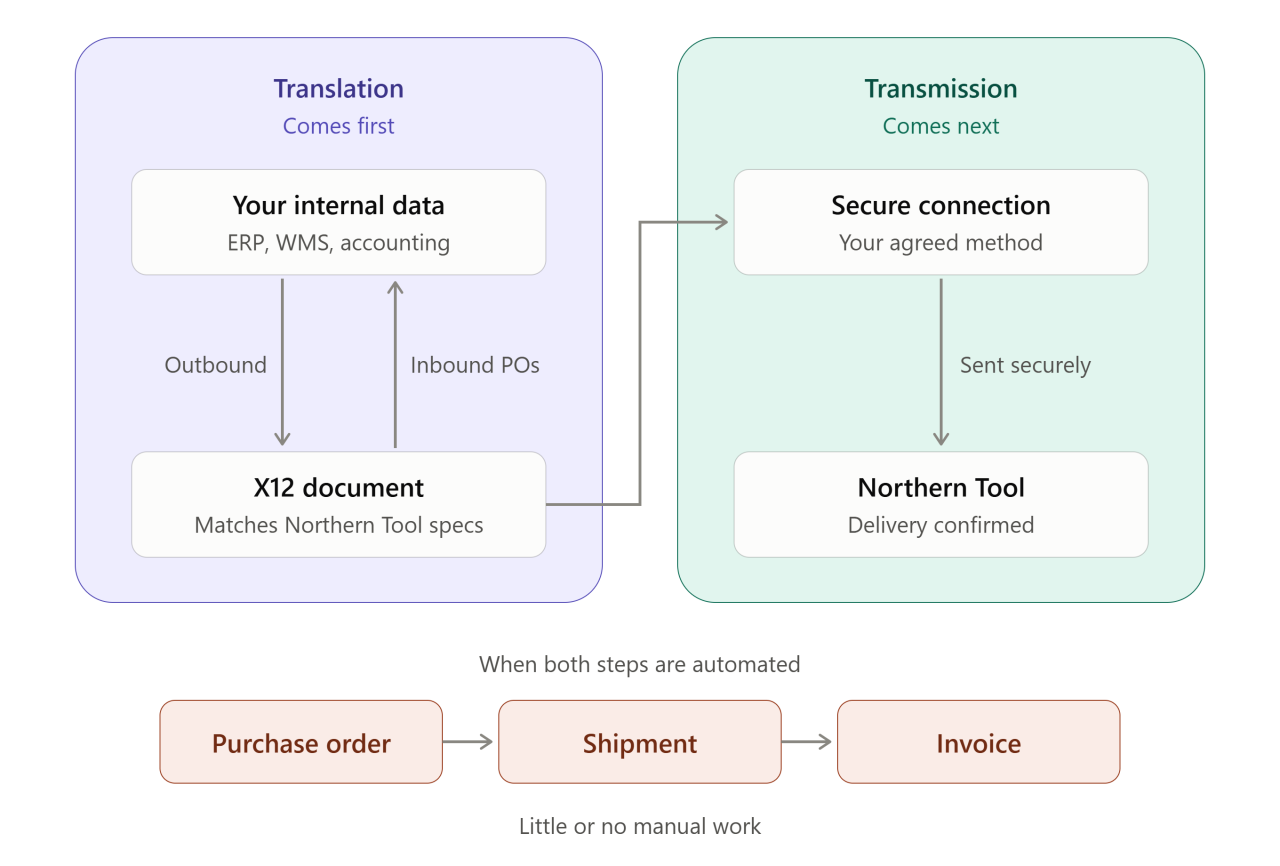
Translation comes first. Your internal purchase orders, shipment records, and invoices, in whatever format your ERP, WMS, or accounting system produces, are converted into X12 documents that match Northern Tool's specifications. Inbound documents such as purchase orders are converted back into a format your system can import.
Transmission comes next. The translated document is sent securely to Northern Tool over your agreed connection method, and delivery is confirmed so nothing gets lost.
When both steps are automated, an order can move from PO to shipment to invoice with little or no manual work.
Step-by-Step: Becoming an EDI-Ready Northern Tool Vendor
1. Confirm your program and order models. Before any technical work, clarify with your Northern Tool buyer whether you'll ship to consumers, stores, DCs, cross-dock, or a mix. This decides which documents, labels, and data you need to support.
2. Get the vendor EDI specifications. Request Northern Tool's current implementation guides, vendor compliance or routing requirements, and label specifications. Treat these as your source of truth, especially for testing timelines, acknowledgment windows, and chargeback policies, which Northern Tool communicates directly to vendors.
3. Set up your connection. Establish connectivity through your EDI provider's network, a VAN, or AS2, and exchange identifiers (ISA/GS IDs) and any certificates needed.
4. Build and map your documents. Map each required transaction to Northern Tool's specs and connect those maps to your ERP, WMS, or accounting system. Work order-type logic into this step, since drop-ship, store, and DC orders often need different data.
5. Prepare your item and label data. Make sure your UPCs, vendor part numbers, and Northern Tool item numbers line up, and that you can produce compliant GS1-128 carton labels where required.
6. Test before going live. Run test documents through Northern Tool's testing process, which your EDI provider can often coordinate. Fix any mapping or data errors, and don't send production documents until you've been approved.
7. Go live and monitor. Once in production, watch acknowledgments, failed documents, and inventory feed timing closely, especially during your first few weeks of orders.
The EDI Documents You'll Actually Use
The exact set depends on your program and order models. Providers that support Northern Tool vendors commonly list these documents: the 850 Purchase Order, 855 Purchase Order Acknowledgment, 860 Purchase Order Change, 865 Purchase Order Change Acknowledgment, 856 Advance Ship Notice, GS1-128 labels, 810 Invoice, 846 Item Inventory, and 997 Functional Acknowledgment.
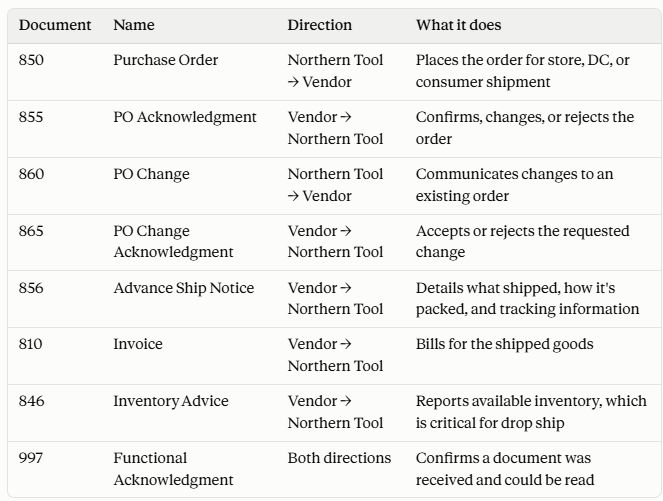
The 846 deserves special attention if you're a drop-ship vendor. It keeps retailers and suppliers current on inventory levels and is required for dropship and direct-to-consumer fulfillment models. It often has to be sent daily or even several times a day. Stale inventory data leads to overselling, cancelled orders, and unhappy customers.
Choosing the Right EDI Translation Approach
Whatever tool you use, its job is the same: turn your internal data into the X12 structure Northern Tool expects, and turn Northern Tool's documents back into data your systems can use. With multiple order models in play, look for a solution that can:
- Tell drop-ship, store, and DC orders apart automatically and route them correctly
- Integrate directly with your ERP, WMS, or accounting platform (for example, QuickBooks or NetSuite) so orders don't need re-keying
- Generate compliant GS1-128 labels and packing slips
- Send 846 inventory updates on a schedule without manual exports
- Alert you to rejected or unacknowledged documents before they turn into chargebacks
The quality of this mapping and automation decides how smoothly orders, shipments, and invoices flow once you're live.
How SBSA Technology Can Help
Supporting Northern Tool's store, DC, cross-dock, and drop-ship models at the same time is where many vendors get stuck. Each model changes what your ASN, labels, and inventory feeds need to contain. SBSA Technology helps vendors plan, map, test, and run their Northern Tool EDI integration from connection setup through go-live. Documents flow directly into your ERP, WMS, or accounting system, so your team isn't re-keying orders or chasing errors.
Frequently Asked Questions
Does Northern Tool require EDI from its vendors? Northern Tool has worked to move its vendor community onto electronic transactions for years, and most vendors are expected to exchange core documents electronically. Your buyer and onboarding packet will confirm the exact requirements for your program.
Which EDI documents matter most? The essentials for most vendors are the 850, 855, 856, 810, and 997. Drop-ship vendors should also plan on the 846 inventory feed, and many vendors need the 860 and 865 for order changes.
Do I need a specific EDI provider? Northern Tool has historically worked with SPS Commerce for vendor enablement, but vendors can generally use any EDI solution that produces compliant X12 documents, connects reliably, and passes Northern Tool's testing. Confirm any provider-specific requirements during onboarding.
What happens if my ASN or labels are wrong? Inaccurate ASNs or non-compliant labels can slow receiving at Northern Tool's DCs and stores and may lead to compliance deductions. Check Northern Tool's vendor compliance guidelines for specific policies.
Conclusion
Northern Tool + Equipment's EDI requirements reflect how it sells: through stores, distribution centers, cross-dock flows, and direct shipments to customers' doors. Vendors who set up their connection, map each order model correctly, and keep inventory and shipment data accurate find that daily orders, shipments, and invoices become largely automatic. Vendors who treat EDI as an afterthought usually find out during their first busy season.
Connect with SBSA Technology
Ready to get compliant with Northern Tool + Equipment, or want a second opinion on your current EDI setup? SBSA Technology works with retail suppliers, distributors, e-commerce brands, and 3PL providers to automate EDI, order processing, and retailer compliance.
- Book a demo: sbsatech.com/consultancy
- Talk to the team: sbsatech.com/contact
- Explore the platform: sbsatech.com
- More insights: sbsatech.com/blog