
At a glance
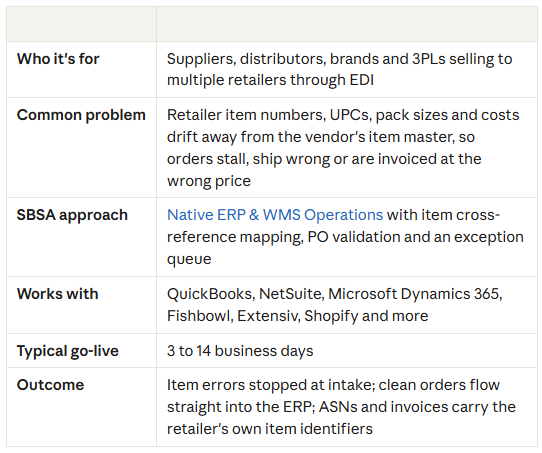
Retail vendors lose orders, margin and retailer trust when the SKU, UPC, pack size or cost on a purchase order does not match their own item master. SBSA Technology closes that gap by validating every EDI 850 line against a per-retailer item cross-reference before the order reaches the ERP or the warehouse.
The challenge: orders that look fine until they fail
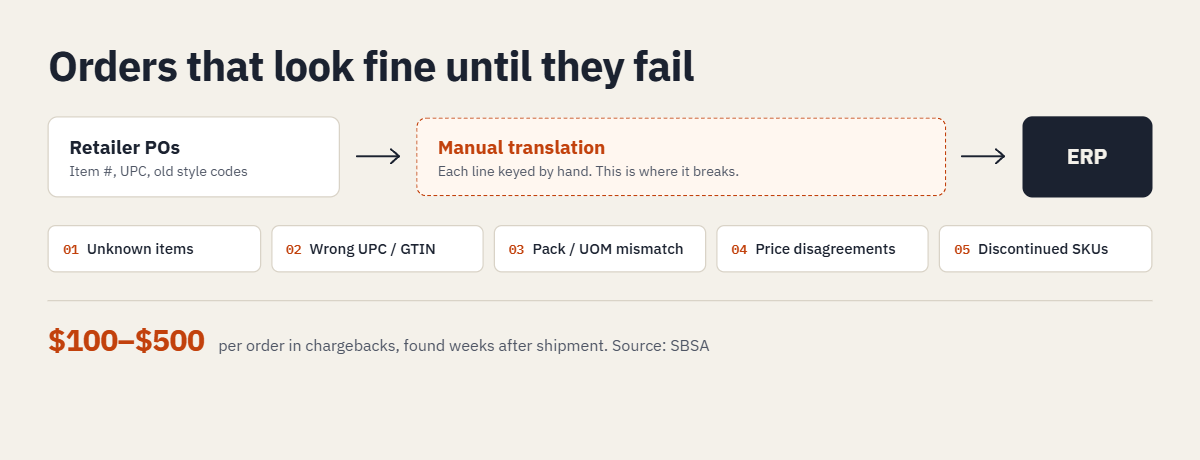
Every retailer describes the same product differently. One sends its own buyer item number, another sends the UPC, a third sends a vendor style code retired two seasons ago. In most vendor operations, someone translates each line by hand before the order can enter the ERP.
That translation step is where things broke:
- Unknown items. A PO line references a retailer item number with no match in the item master, so the order sits in an inbox until someone researches it.
- Wrong UPC or GTIN. A product refresh changes the UPC, but the retailer's catalog still carries the old one. The ASN and carton labels go out with a barcode the retailer's DC cannot receive against.
- Pack and unit-of-measure mismatches. The retailer orders in cases of 12; the item master stocks eaches. Quantities are keyed wrong, creating short or over shipments.
- Price disagreements. The PO cost does not match the vendor's price list, and nobody notices until the 810 invoice is rejected or short-paid.
- Discontinued or substituted SKUs. Orders for retired items are accepted and acknowledged, then cancelled at the last minute.
Each error surfaces late: at the warehouse, at the retailer's receiving dock, or in a deduction weeks after shipment. SBSA notes that a missing or wrong ASN or invoice often costs $100 to $500 per order in chargebacks, with little room to dispute it.
Root cause: no single source of item truth between EDI and the ERP
These errors are rarely typos. They come from a structural gap: product data lives in three places that never check each other.
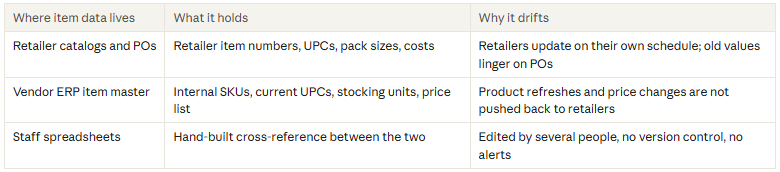
When people act as the integration layer, every new retailer or product change multiplies the chance of a mismatch. The fix is to move the cross-reference inside the EDI workflow and check it automatically on every order.
The SBSA solution: validate every PO line before it becomes an order
SBSA moves the item cross-reference out of spreadsheets and into the EDI workflow itself. Every inbound EDI 850 is checked line by line against the vendor's mapped item data before anything reaches the ERP or the warehouse.
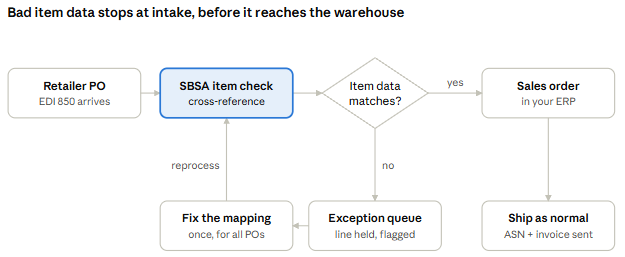
Clean orders pass straight through; only lines with a real problem stop, and each fix improves every future order for that item.
What SBSA put in place
- Per-retailer item cross-reference. Each retailer's item number, UPC or GTIN, case pack and cost is mapped to one internal SKU.
- Line-level PO validation. Unknown items, discontinued SKUs, unit-of-measure conflicts and cost variances are detected on arrival.
- Exception queue with alerts. Problem lines are held and flagged in the SBSA portal so the team fixes them before the 855 acknowledgment goes out.
- Native ERP sync. Validated orders land in the ERP (QuickBooks, NetSuite, Dynamics 365 and others) as native sales orders, with no re-keying.
- Outbound documents from mapped data. The 856 ASN, GS1-128 carton labels and 810 invoice use the retailer's own identifiers, sent automatically when the shipping label is printed.
- Inventory feeds. The EDI 846 sends availability by the retailer's item number, so retailers stop ordering items the supplier cannot ship.
- Specification monitoring. SBSA tracks retailer EDI and routing-guide changes and updates mappings proactively.
Implementation: a managed rollout, live within business days
Most vendors choose SBSA's managed rollout, where an assigned account manager runs the setup and no internal IT team is needed. SBSA's typical window is 3 to 14 business days.
- Questionnaire and discovery. SBSA captures each retailer, its EDI documents and the systems in use.
- Item master audit. Every active SKU is lined up against the item numbers, UPCs and pack sizes found in recent retailer POs. Dead and duplicate records are flagged for cleanup.
- Cross-reference build. One mapping table per retailer: retailer item number to internal SKU, UPC, unit of measure, case pack and agreed cost.
- Validation rules. Rules set what blocks an order (unknown item, discontinued SKU) and what only warns (cost variance, unusual quantity).
- ERP and WMS connection. Validated orders map into the ERP as native sales orders; shipping activity triggers the 856 ASN and 810 invoice.
- Parallel run and training. Live POs run through SBSA while the team checks results, then the spreadsheet process is retired.
- Go-live and 24/7 support. The exception queue becomes part of the daily order routine.
Results: errors caught at intake instead of at the dock
The biggest change was timing. Item problems now appear minutes after a PO arrives, while there is still time to fix them, instead of after the truck has left.
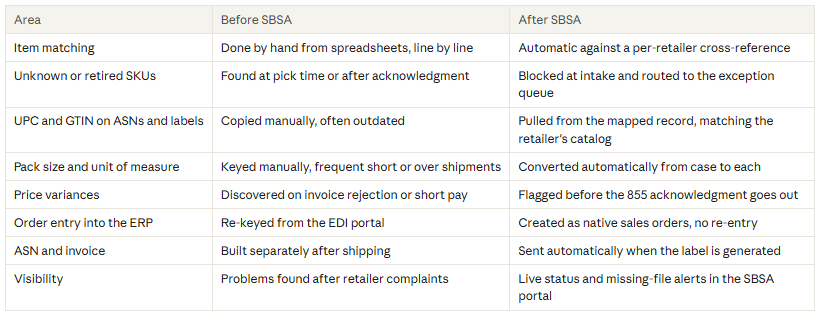
Order teams spend their time on the few exceptions rather than on every line of every order. Adding a retailer or launching a product means updating one cross-reference, not retraining staff on another spreadsheet.
Business impact: clean data became a growth enabler
Without validation, every new retailer means another set of item numbers to memorize and another spreadsheet to maintain. With SBSA, vendors can take on new accounts and new products without adding order-entry headcount at the same rate.
Fix the item once, in one place, and every future order for that item is right.
- Fewer deductions. ASNs, labels and invoices carry the identifiers the retailer expects, removing a common trigger for compliance chargebacks.
- Stronger retailer scorecards. Fewer cancellations, short shipments and receiving exceptions.
- Faster cash. Invoices that match the PO get paid without disputes.
- Audit-ready history. Every transaction is stored for 5 years and searchable by order number, retailer or document type.
Lessons for retail vendors
Most order failures blamed on EDI are really product data failures. Five practices apply to any supplier selling to multiple retailers:
- Validate at the 850, not at the 856. The cheapest moment to catch a bad SKU is before the order is acknowledged.
- Keep one cross-reference per retailer inside the EDI layer. Spreadsheets on shared drives drift; mapped records do not.
- Separate blocking errors from warnings. An unknown item must stop; a small cost variance can be reviewed without holding the order.
- Treat product changes as EDI events. A new UPC, case pack or price should update the cross-reference the same day it changes in the ERP.
- Watch the exception queue daily. A short queue reviewed every morning beats a long list of chargebacks reviewed every month.
Is your item data putting orders at risk? Look for these signs: staff re-keying POs, a cross-reference spreadsheet only one person understands, ASN or barcode rejections at retailer DCs, or invoices short-paid for price differences.
About SBSA Technology
SBSA Technology runs the full retail vendor operation, from order to payment, on one platform. It connects suppliers to 350,000+ trading partners, including Walmart, Costco, Amazon, Target and Home Depot, over AS2, SFTP, VAN and API.
- Native ERP and WMS integration with QuickBooks Online and Enterprise, NetSuite, Microsoft Dynamics 365, Fishbowl, Extensiv, Logiwa, SkuVault, Cin7, Shopify, WooCommerce and BigCommerce.
- Full EDI coverage including 850, 855, 856, 810, 846, 860, 820 and 997, in X12 and EDIFACT.
- Fast implementation in 3 to 14 business days, with an assigned account manager and 24/7 support after launch.
- Recognized on G2 for easiest setup, fastest implementation and best support in EDI. An Intuit Silver Partner.
Stop SKU errors before they become chargebacks.
- Book a demo: sbsatech.com/consultancy
- Talk to the team: sbsatech.com/contact
- Explore the platform: sbsatech.com
- More insights: sbsatech.com/blog