
When businesses exchange electronic documents with retailers, they need to know whether their EDI transactions were successfully received and passed validation. Two important ANSI X12 transaction sets help with this process: EDI 997 and EDI 999.
Although both provide acknowledgment information, they differ in how they report transaction validation results. Understanding these differences helps retail vendors identify errors, correct rejected documents, and maintain reliable EDI operations.
What Is EDI 997?
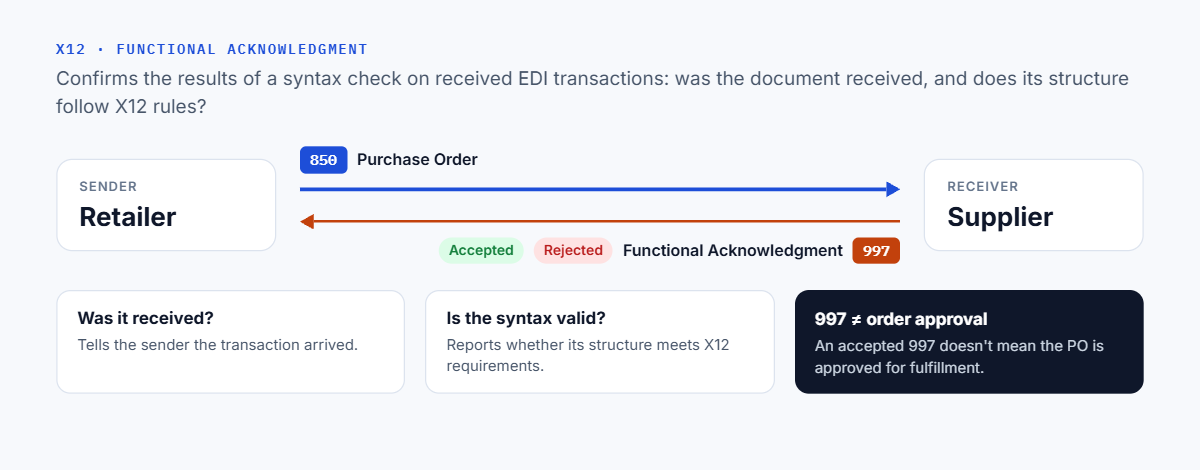 EDI 997, or Functional Acknowledgment, confirms the results of a syntactical review of received EDI transactions.
It helps trading partners determine whether an EDI document was received and whether its structure follows the applicable X12 syntax requirements.
For example, when a retailer sends an EDI 850 Purchase Order, the supplier's system may return a 997 acknowledgment indicating whether the transaction was accepted or rejected.
A successful 997 does not mean the purchase order has been approved for fulfillment. It only reports the applicable EDI acknowledgment results.
What Is EDI 999?
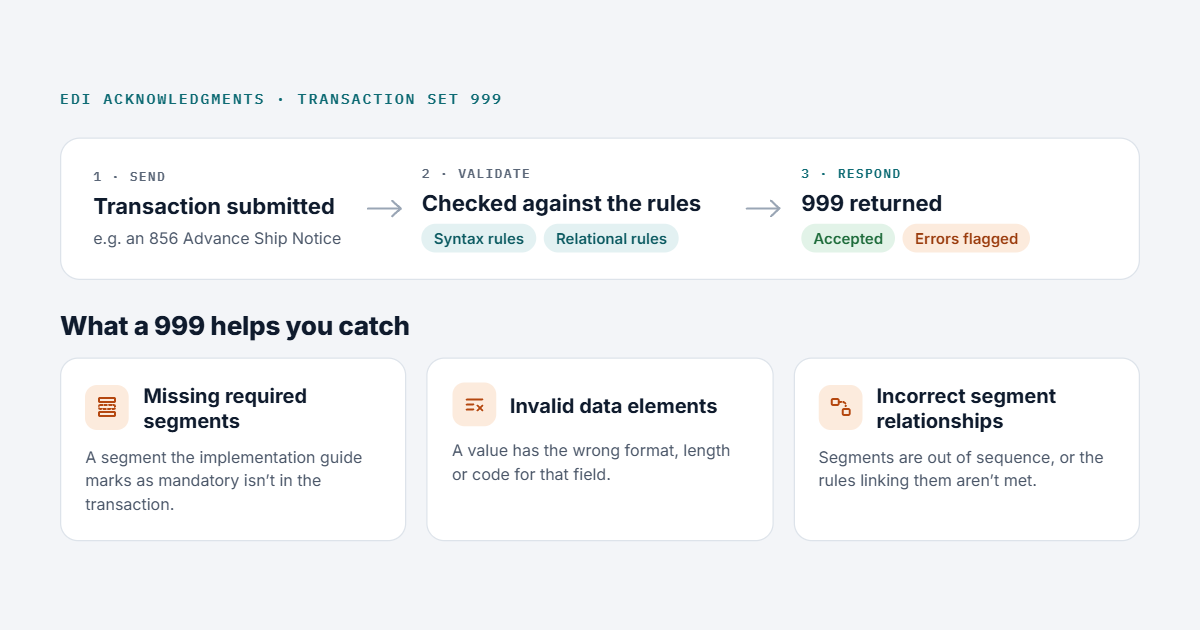 EDI 999, or Implementation Acknowledgment, provides more detailed validation feedback.
It evaluates transactions against applicable EDI implementation requirements, including syntax and relational rules. This helps identify problems such as missing required segments, invalid data elements, and incorrect segment relationships.
For example, if a retailer requires specific information in an EDI 856 Advance Ship Notice, a 999 can help identify whether the submitted transaction meets those requirements.
EDI 997 vs. EDI 999: Key Differences
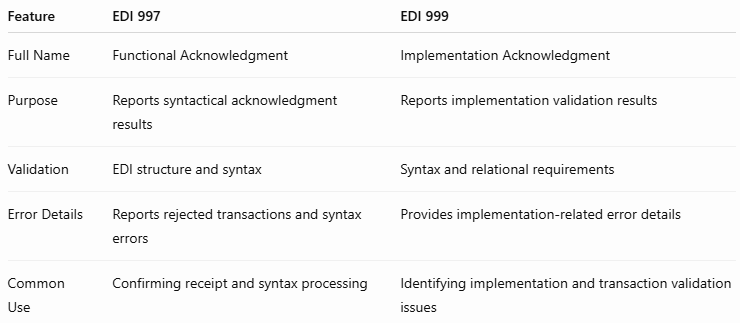
Both acknowledgments help businesses monitor EDI communications, but neither confirms business approval of an order, shipment, or invoice.
Common EDI Errors
Retail vendors may encounter several issues that result in rejected transactions, including:
-
Missing required segments or data elements.
-
Incorrect date and quantity formats.
-
Invalid product or retailer identification codes.
-
Incorrect segment relationships.
-
EDI mapping and configuration errors.
Reviewing 997 and 999 acknowledgments helps businesses identify these problems and determine what needs correction.
How SBSA Technology Can Help
 SBSA Technology helps retail vendors simplify EDI operations through automation and seamless system integration.
With SBSA's EDI solutions, businesses can:
-
Automate EDI acknowledgments: Monitor and process 997 and 999 responses to identify transaction issues.
-
Reduce manual errors: Validate EDI documents and improve data accuracy before transmission.
-
Improve error tracking: Identify rejected transactions and help teams resolve issues faster.
-
Integrate business systems: Connect EDI workflows with ERP, accounting, and warehouse management systems.
-
Streamline retail operations: Automate purchase orders, shipping notices, invoices, and other retailer transactions.
Whether you're working with major retailers or managing multiple trading partners, SBSA Technology helps streamline document exchanges, improve transaction visibility, and reduce manual workloads.
Conclusion
EDI 997 and EDI 999 acknowledgments play important roles in maintaining reliable EDI communications.
While EDI 997 focuses on syntactical acknowledgment, EDI 999 provides additional implementation validation feedback. Understanding how both work helps retail vendors identify transaction errors, improve data accuracy, and maintain compliance with retailer requirements.
Ready to Improve Your EDI Operations?
Contact SBSA Technology to learn how EDI automation can help your business simplify transaction validation, reduce errors, and streamline retailer communications.
- Book a demo: sbsatech.com/consultancy
- Talk to the team: sbsatech.com/contact
- Explore the platform: sbsatech.com
- More insights: sbsatech.com/blog