
Retail vendors, manufacturers, and distributors often work with warehouses and third-party logistics providers (3PLs) to store inventory and fulfill customer orders. Managing these operations manually through spreadsheets, emails, and phone calls can lead to shipping delays, incorrect quantities, and inventory discrepancies.
Electronic Data Interchange (EDI) helps automate communication between vendors and warehouse partners. Two important transactions used in warehouse fulfillment are EDI 940 (Warehouse Shipping Order) and EDI 945 (Warehouse Shipping Advice).
EDI 940 tells the warehouse what to ship, while EDI 945 confirms what was actually shipped. Together, they help businesses improve fulfillment accuracy, inventory visibility, and warehouse efficiency.
What Is EDI 940 (Warehouse Shipping Order)?
EDI 940 is an electronic document that allows a business to send shipping instructions to a warehouse or 3PL provider.
Instead of manually sending order details, the vendor's system generates an EDI 940 containing the information needed to pick, pack, and ship products.
An EDI 940 typically includes:
-
Order and purchase order references
-
Product SKUs and descriptions
-
Requested shipping quantities
-
Ship-to addresses
-
Requested shipping dates
-
Carrier and handling instructions
Once received, the warehouse can import the transaction into its Warehouse Management System (WMS) and begin processing the order.
What Is EDI 945 (Warehouse Shipping Advice)?
EDI 945 is an electronic document sent by the warehouse back to the vendor to confirm that an order has been processed and shipped.
While EDI 940 provides shipping instructions, EDI 945 reports the actual fulfillment results.
An EDI 945 typically contains:
-
Original order reference
-
Products shipped
-
Actual shipped quantities
-
Shipment date
-
Carrier information
-
Tracking numbers, when available
-
Backordered or unshipped quantities, when applicable
The vendor's ERP or order management system can use this information to update fulfillment records, adjust inventory, and track shipment progress.
How EDI 940 and 945 Work Together
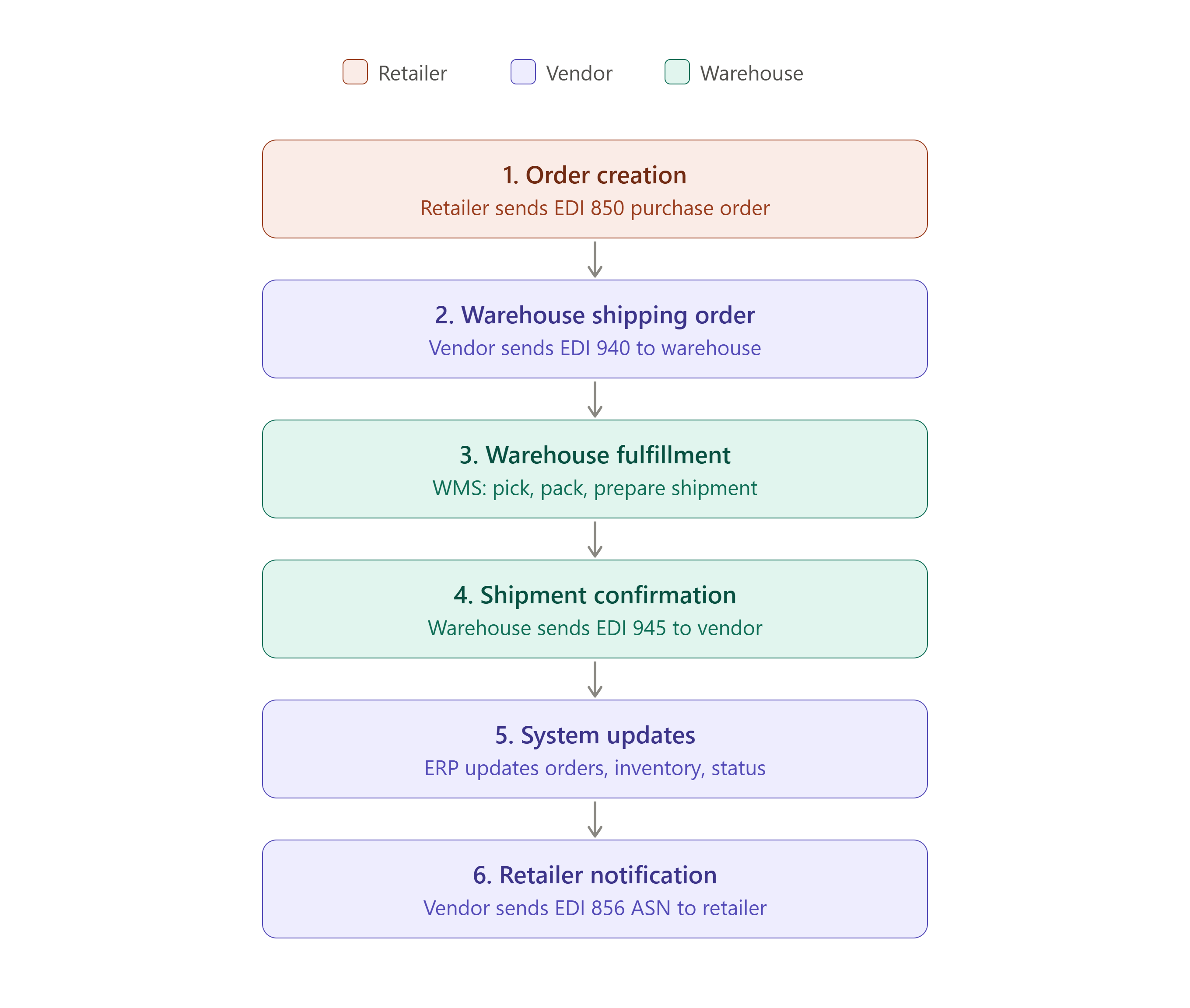
EDI 940 and 945 create an automated communication process between vendors and their warehouse partners.
A typical workflow looks like this:
1. Order Creation: A retailer sends an EDI 850 Purchase Order to the vendor.
2. Warehouse Shipping Order: The vendor generates an EDI 940 containing product details, quantities, and shipping instructions.
3. Warehouse Fulfillment: The warehouse receives the order through its WMS, picks the products, packs them, and prepares the shipment.
4. Shipment Confirmation: After processing the order, the warehouse sends an EDI 945 confirming the products and quantities shipped.
5. System Updates: The vendor's ERP receives the confirmation and updates sales orders, inventory records, and fulfillment status.
6. Retailer Notification: The vendor can use the confirmed shipment information to generate an EDI 856 Advance Ship Notice (ASN) for the retailer.
This workflow reduces manual communication and helps keep warehouse and vendor systems synchronized.
EDI 940 vs. EDI 945: Key Differences
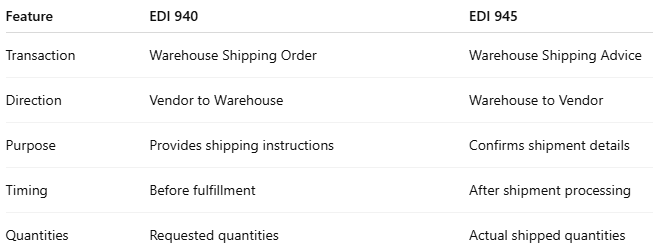
In simple terms, EDI 940 tells the warehouse what to ship, while EDI 945 tells the vendor what was shipped.
Benefits of EDI 940 and 945 for Retail Vendors
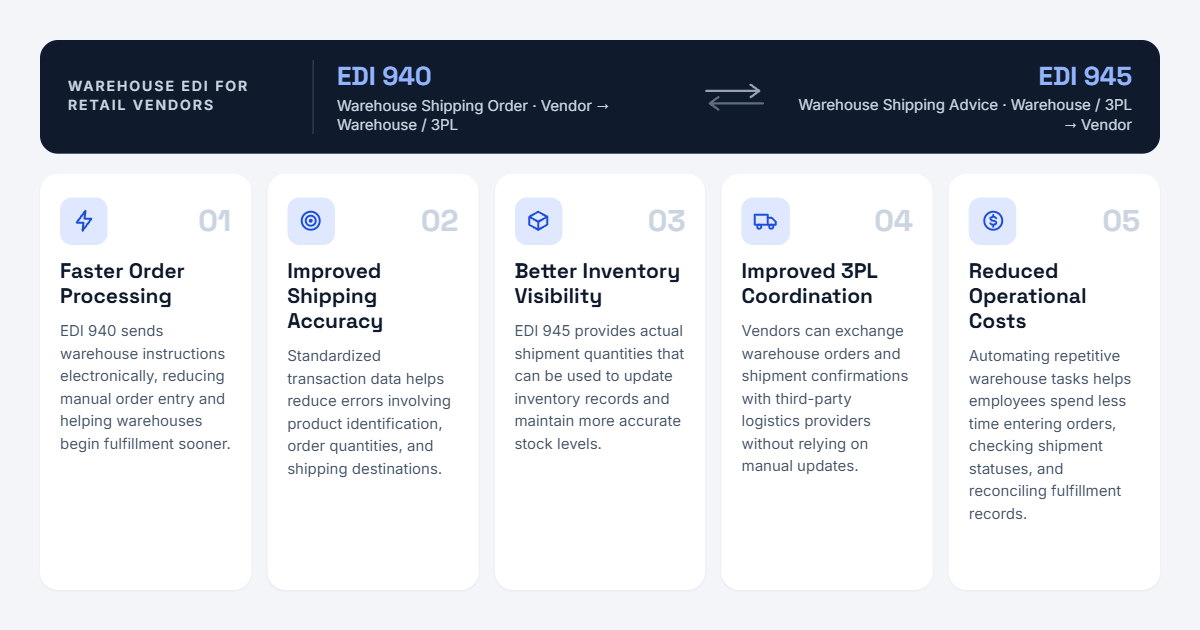 Automating warehouse communication offers several operational advantages:
1. Faster Order Processing
EDI 940 sends warehouse instructions electronically, reducing manual order entry and helping warehouses begin fulfillment sooner.
2. Improved Shipping Accuracy
Standardized transaction data helps reduce errors involving product identification, order quantities, and shipping destinations.
3. Better Inventory Visibility
EDI 945 provides actual shipment quantities that can be used to update inventory records and maintain more accurate stock levels.
4. Improved 3PL Coordination
Vendors can exchange warehouse orders and shipment confirmations with third-party logistics providers without relying on manual updates.
5. Reduced Operational Costs
Automating repetitive warehouse tasks helps employees spend less time entering orders, checking shipment statuses, and reconciling fulfillment records.
How SBSA Technology Helps Automate Warehouse EDI Operations
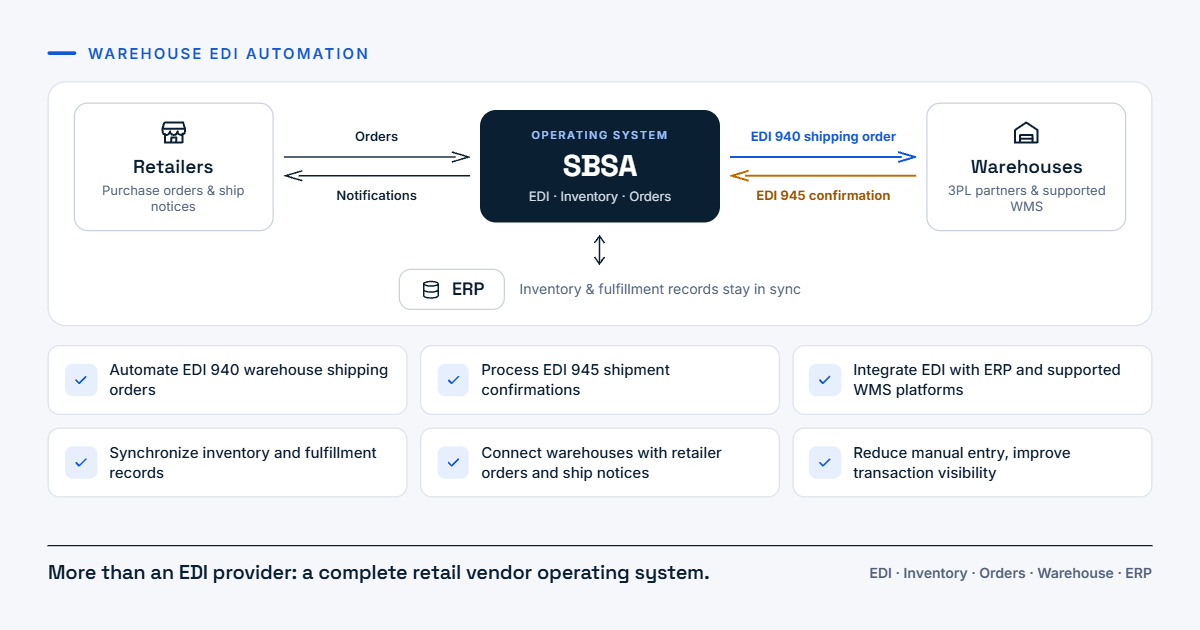 Managing orders across retailers, ERP platforms, and multiple warehouse partners can become complicated when systems operate independently.
SBSA Technology helps retail vendors automate EDI transactions and connect warehouse operations with their business systems.
With SBSA, businesses can:
-
Automate EDI 940 warehouse shipping orders.
-
Process EDI 945 shipment confirmations.
-
Integrate EDI workflows with ERP and supported WMS platforms.
-
Synchronize inventory and fulfillment records.
-
Connect warehouse operations with retailer orders and shipment notifications.
-
Reduce manual data entry and improve transaction visibility.
Rather than functioning only as an EDI provider, SBSA Technology offers a complete retail vendor operating system that connects EDI, inventory, order processing, warehouse operations, and ERP integrations.
Final Thoughts
EDI 940 and EDI 945 help retail vendors automate communication with warehouses and 3PL providers. EDI 940 sends shipping instructions, while EDI 945 confirms the products and quantities actually shipped.
When integrated with ERP and warehouse management systems, these transactions help improve fulfillment accuracy, inventory visibility, and operational efficiency.
SBSA Technology helps businesses go beyond basic EDI connectivity by connecting retail transactions, warehouse operations, inventory management, and ERP workflows.
Ready to simplify your warehouse fulfillment operations? Contact SBSA Technology to learn how EDI automation can help streamline your business.
- Book a demo: sbsatech.com/consultancy
- Talk to the team: sbsatech.com/contact
- Explore the platform: sbsatech.com
- More insights: sbsatech.com/blog