
Grocery retailers and wholesalers frequently need to modify purchase orders due to changing inventory levels, customer demand, pricing updates, and delivery requirements. For suppliers and distributors, managing these changes manually can lead to fulfillment errors, inventory discrepancies, and delayed shipments.
EDI 876 (Grocery Products Purchase Order Change) helps automate this process by allowing retailers and wholesalers to communicate changes to previously submitted grocery purchase orders electronically.
In this article, we'll explain how EDI 876 works, what information it contains, and how grocery suppliers can use EDI automation to improve order accuracy and fulfillment operations.
What Is EDI 876?
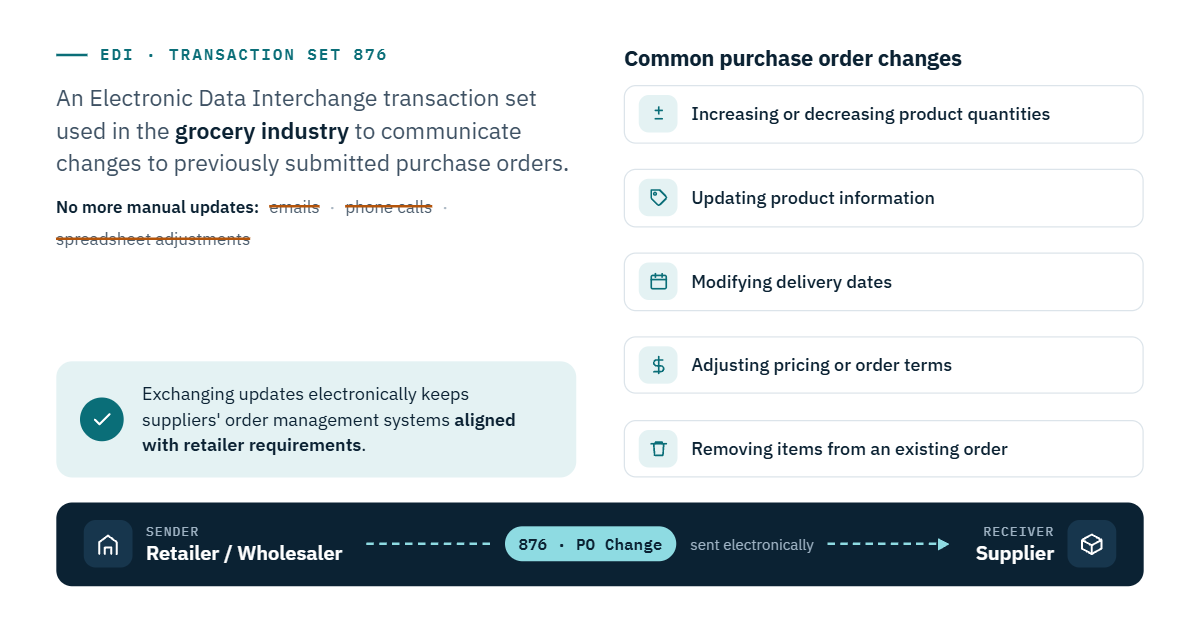 EDI 876 is an Electronic Data Interchange (EDI) transaction set used in the grocery industry to communicate changes to previously submitted purchase orders.
It allows retailers or wholesalers to request updates to existing orders without relying on manual emails, phone calls, or spreadsheet adjustments.
Common purchase order changes may include:
-
Increasing or decreasing product quantities
-
Updating product information
-
Modifying delivery dates
-
Adjusting pricing or order terms
-
Removing items from an existing order
By exchanging these updates electronically, suppliers can keep their order management systems aligned with retailer requirements.
How Does EDI 876 Work?
EDI 876 typically works alongside EDI 875 (Grocery Products Purchase Order), which is used to transmit the original grocery purchase order.
Here's a simplified workflow:
-
Retailer Sends EDI 875: The retailer sends a grocery purchase order to the supplier.
-
Supplier Receives the Order: The supplier's EDI system processes the purchase order and updates its order management or ERP system.
-
Retailer Sends EDI 876: If changes are needed, the retailer sends an EDI 876 transaction referencing the original purchase order.
-
Supplier Processes the Changes: The supplier's EDI system validates the updated order information and applies the changes to the appropriate records.
-
Inventory and Fulfillment Are Updated: The supplier adjusts inventory allocation, picking, packing, and shipping activities based on the accepted changes.
This process helps suppliers respond to retailer updates more efficiently while reducing manual data entry.
What Information Does an EDI 876 Include?
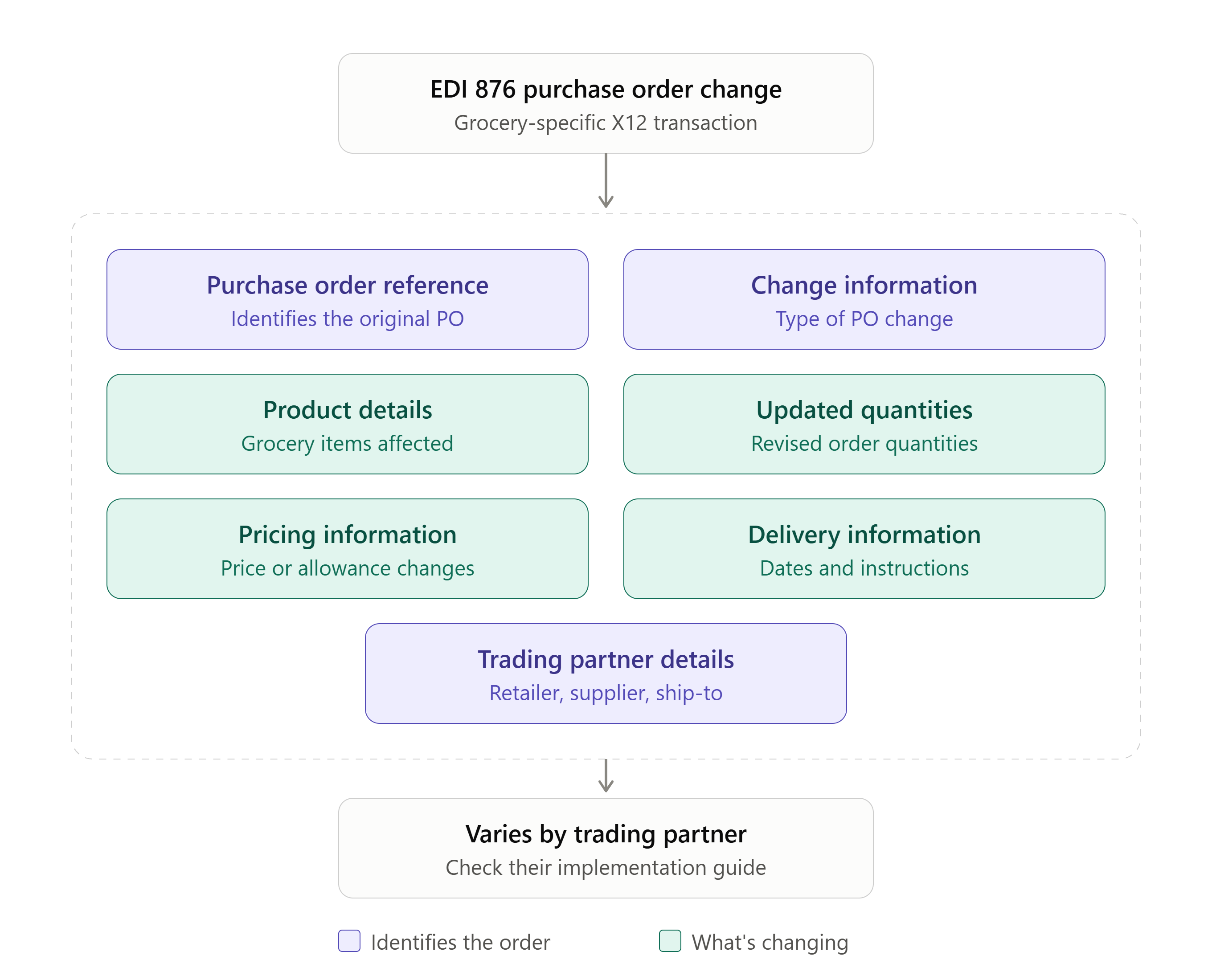
An EDI 876 transaction contains information needed to identify the original purchase order and communicate the requested changes.
Common information includes:
-
Purchase Order Reference: Identifies the original purchase order being modified.
-
Change Information: Identifies the type of purchase order change.
-
Product Details: Specifies the grocery products affected by the update.
-
Updated Quantities: Communicates revised order quantities.
-
Pricing Information: Provides applicable price or allowance changes.
-
Delivery Information: Communicates relevant delivery dates and instructions.
-
Trading Partner Details: Identifies the retailer, supplier, and ship-to location.
One important detail is that EDI 876 follows grocery-specific X12 standards. Its structure and required information may vary depending on the trading partner's implementation guidelines.
EDI 876 vs. EDI 875: What's the Difference?
Although both transactions are used in grocery EDI operations, they serve different purposes.

For example, a grocery retailer may initially order 500 cases of a product using EDI 875. If demand changes, the retailer can communicate a revised order through EDI 876.
The supplier can then process the update and adjust its fulfillment activities accordingly.
Common Challenges When Processing EDI 876
Without proper EDI automation, grocery suppliers may encounter several operational problems.
1. Incorrect Order Quantities
Manually updating purchase orders can result in incorrect quantities being processed or shipped.
2. Inventory Discrepancies
If updated orders are not synchronized with inventory records, suppliers may allocate more or fewer products than required.
3. Delayed Fulfillment
Late processing of purchase order changes can disrupt warehouse picking, packing, and shipping schedules.
4. Pricing and Allowance Errors
Changes to pricing or promotional terms may not be reflected correctly in order and accounting records.
5. Disconnected Business Systems
Suppliers using separate EDI, ERP, inventory, and warehouse systems may struggle to keep order information synchronized.
How SBSA Technology Can Help
 SBSA Technology helps grocery suppliers, manufacturers, distributors, and retail vendors automate their EDI operations through integrated retail and fulfillment solutions.
Our platform helps businesses manage grocery purchase orders, process EDI transactions, synchronize inventory, and connect their systems with major retail trading partners.
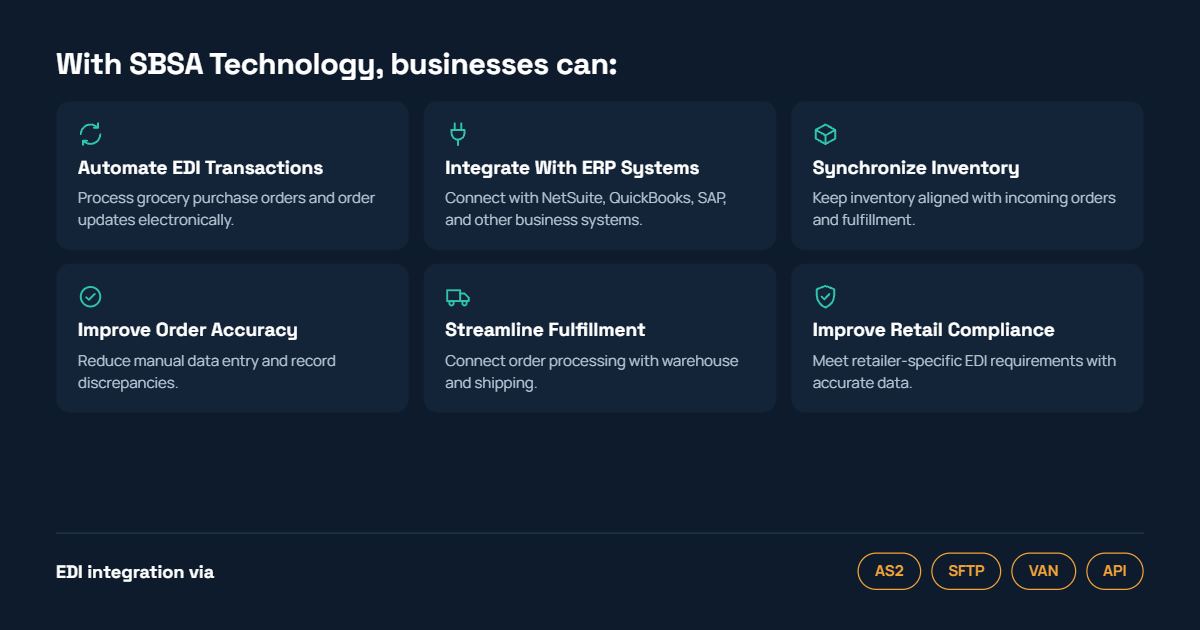
With SBSA Technology, businesses can:
-
Automate EDI Transactions: Process grocery purchase orders and order updates electronically.
-
Integrate With ERP Systems: Connect EDI transactions with platforms such as NetSuite, QuickBooks, SAP, and other business systems.
-
Synchronize Inventory: Keep inventory information aligned with incoming orders and fulfillment activities.
-
Improve Order Accuracy: Reduce manual data entry and minimize discrepancies between EDI documents and internal records.
-
Streamline Fulfillment: Connect order processing with warehouse and shipping operations.
-
Improve Retail Compliance: Help maintain accurate transaction data and meet retailer-specific EDI requirements.
SBSA Technology supports EDI integration through AS2, SFTP, VAN, and API connections, helping businesses simplify communication with their trading partners.
Final Thoughts
EDI 876 plays an important role in grocery supply chain operations by allowing retailers and wholesalers to communicate changes to previously submitted purchase orders electronically.
For grocery suppliers, processing these updates accurately is essential to maintaining inventory visibility, coordinating warehouse activities, and preventing fulfillment delays.
With the right EDI automation solution, businesses can reduce manual work, improve order accuracy, and build more efficient retail operations.
Looking to automate your grocery EDI operations?
SBSA Technology helps suppliers connect EDI, ERP, inventory, and fulfillment processes through one integrated retail vendor operating system.
Contact SBSA Technology today to learn how we can simplify your EDI operations and improve your retail supply chain.
- Book a demo: sbsatech.com/consultancy
- Talk to the team: sbsatech.com/contact
- Explore the platform: sbsatech.com
- More insights: sbsatech.com/blog