
Food manufacturers, grocery suppliers, and consumer packaged goods (CPG) companies often manage large volumes of purchase orders and invoices from grocery retailers and distributors. Handling these transactions manually can lead to data entry errors, delayed order processing, and payment discrepancies.
EDI 875 and EDI 880 help automate these processes by allowing suppliers and grocery retailers to exchange purchase orders and invoices electronically.
In this guide, we explain how EDI 875 and 880 work, their differences, and how suppliers can use them to improve grocery order management.
What Is EDI 875?
EDI 875 (Grocery Products Purchase Order) is an electronic document used by grocery retailers and distributors to send purchase orders to suppliers.
It contains important order information, including:
-
Product descriptions and item numbers
-
Ordered quantities
-
Pricing and unit measurements
-
Delivery dates and locations
-
Purchase order references
For example, when a grocery retailer needs to replenish beverages, packaged foods, or household products, it can send an EDI 875 purchase order directly to the supplier.
The supplier's EDI system receives the order and converts it into information that can be processed by its ERP or order management system.
What Is EDI 880?
EDI 880 (Grocery Products Invoice) is an electronic document used by suppliers to send invoices to grocery retailers and distributors.
Instead of manually preparing and sending invoices, suppliers can generate EDI 880 transactions based on completed orders and billing information.
An EDI 880 typically includes:
-
Invoice number and date
-
Purchase order references
-
Product descriptions and quantities
-
Item pricing and extended amounts
-
Allowances and charges
-
Invoice totals
This allows grocery retailers to receive standardized invoice information, helping improve payment processing and reduce manual reconciliation.
EDI 875 vs. EDI 880: What's the Difference?
Although both transactions support grocery operations, they serve different purposes.

EDI 875 communicates what products the retailer wants to purchase.
EDI 880 communicates how much the retailer needs to pay for those products.
Together, these transactions help streamline purchasing and invoicing between grocery retailers and their suppliers.
How EDI 875 and 880 Work Together
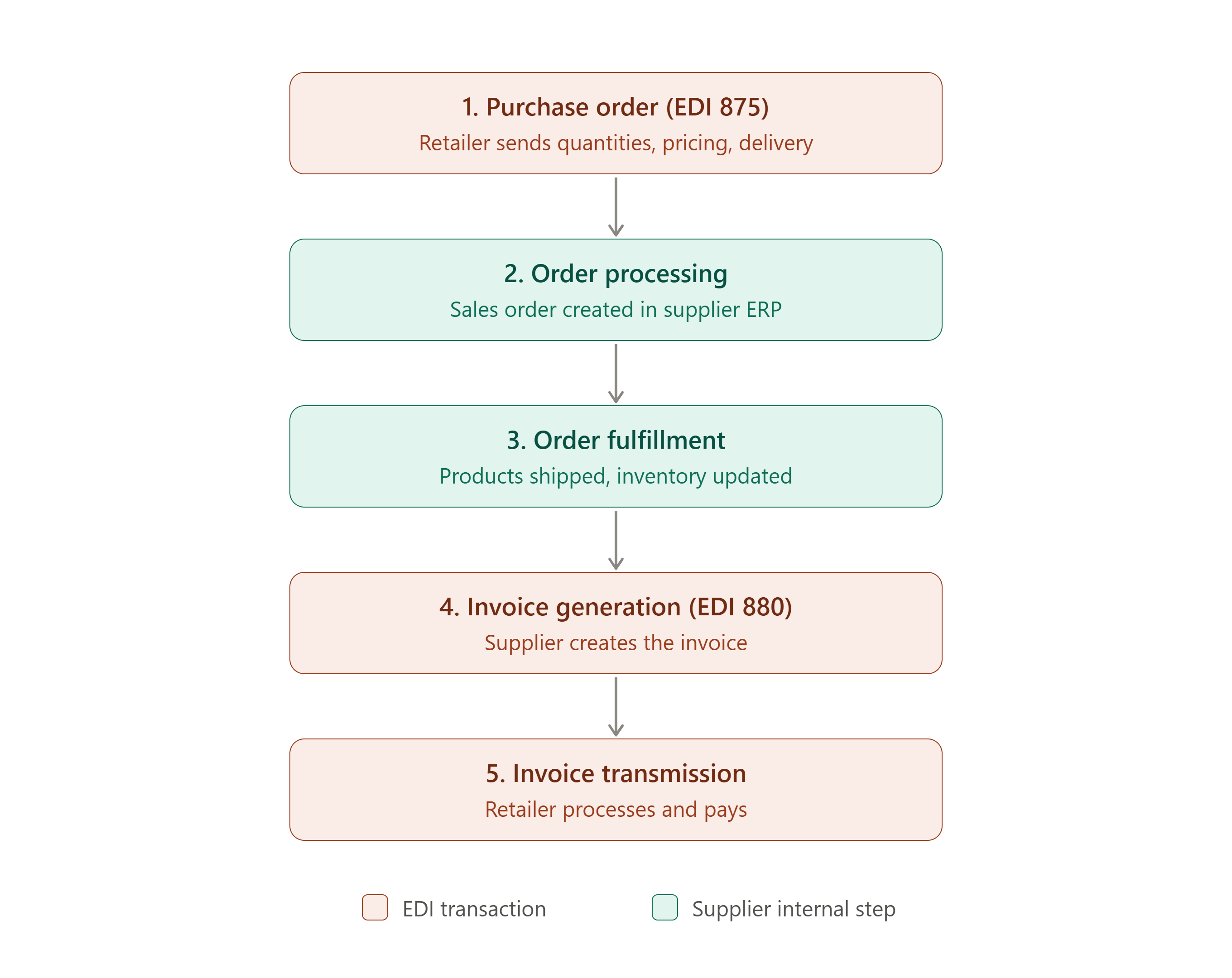
A typical grocery EDI workflow follows these steps:
-
Purchase Order: The retailer sends an EDI 875 containing product quantities, pricing, and delivery information.
-
Order Processing: The supplier's EDI system receives the transaction and creates a corresponding sales order in its ERP.
-
Order Fulfillment: The supplier prepares the products for shipment and updates its inventory.
-
Invoice Generation: Once the order is fulfilled, the supplier generates an EDI 880 invoice.
-
Invoice Transmission: The EDI 880 is transmitted to the retailer for processing and payment.
Automating this workflow reduces manual data entry and helps suppliers process grocery orders more efficiently.
Common Challenges for Food and CPG Suppliers
Without proper EDI automation, suppliers may encounter several operational problems:
-
Manual Order Entry: Re-entering purchase order information increases the risk of errors.
-
Incorrect Product Quantities: Differences between ordered and invoiced quantities can delay reconciliation.
-
Pricing Discrepancies: Incorrect item pricing or charges can result in invoice disputes.
-
Delayed Invoicing: Manual invoice preparation can slow down billing and payment processing.
-
Limited Inventory Visibility: Disconnected systems make it harder to maintain accurate inventory records.
These issues can affect order accuracy, retailer relationships, and overall operational efficiency.
How SBSA Technology Can Help
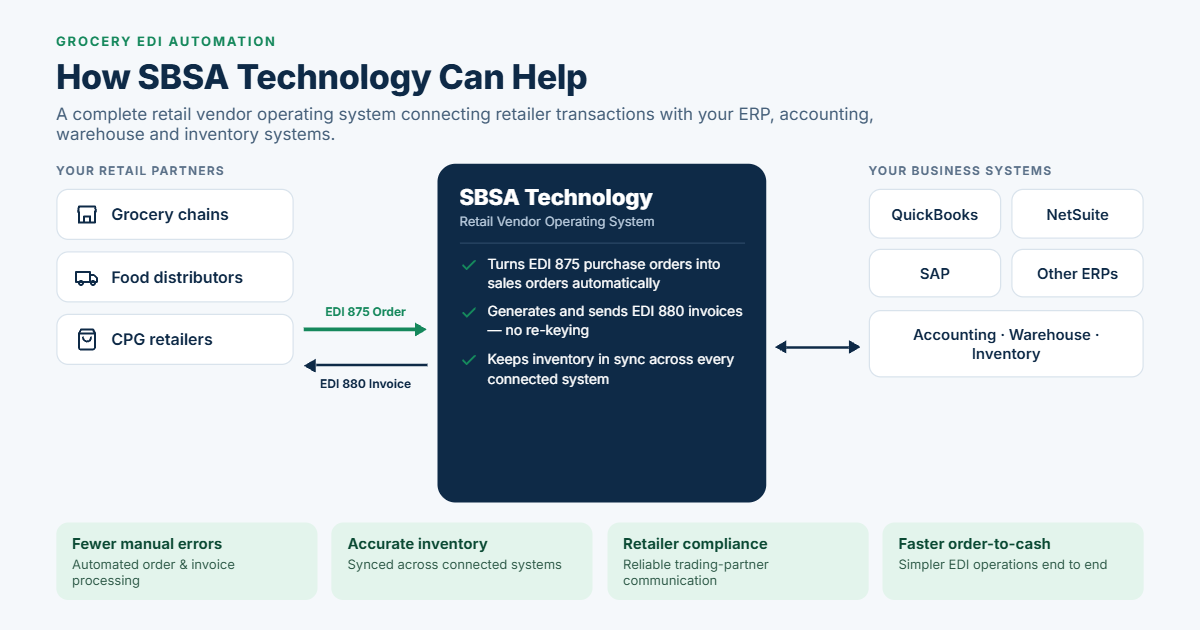 SBSA Technology helps food manufacturers, distributors, and CPG suppliers automate grocery EDI transactions through a complete retail vendor operating system.
Our EDI solutions connect retailer transactions with your existing ERP, accounting, warehouse, and inventory systems.
With SBSA Technology, businesses can:
-
Automate EDI 875 Orders: Receive grocery purchase orders and automatically convert them into sales orders.
-
Generate EDI 880 Invoices: Create and transmit electronic invoices without repetitive manual entry.
-
Integrate with ERP Systems: Connect EDI transactions with platforms such as QuickBooks, NetSuite, SAP, and other business systems.
-
Improve Inventory Synchronization: Maintain more accurate inventory information across connected systems.
-
Reduce Manual Errors: Automate order and invoice processing to minimize data entry mistakes.
-
Improve Retailer Compliance: Support accurate transaction processing and more reliable communication with trading partners.
Whether you supply grocery chains, food distributors, or major CPG retailers, SBSA Technology helps simplify your EDI operations and improve order-to-cash workflows.
Final Thoughts
EDI 875 and EDI 880 play an important role in automating grocery purchasing and invoicing. By exchanging purchase orders and invoices electronically, food and CPG suppliers can reduce manual work, improve transaction accuracy, and streamline their operations.
With SBSA Technology, suppliers can connect their EDI transactions with their existing business systems and manage grocery retail operations more efficiently.
Looking to automate your grocery EDI processes? Contact SBSA Technology to learn how our EDI solutions can help simplify your purchase orders, invoicing, and retail operations.
- Book a demo: sbsatech.com/consultancy
- Talk to the team: sbsatech.com/contact
- Explore the platform: sbsatech.com
- More insights: sbsatech.com/blog