
When retailers receive shipments from suppliers, they need to verify that the products delivered match the original purchase orders and shipping information. Missing items, incorrect quantities, damaged products, and shipment discrepancies can lead to payment delays and costly chargebacks.
This is where EDI 861 (Receiving Advice) becomes important.
EDI 861 is an electronic document that allows retailers or buyers to communicate receiving information to their suppliers. It provides details about what was actually received, helping vendors identify discrepancies, investigate shipment issues, and improve delivery accuracy.
In this guide, we'll explain how EDI 861 works, why it matters to retail suppliers, and how automation can help prevent receiving-related problems.
What Is EDI 861 Receiving Advice?

EDI 861, also known as Receiving Advice or Receiving Advice/Acceptance Certificate, is an electronic transaction used by buyers to communicate the results of receiving goods from a supplier.
It typically contains information about:
-
Purchase order references
-
Shipment and delivery details
-
Products received
-
Actual quantities received
-
Accepted or rejected items
-
Damaged, missing, or incorrect products
-
Receiving discrepancies
For example, a supplier ships 500 units to a retailer, but the retailer's warehouse confirms that only 480 units were received. The retailer can send an EDI 861 to report the actual quantity received.
This allows the supplier to investigate the missing 20 units and determine whether the issue occurred during picking, packing, transportation, or warehouse receiving.
How Does EDI 861 Work?
EDI 861 is generally sent by the retailer or buyer to the supplier after the shipment arrives and receiving activities are completed.
Here is a simplified workflow:
-
Purchase Order: The retailer sends an EDI 850 Purchase Order to the supplier.
-
Order Confirmation: The supplier sends an EDI 855 Purchase Order Acknowledgment.
-
Shipment Notification: The supplier sends an EDI 856 Advance Ship Notice (ASN) before delivery.
-
Goods Received: The retailer receives the shipment and checks the delivered products against the purchase order and ASN.
-
Receiving Advice: The retailer sends an EDI 861 with the actual receiving results.
-
Discrepancy Resolution: The supplier reviews any missing, damaged, or incorrect quantities and takes corrective action.
By connecting EDI 861 with inventory, order management, and accounting systems, suppliers can respond to receiving issues more efficiently.
Common Receiving Discrepancies Reported Through EDI 861
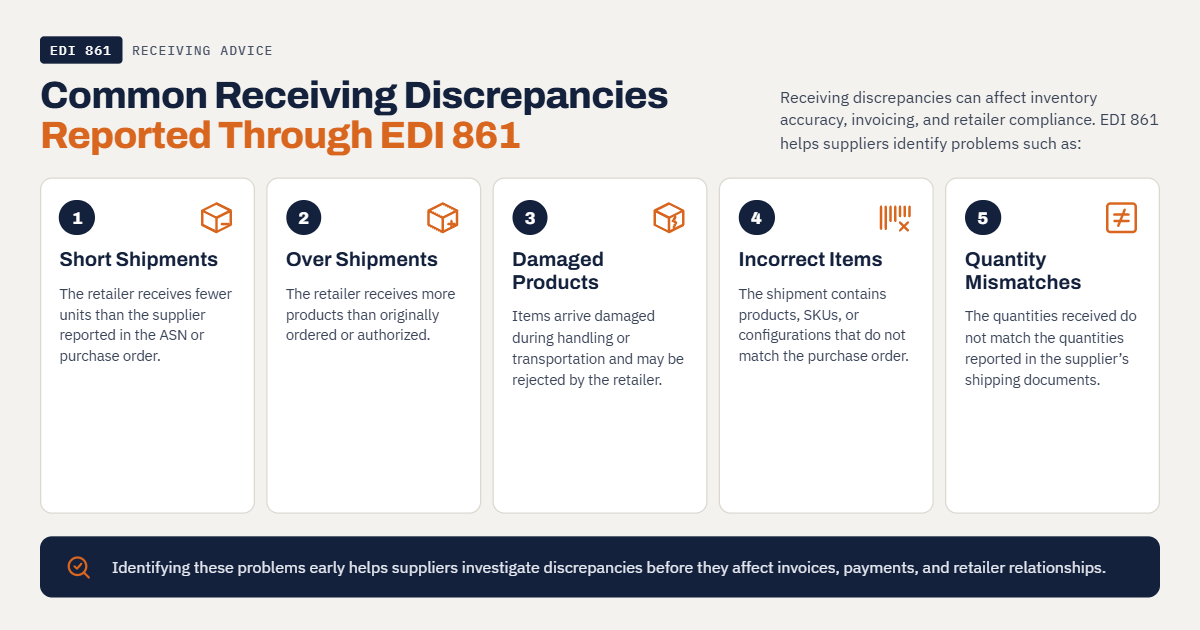
Receiving discrepancies can affect inventory accuracy, invoicing, and retailer compliance. EDI 861 helps suppliers identify problems such as:
1. Short Shipments
The retailer receives fewer units than the supplier reported in the ASN or purchase order.
2. Over Shipments
The retailer receives more products than originally ordered or authorized.
3. Damaged Products
Items arrive damaged during handling or transportation and may be rejected by the retailer.
4. Incorrect Items
The shipment contains products, SKUs, or configurations that do not match the purchase order.
5. Quantity Mismatches
The quantities received do not match the quantities reported in the supplier's shipping documents.
Identifying these problems early helps suppliers investigate discrepancies before they affect invoices, payments, and retailer relationships.
How EDI 861 Helps Prevent Retailer Chargebacks
Retailer chargebacks can result from shipment errors, inaccurate ASNs, incorrect quantities, and failure to meet receiving requirements.
EDI 861 helps suppliers reduce these risks by providing visibility into what retailers actually received.
Here are several ways it helps:
-
Identify shipment discrepancies: Compare actual received quantities against the original purchase order and ASN.
-
Investigate shortages: Determine whether missing products resulted from warehouse picking, packing, or transportation issues.
-
Improve ASN accuracy: Identify differences between reported shipment information and actual receiving results.
-
Resolve disputes faster: Use receiving records to support investigations and communicate with retailer compliance teams.
-
Improve inventory accuracy: Update inventory records based on confirmed receiving information.
EDI 861 does not automatically prevent every chargeback, but when integrated with other EDI transactions, it helps suppliers detect and address problems before they become recurring issues.
EDI 861 vs. EDI 856: What's the Difference?
Both transactions are important in retail shipping operations, but they serve different purposes.
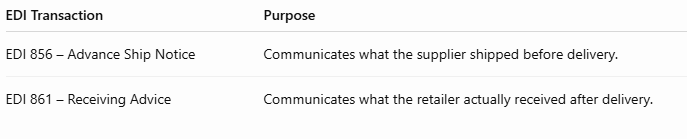
For example, an EDI 856 may report that 500 units were shipped, while the EDI 861 confirms that only 480 units were received.
Comparing these transactions helps suppliers identify shipment discrepancies and improve fulfillment accuracy.
How SBSA Technology Helps Automate EDI 861
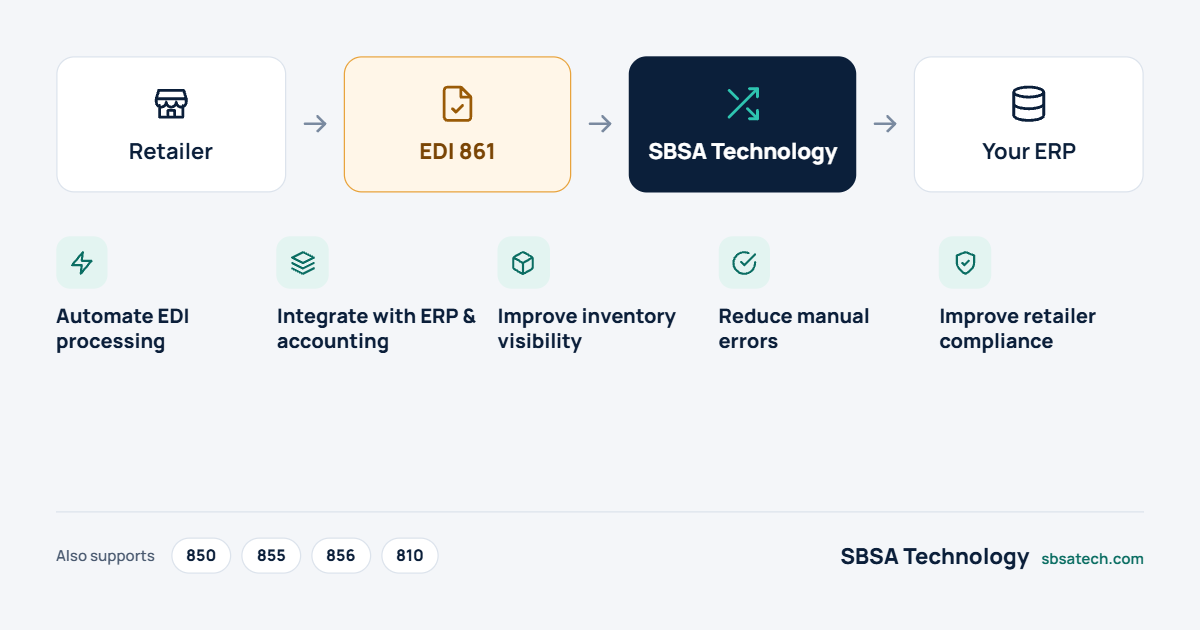
Managing receiving information manually can create delays, inaccurate inventory records, and difficulty resolving retailer disputes.
SBSA Technology helps retail vendors automate EDI transactions and connect receiving information with their existing business systems.
With SBSA Technology, businesses can:
-
Automate EDI Processing: Exchange receiving advice and other retail EDI transactions without relying on manual data entry.
-
Integrate with ERP and Accounting Systems: Connect EDI workflows with platforms such as QuickBooks, NetSuite, SAP, and other business applications.
-
Improve Inventory Visibility: Use receiving information to help maintain more accurate inventory records.
-
Reduce Manual Errors: Automate data exchange between retailers, suppliers, warehouses, and internal systems.
-
Improve Retailer Compliance: Maintain better visibility into purchase orders, shipments, receiving results, and invoicing.
SBSA Technology supports the broader retail vendor workflow, including EDI 850, 855, 856, 810, and other essential transactions.
Rather than managing EDI as a standalone process, businesses can connect their retail operations through a more integrated and automated system.
Final Thoughts
EDI 861 Receiving Advice gives suppliers valuable visibility into what retailers actually receive after a shipment arrives. By comparing receiving results with purchase orders and ASNs, vendors can identify shortages, incorrect shipments, and other discrepancies.
When integrated with other EDI transactions and business systems, EDI 861 helps improve inventory accuracy, speed up discrepancy resolution, and reduce the risk of retailer chargebacks.
Looking to simplify your retail EDI operations? SBSA Technology helps automate EDI transactions, streamline fulfillment workflows, and connect your business systems so you can manage retailer requirements more efficiently.
Visit SBSA Technology to learn more about our EDI automation solutions.
- Book a demo: sbsatech.com/consultancy
- Talk to the team: sbsatech.com/contact
- Explore the platform: sbsatech.com
- More insights: sbsatech.com/blog