
Retail vendors need accurate information about product sales, inventory movement, and demand to keep products available without carrying unnecessary stock. However, when retailers and suppliers rely on disconnected systems, spreadsheets, or delayed reports, planning replenishment becomes more difficult.
EDI 852 Product Activity Data helps retailers share product activity information with their suppliers, providing greater visibility into sales and inventory trends. When integrated with inventory management and ERP systems, this data can help vendors make more informed replenishment and purchasing decisions.
What Is EDI 852 Product Activity Data?
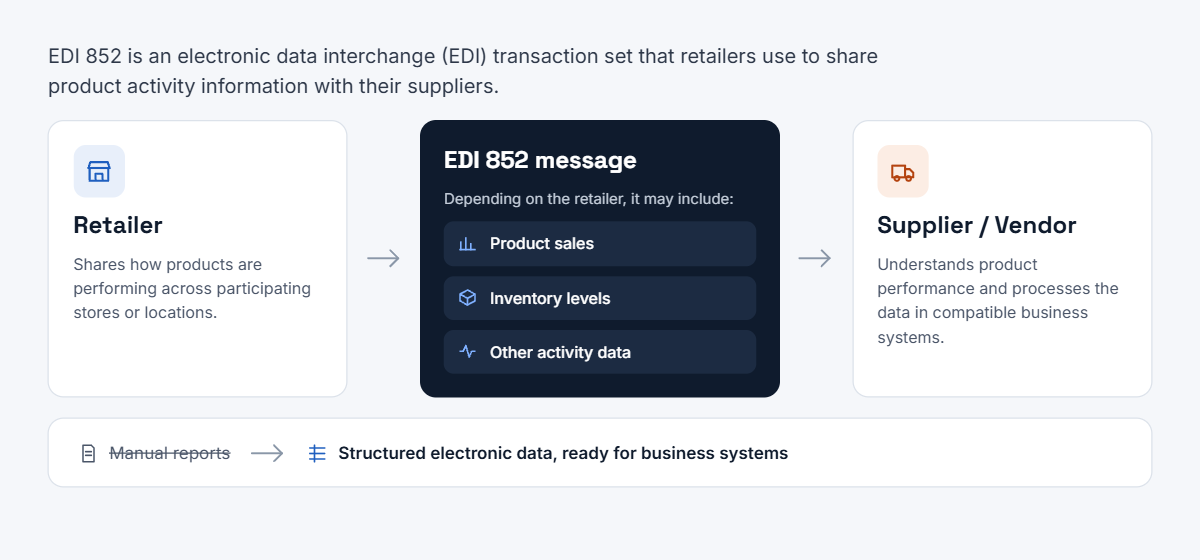 EDI 852 is an electronic data interchange (EDI) transaction set used to communicate product activity information between trading partners. Depending on the retailer's implementation, the information may include product sales, inventory levels, and other activity data.
Retailers can use EDI 852 to share relevant product activity with suppliers, helping them understand how their products are performing across participating stores or locations.
Instead of relying entirely on manual reports, vendors can receive structured electronic data that can be processed by compatible business systems.
How Does EDI 852 Work?
The EDI 852 workflow generally follows these steps:
-
Product activity is collected: The retailer gathers relevant sales, inventory, or product movement information.
-
The EDI 852 document is generated: The retailer formats the applicable data according to the agreed EDI specifications.
-
The data is transmitted: The transaction is delivered to the supplier through an agreed connection, such as AS2, SFTP, or a value-added network (VAN).
-
The supplier processes the data: An EDI platform validates and translates the information into a format the supplier's business systems can use.
-
Inventory planning is updated: The supplier analyzes the available data to support replenishment planning, demand forecasting, and inventory decisions.
The exact information, transmission frequency, and processing requirements depend on the retailer's EDI guidelines and trading-partner agreement.
How EDI 852 Improves Inventory Planning and Replenishment
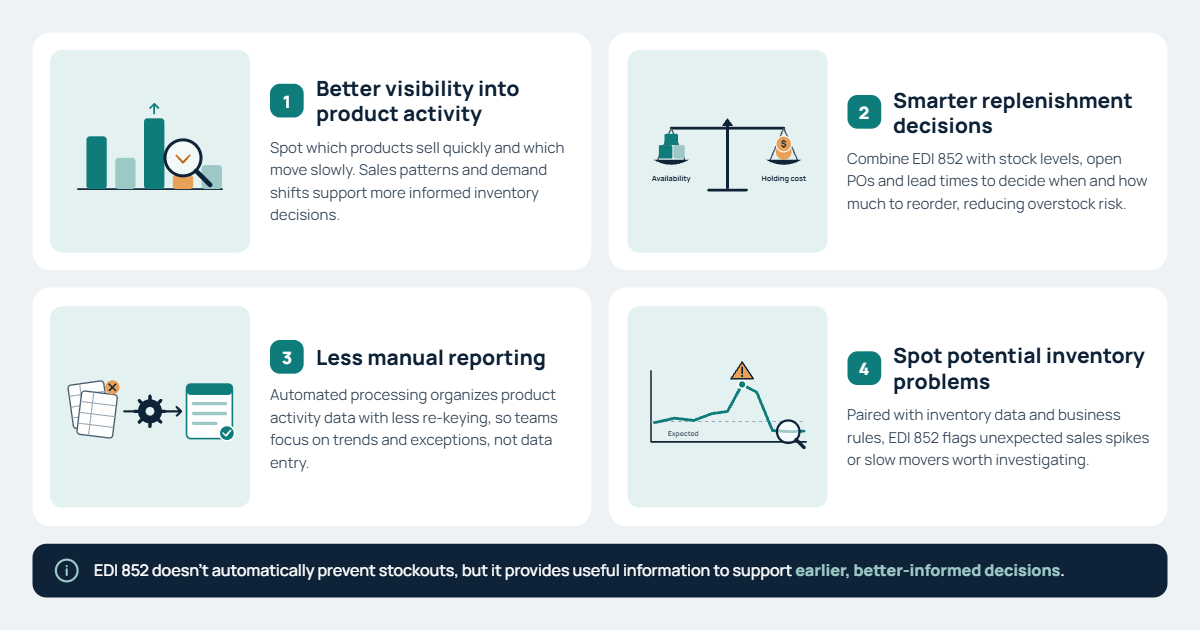 1. Provides Better Visibility Into Product Activity
Without timely retailer data, suppliers may struggle to determine which products are selling quickly and which are moving slowly.
EDI 852 can provide useful product activity information, helping vendors identify sales patterns and changes in demand. This visibility supports more informed inventory decisions.
2. Supports Smarter Replenishment Decisions
Suppliers need to balance product availability against the cost of holding excess inventory.
By analyzing EDI 852 data alongside current stock levels, open purchase orders, and lead times, vendors can better evaluate when and how much inventory to replenish.
This can help reduce the risk of overstocking and improve preparation for products experiencing increased demand.
3. Reduces Manual Reporting
Manually collecting retailer reports and transferring information between spreadsheets and business systems consumes time and introduces opportunities for errors.
Automating EDI 852 processing allows compatible systems to receive and organize product activity data with less manual intervention.
Teams can spend more time analyzing inventory trends and addressing exceptions instead of repeatedly entering data.
4. Helps Identify Potential Inventory Problems
Changes in product activity may reveal potential issues, such as faster-than-expected sales or products that are not moving as anticipated.
When EDI 852 information is combined with inventory data and appropriate business rules, suppliers can identify situations that require further investigation and adjust their plans accordingly.
EDI 852 does not automatically prevent stockouts, but it can provide useful information to support earlier, better-informed decisions.
Common EDI 852 Integration Challenges
Although EDI 852 can improve data visibility, suppliers may encounter several implementation challenges:
-
Inconsistent product identifiers: Retailer product codes and supplier SKU numbers may require accurate mapping.
-
Different retailer requirements: Each trading partner may have specific transaction formats, data requirements, and transmission schedules.
-
Disconnected business systems: Product activity data may not automatically flow into the supplier's ERP or inventory management platform.
-
Delayed or incomplete data: Reporting gaps can affect the usefulness of activity information for planning.
-
Limited exception monitoring: Failed transactions or mapping problems may go unnoticed without appropriate alerts and monitoring procedures.
Addressing these challenges requires reliable EDI processing, accurate data mapping, and integration with the systems used for inventory and purchasing decisions.
How SBSA Technology Helps Retail Vendors
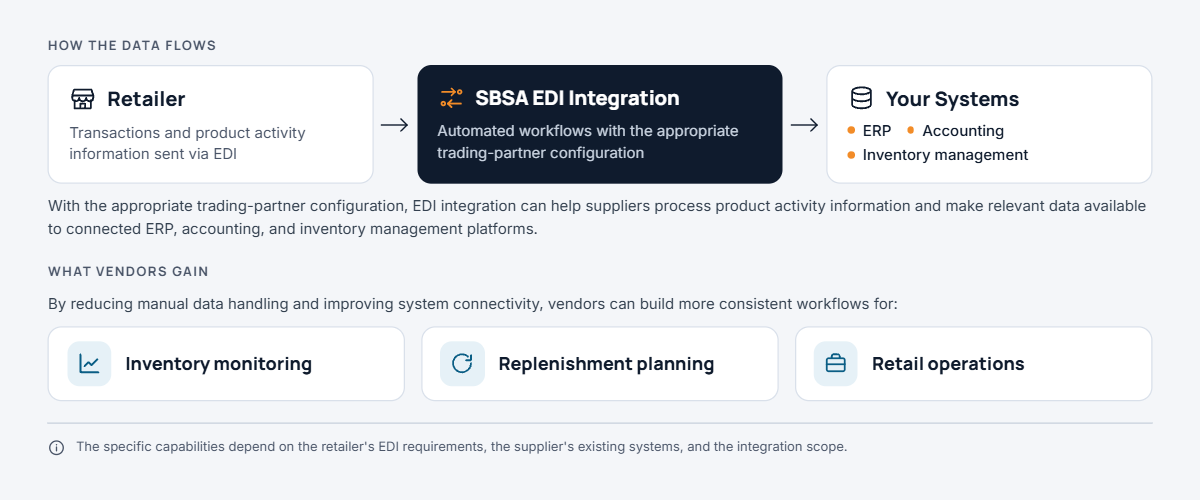 SBSA Technology helps manufacturers, distributors, wholesalers, and retail vendors automate EDI workflows and connect retailer transactions with their business systems.
With the appropriate trading-partner configuration, EDI integration can help suppliers process product activity information and make relevant data available to connected ERP, accounting, and inventory management platforms.
By reducing manual data handling and improving system connectivity, vendors can build more consistent workflows for inventory monitoring, replenishment planning, and retail operations.
The specific capabilities depend on the retailer's EDI requirements, the supplier's existing systems, and the integration scope.
Frequently Asked Questions
What is EDI 852 used for?
EDI 852 is used to exchange product activity information between trading partners. Depending on the implementation, it may include product sales, inventory information, and other activity data.
Does EDI 852 automatically replenish inventory?
No. EDI 852 provides information that can support replenishment decisions. Automatic replenishment requires additional systems, inventory rules, and business logic.
Can EDI 852 integrate with an ERP system?
Yes. With the appropriate EDI mapping and integration, EDI 852 data can be made available to compatible ERP and inventory management systems.
What is the difference between EDI 852 and EDI 846?
EDI 852 focuses on product activity information, while EDI 846 is commonly used to communicate inventory inquiry or advice information. The exact data exchanged depends on the trading partners' implementation requirements.
Final Thoughts
EDI 852 Product Activity Data gives retail suppliers a way to receive structured information about product activity from participating retailers. When combined with inventory records, demand forecasts, and replenishment rules, this information can support smarter purchasing and stock management decisions.
For vendors managing multiple retail accounts, automating EDI data exchange can also reduce manual reporting and improve operational visibility.
Looking to simplify your retail EDI operations? Contact SBSA Technology to explore how EDI automation and business system integration can help connect your retail workflows with your existing operations.
- Book a demo: sbsatech.com/consultancy
- Talk to the team: sbsatech.com/contact
- Explore the platform: sbsatech.com
- More insights: sbsatech.com/blog