
Accurate inventory information is essential for retail vendors selling through multiple retailers, distribution centers, and e-commerce channels. When inventory data is outdated or inconsistent, businesses can face stockouts, order cancellations, fulfillment delays, and lost sales.
EDI 846, also known as Inventory Inquiry/Advice, helps businesses exchange inventory information electronically with their trading partners. When integrated with inventory management systems, enterprise resource planning (ERP) software, and warehouse management systems (WMS), it can help suppliers maintain more consistent inventory records and communicate product availability more efficiently.
In this article, we'll explain how EDI 846 works, common inventory synchronization challenges, and how automation can help retail vendors improve inventory visibility.
What Is EDI 846?
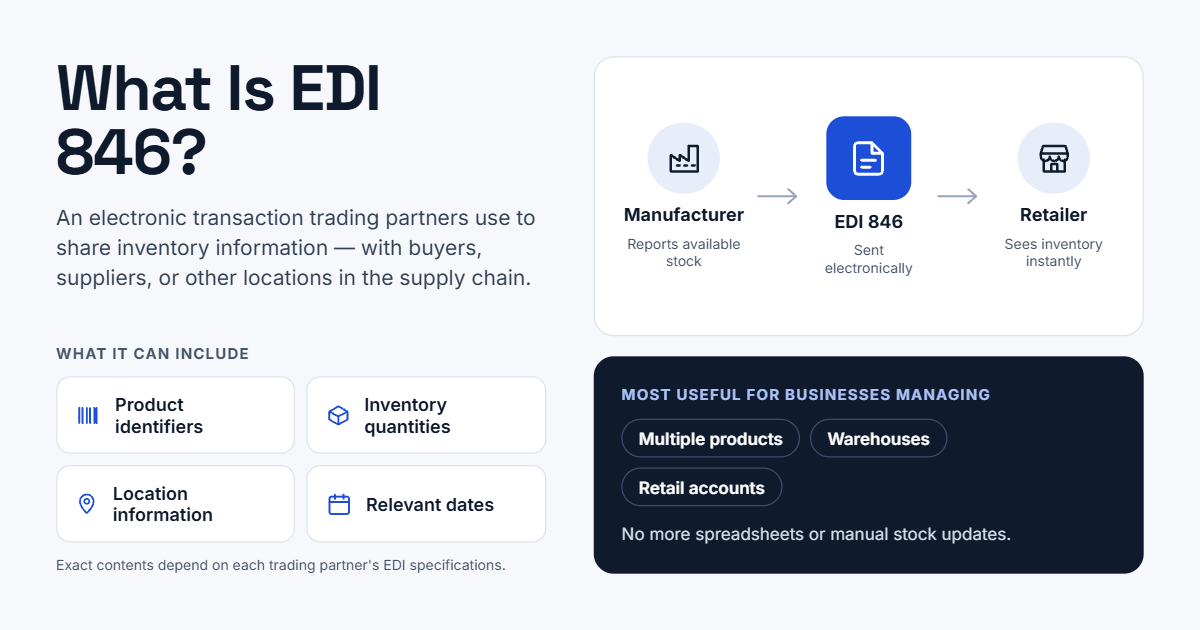
EDI 846 is an Electronic Data Interchange (EDI) transaction used to communicate inventory information between trading partners. Depending on the business arrangement, it can share stock information with buyers, suppliers, or other locations within a supply chain.
For example, a manufacturer selling products through a major retailer may use EDI 846 to report available quantities for specific products. This allows the retailer or trading partner to receive inventory information electronically rather than relying on spreadsheets or manual updates.
The exact information included depends on the trading partners' EDI specifications. It may include product identifiers, inventory quantities, location information, and relevant dates.
EDI 846 is particularly useful for businesses that manage multiple products, warehouses, and retail accounts.
How Does EDI 846 Work?
EDI 846 typically follows a process that connects a supplier's inventory system with its trading partner.
Here's how the workflow may operate:
1. Inventory data is collected.
The supplier's ERP or WMS maintains inventory information, including stock quantities for individual products and warehouse locations.
2. Inventory information is converted into EDI format.
An EDI platform maps the relevant inventory data into an EDI 846 document according to the trading partner's requirements.
3. The inventory report is transmitted.
The document is sent through an agreed communication method, such as AS2, SFTP, or a value-added network (VAN).
4. The trading partner processes the information.
The receiving system validates and processes the inventory data according to its implementation requirements.
5. Inventory information is updated or reviewed.
The receiving business uses the data for its supported inventory visibility, planning, or reconciliation processes.
The transmission frequency depends on the retailer's requirements and the supplier's operational needs. Some trading partners require daily inventory reports, while others may specify a different schedule.
EDI 846 vs. EDI 852: What's the Difference?
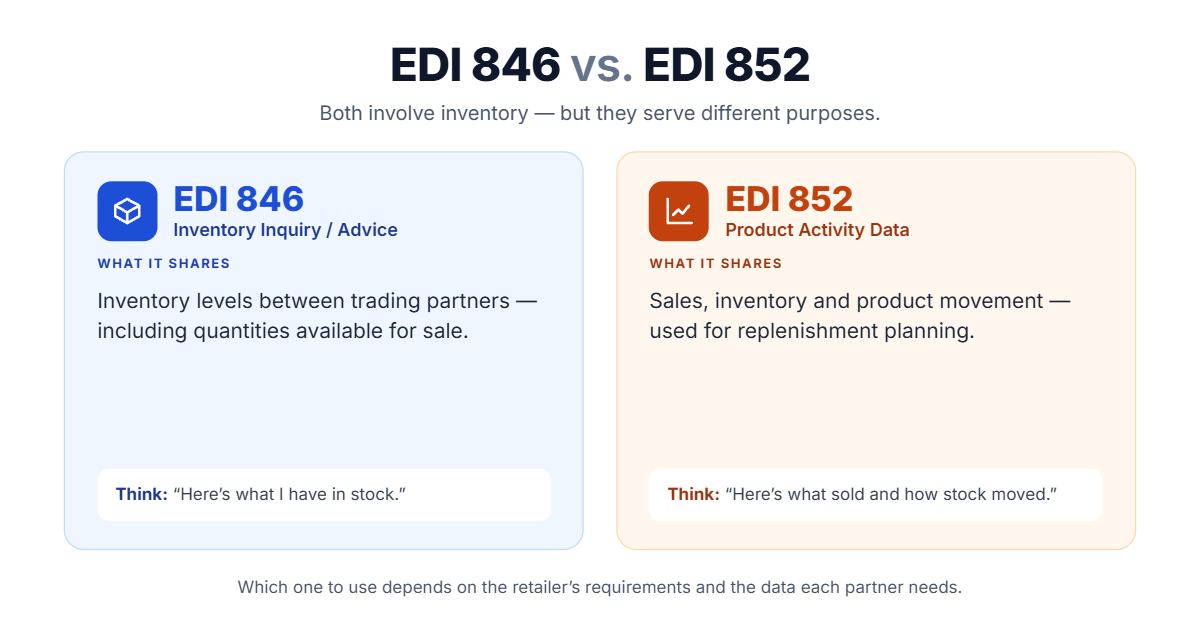
Although both transactions involve inventory information, they serve different purposes.
EDI 846 — Inventory Inquiry/Advice: Communicates inventory information between trading partners, including available quantities where supported by the implementation.
EDI 852 — Product Activity Data: Communicates product activity information, which can include inventory, sales, and other product movement data used for replenishment planning.
For example, a supplier might use EDI 846 to communicate inventory quantities available for sale, while EDI 852 helps trading partners exchange information about product sales and inventory activity.
Using the appropriate transaction depends on the retailer's requirements and the information each business needs to exchange.
Common Inventory Synchronization Challenges
Even businesses with established inventory systems can experience problems when information is not updated or shared consistently.
1. Outdated Inventory Quantities
When inventory reports are generated too infrequently, the quantities communicated to trading partners may no longer reflect current stock levels.
A product might be available when a report is created but become unavailable after several orders are processed.
2. SKU and Product Mapping Errors
Different systems may use different identifiers for the same product. Incorrect SKU, UPC, or GTIN mappings can cause inventory quantities to be associated with the wrong item or rejected during processing.
Consistent product identification is essential for accurate inventory communication.
3. Multiple Warehouse Discrepancies
Businesses operating several warehouses must account for stock across different locations. Inventory may be available at one facility but unavailable at another.
Without accurate location-level data and clear allocation rules, suppliers may communicate quantities that cannot be fulfilled from the required shipping location.
4. Manual Data Entry
Manually preparing inventory reports increases the risk of incorrect quantities, missing products, and delayed transmissions.
As the number of products and retail accounts grows, maintaining inventory information through spreadsheets becomes increasingly difficult.
5. Disconnected Business Systems
When the ERP, WMS, e-commerce platform, and EDI system operate independently, inventory changes may not flow consistently between them.
This can result in duplicate updates, conflicting quantities, and unnecessary manual reconciliation.
How Can Retail Vendors Improve EDI 846 Accuracy?
Retail vendors can improve inventory communication by strengthening their data management processes and integrating the systems responsible for inventory updates.
Automate inventory data transfers. Connect the inventory source to the EDI platform to reduce manual report preparation and minimize avoidable data-entry errors.
Maintain accurate product mappings. Regularly review SKU, UPC, GTIN, and other identifiers required by each trading partner.
Establish clear inventory rules. Determine how the business calculates available inventory, including how it accounts for reserved stock, pending orders, and location-specific quantities.
Follow retailer-specific requirements. Confirm the required EDI version, document structure, transmission frequency, communication method, and validation rules before implementing an integration.
Monitor transmission and processing errors. Review failed transmissions, rejected documents, and discrepancies between inventory systems so issues can be resolved promptly.
Reconcile inventory records regularly. Compare inventory information across the ERP, warehouse system, and relevant trading partner records to identify inconsistencies.
These practices help create a more reliable inventory communication process while reducing dependence on manual work.
Improve Inventory Visibility With SBSA Technology
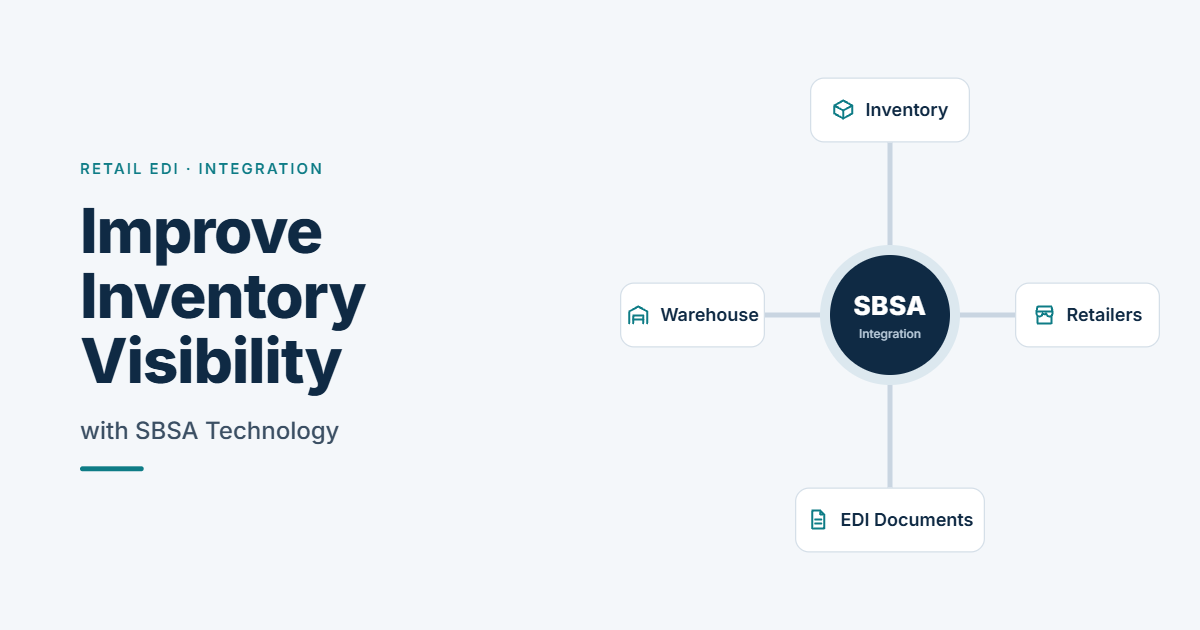
Managing inventory across multiple retailers and warehouses requires more than exchanging EDI documents. Businesses also need reliable connections between their inventory systems, warehouse operations, and trading partners.
SBSA Technology helps businesses streamline retail EDI and operational workflows through integration and automation. By connecting compatible business systems with retailer EDI processes, suppliers can reduce manual tasks and improve the consistency of their data exchange.
Whether your business is managing inventory reports, retail orders, shipment notifications, or invoices, an effective integration strategy can help simplify daily operations as your business grows.
Frequently Asked Questions
1. What does EDI 846 mean?
EDI 846 stands for Inventory Inquiry/Advice. It is an EDI transaction used to exchange inventory information between trading partners.
2. Is EDI 846 used to update inventory automatically?
It can support automated inventory updates or inventory visibility workflows when the receiving system is configured to process the document accordingly. Actual behavior depends on the trading partner's specifications and integration.
3. What is the difference between EDI 846 and EDI 852?
EDI 846 communicates inventory information, while EDI 852 communicates product activity data, which may include sales, inventory, and other product movement information.
4. Can EDI 846 integrate with an ERP or WMS?
Yes. EDI 846 can be integrated with compatible ERP and WMS platforms to exchange inventory information. The specific integration depends on the systems involved and the trading partner's requirements.
5. How often should EDI 846 be sent?
The transmission schedule depends on the retailer's requirements, the supplier's inventory processes, and the integration design. Businesses should confirm the required frequency with each trading partner.
Final Thoughts
Accurate inventory information is essential for retail vendors managing multiple products, warehouses, and trading partners. EDI 846 provides a standardized way to exchange inventory information, helping businesses reduce manual reporting and improve inventory visibility when supported by effective integration processes.
By combining accurate inventory records, consistent product mapping, and automated EDI workflows, suppliers can strengthen their inventory communication and support more efficient retail operations.
Ready to improve your retail EDI workflows? Contact SBSA Technology to discuss how EDI integration and automation can support your business.
- Book a demo: sbsatech.com/consultancy
- Talk to the team: sbsatech.com/contact
- Explore the platform: sbsatech.com
- More insights: sbsatech.com/blog