
Managing product information and pricing across multiple retailers can be challenging. Suppliers often need to update product descriptions, UPCs, SKUs, packaging details, and prices to meet different retailer requirements.
EDI 832 (Price/Sales Catalog) simplifies this process by allowing suppliers to electronically exchange product catalog and pricing information with their retail trading partners.
What Is EDI 832?
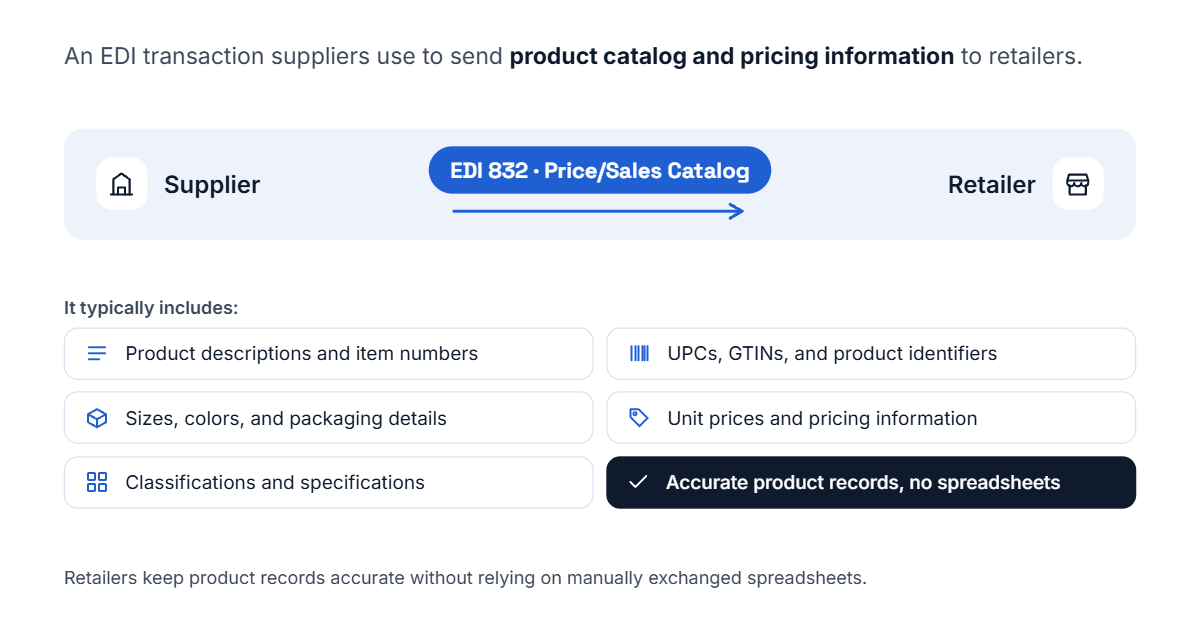 EDI 832 is an Electronic Data Interchange transaction used by suppliers to send product catalog and pricing information to retailers.
It typically includes:
-
Product descriptions and item numbers
-
UPCs, GTINs, and product identifiers
-
Product sizes, colors, and packaging details
-
Unit prices and pricing information
-
Product classifications and specifications
This allows retailers to maintain accurate product records without relying on manually exchanged spreadsheets.
How Does EDI 832 Work?
The EDI 832 process generally follows these steps:
-
Prepare Product Data: The supplier maintains product information and pricing in its ERP or product management system.
-
Generate EDI 832: The system converts the information into the required EDI format.
-
Transmit to Retailers: The EDI file is sent through AS2, SFTP, or a VAN.
-
Retailer Validation: The retailer checks the submitted product and pricing information against its requirements.
-
Update Product Records: Accepted information is used to update the retailer's product catalog.
Benefits of EDI 832 for Retail Suppliers
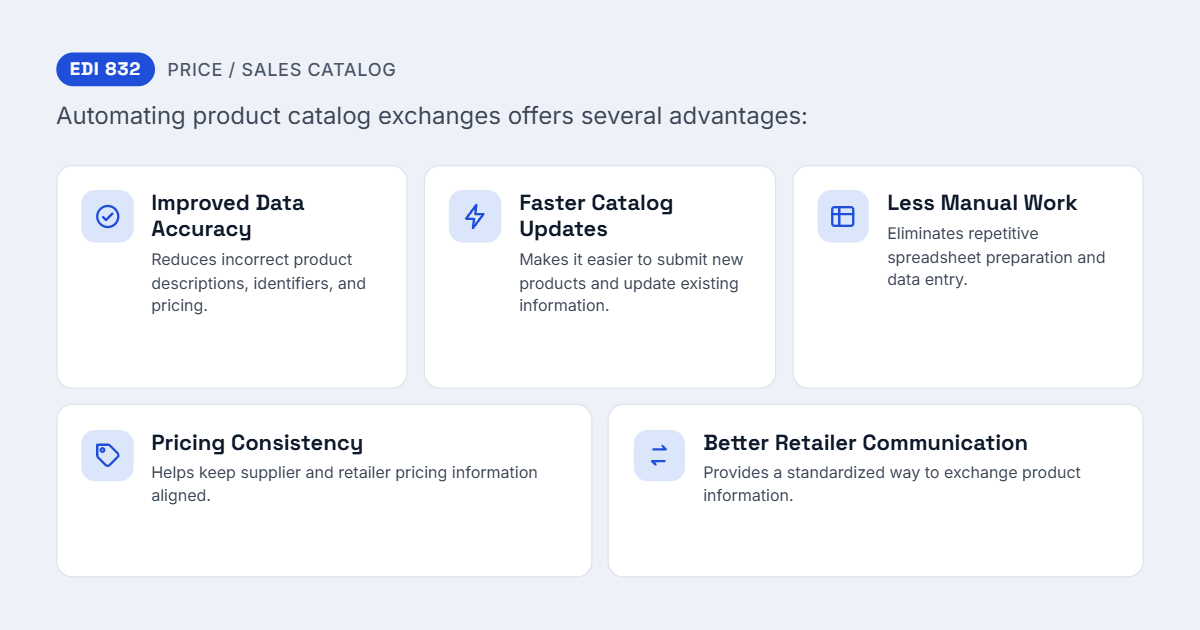 Automating product catalog exchanges offers several advantages:
-
Improved Data Accuracy: Reduces incorrect product descriptions, identifiers, and pricing.
-
Faster Catalog Updates: Makes it easier to submit new products and update existing information.
-
Less Manual Work: Eliminates repetitive spreadsheet preparation and data entry.
-
Pricing Consistency: Helps keep supplier and retailer pricing information aligned.
-
Better Retailer Communication: Provides a standardized way to exchange product information.
Common EDI 832 Errors to Avoid
Suppliers should check their product information before transmitting EDI 832 transactions. Common issues include:
-
Incorrect UPCs, GTINs, or SKUs
-
Missing product descriptions or required details
-
Incorrect pricing information
-
Invalid units of measure or packaging details
-
Incorrect EDI formatting
-
Outdated product catalog information
Validating product data before transmission helps reduce errors and delays in retailer catalog updates.
How SBSA Technology Helps Automate EDI Operations
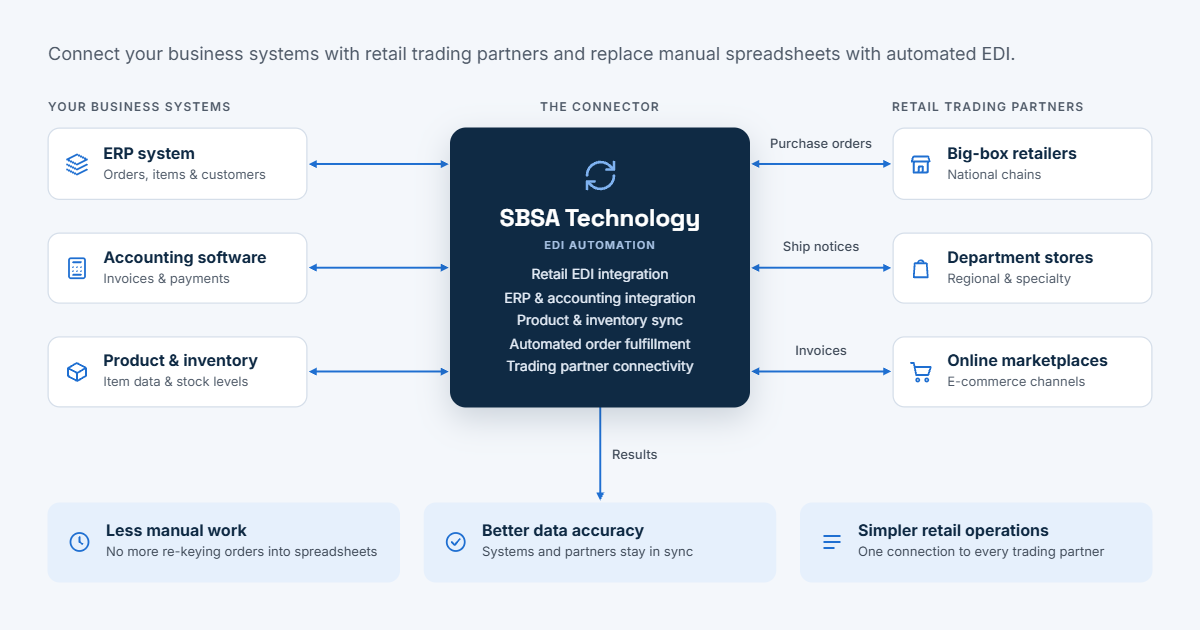 Managing product information across multiple retailers doesn't have to involve manual spreadsheets and disconnected systems.
SBSA Technology helps manufacturers, distributors, and retail suppliers automate EDI processes and connect their business systems with retail trading partners.
Our solutions support:
-
Retail EDI integration and transaction processing
-
ERP and accounting system integration
-
Product and inventory data synchronization
-
Automated order and fulfillment workflows
-
Trading partner connectivity
With SBSA Technology, suppliers can reduce manual work, improve data accuracy, and simplify retail operations.
Final Thoughts
EDI 832 helps retail suppliers automate product catalog and pricing updates while improving communication with their trading partners.
By integrating EDI 832 with existing business systems, suppliers can maintain accurate product information, reduce manual processes, and manage multiple retail accounts more efficiently.
Looking to simplify your retail EDI operations?
Contact SBSA Technology to learn how our EDI automation solutions can help streamline your business.
- Book a demo: sbsatech.com/consultancy
- Talk to the team: sbsatech.com/contact
- Explore the platform: sbsatech.com
- More insights: sbsatech.com/blog