
Retail suppliers need accurate demand forecasts to manage inventory, schedule production, and prepare for upcoming orders. Without clear visibility into retailer demand, businesses risk producing too much inventory, running out of stock, or missing delivery deadlines.
EDI 830 Planning Schedule helps address these challenges by allowing retailers to electronically communicate their anticipated product requirements to suppliers. By using this information effectively, suppliers can plan ahead, coordinate with warehouses, and make better purchasing and production decisions.
In this guide, we explain how EDI 830 works, what information it contains, and how suppliers can use it to improve retail operations.
What Is EDI 830 Planning Schedule?
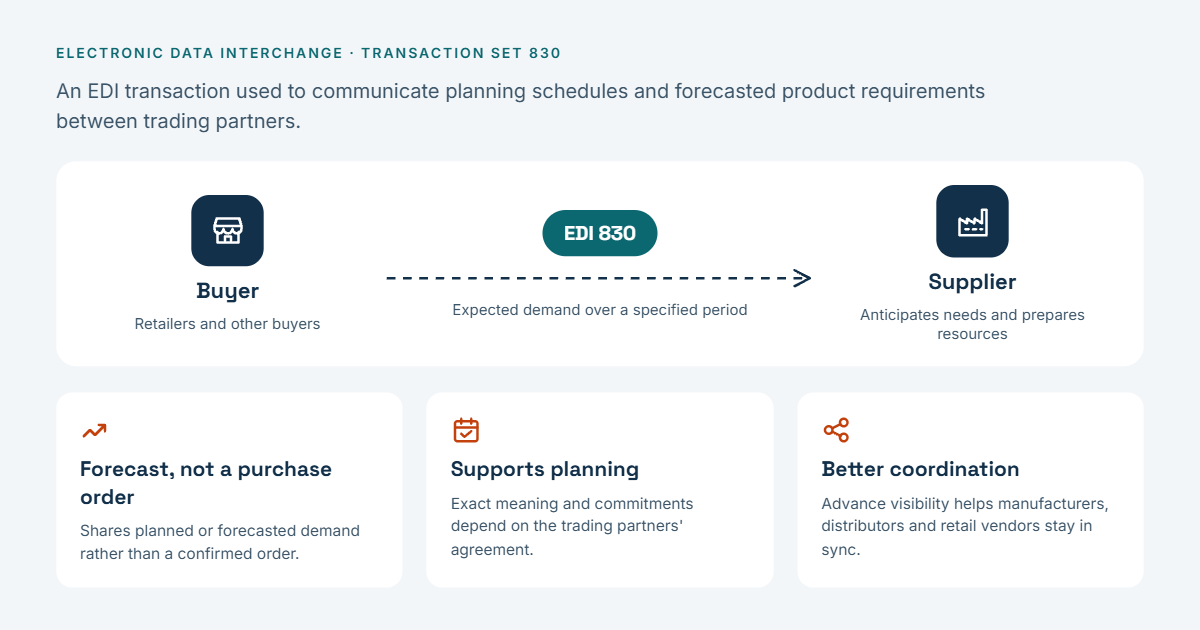 EDI 830 is an Electronic Data Interchange (EDI) transaction used to communicate planning schedules and forecasted product requirements between trading partners.
Retailers and other buyers can send EDI 830 transactions to suppliers to share expected demand over a specified period. This information helps suppliers anticipate future requirements and prepare the resources needed to fulfill them.
Unlike an actual purchase order, EDI 830 generally communicates planned or forecasted demand rather than a confirmed order. Its purpose is to support planning, although the exact meaning and commitments depend on the trading partners' agreement.
For manufacturers, distributors, and retail vendors, this advance visibility can improve coordination across the supply chain.
How Does EDI 830 Work?
The EDI 830 process typically follows these steps:
1. The retailer prepares a demand forecast.
The retailer estimates future product requirements based on sales trends, inventory levels, promotions, seasonal demand, and other planning factors.
2. The retailer sends the EDI 830 transaction.
The planning schedule is transmitted electronically through an agreed EDI connection, such as AS2, SFTP, or a value-added network (VAN).
3. The supplier receives and processes the forecast.
The supplier's EDI system validates the transaction and converts the information into a format that its planning, ERP, or inventory management system can use.
4. The supplier evaluates upcoming requirements.
The supplier reviews forecasted quantities, product identifiers, and schedule dates to determine whether available inventory and production capacity can meet anticipated demand.
5. The supplier adjusts its operations.
Based on the forecast and its business rules, the supplier may adjust purchasing plans, production schedules, warehouse staffing, or inventory allocation.
6. The supplier monitors updates.
As new planning schedules arrive, the supplier compares them with previous forecasts and adjusts plans when necessary.
This process gives suppliers more time to prepare instead of relying entirely on incoming purchase orders.
What Information Does EDI 830 Contain?
An EDI 830 transaction may include information such as:
-
Product identification: Identifies the products covered by the planning schedule.
-
Forecasted quantities: Indicates expected product requirements for specific periods.
-
Schedule dates: Specifies the dates or time periods associated with forecasted demand.
-
Delivery or shipment-related requirements: May communicate planning details relevant to expected product availability or shipments, depending on the implementation.
-
Planning references: Provides information used to identify and interpret the planning schedule.
The exact information depends on the retailer's EDI specifications and the trading partners' implementation.
Suppliers should follow each retailer's requirements to ensure that planning data is interpreted correctly.
5 Benefits of EDI 830 for Retail Suppliers
1. Better Inventory Planning
Forecast information helps suppliers estimate how much inventory they may need in the coming weeks or months.
By comparing anticipated demand with current inventory, suppliers can identify potential shortages and plan replenishment earlier.
2. Improved Production Scheduling
Manufacturers can use demand forecasts to plan production runs, allocate raw materials, and coordinate manufacturing capacity.
This helps reduce last-minute production changes and makes it easier to prepare for seasonal demand or major retail promotions.
3. Reduced Stockouts and Excess Inventory
Without reliable demand information, suppliers may hold too much inventory or fail to prepare enough products for upcoming requirements.
EDI 830 supports more informed inventory decisions by providing advance visibility into expected demand. However, forecasts still need to be evaluated against actual sales, inventory, and other business conditions.
4. More Efficient Warehouse Operations
Understanding anticipated demand helps suppliers prepare warehouse capacity, coordinate labor, and allocate products across locations.
For businesses operating multiple warehouses, forecast information can also support inventory distribution decisions.
5. Stronger Retailer-Supplier Coordination
EDI 830 improves the exchange of planning information between retailers and suppliers.
When both parties work from consistent, timely data, they can identify potential supply issues earlier and coordinate adjustments before they disrupt fulfillment.
EDI 830 vs. EDI 850: What's the Difference?
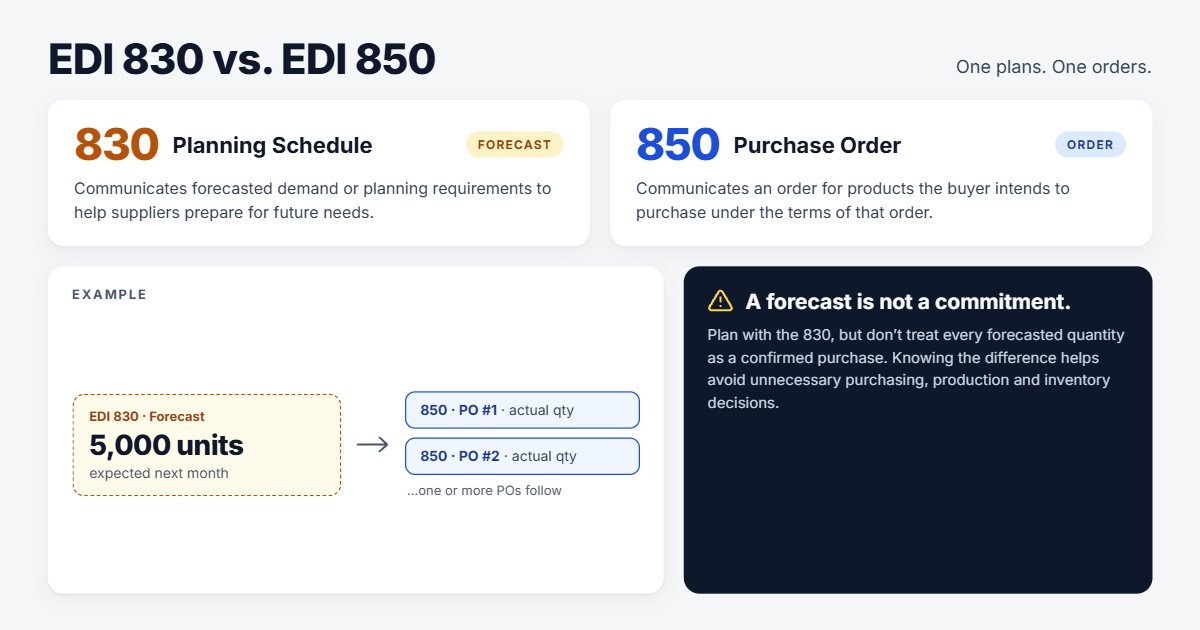 EDI 830 and EDI 850 serve different purposes in the retail supply chain.
EDI 830 — Planning Schedule: Communicates forecasted demand or planning requirements to help suppliers prepare for future needs.
EDI 850 — Purchase Order: Communicates an order for products that the buyer intends to purchase under the terms of that order.
For example, a retailer might send an EDI 830 indicating that it expects to need 5,000 units of a product over the next month. The retailer may subsequently send one or more EDI 850 purchase orders specifying the quantities actually being ordered.
The forecast is useful for planning, but suppliers should not automatically treat every forecasted quantity as a confirmed purchase commitment.
Understanding this distinction helps businesses avoid unnecessary purchasing, production, and inventory decisions.
Best Practices for Managing EDI 830 Planning Schedules
To get the most value from EDI 830, suppliers should follow these practices:
-
Automate EDI processing: Reduce manual data entry by integrating incoming planning schedules with the appropriate business systems.
-
Validate incoming data: Check product identifiers, dates, quantities, and required fields against the retailer's specifications.
-
Compare forecasts with available inventory: Review stock levels, open orders, and production capacity before making replenishment decisions.
-
Monitor forecast changes: Compare new schedules with previous versions to identify significant increases or decreases in expected demand.
-
Coordinate across departments: Share relevant planning information with purchasing, production, inventory, and warehouse teams.
-
Integrate EDI with your ERP: Connect planning data to inventory and operational workflows to improve visibility and reduce duplicate work.
These practices help suppliers turn retailer forecasts into actionable plans while maintaining flexibility when demand changes.
How SBSA Technology Helps Suppliers Manage EDI
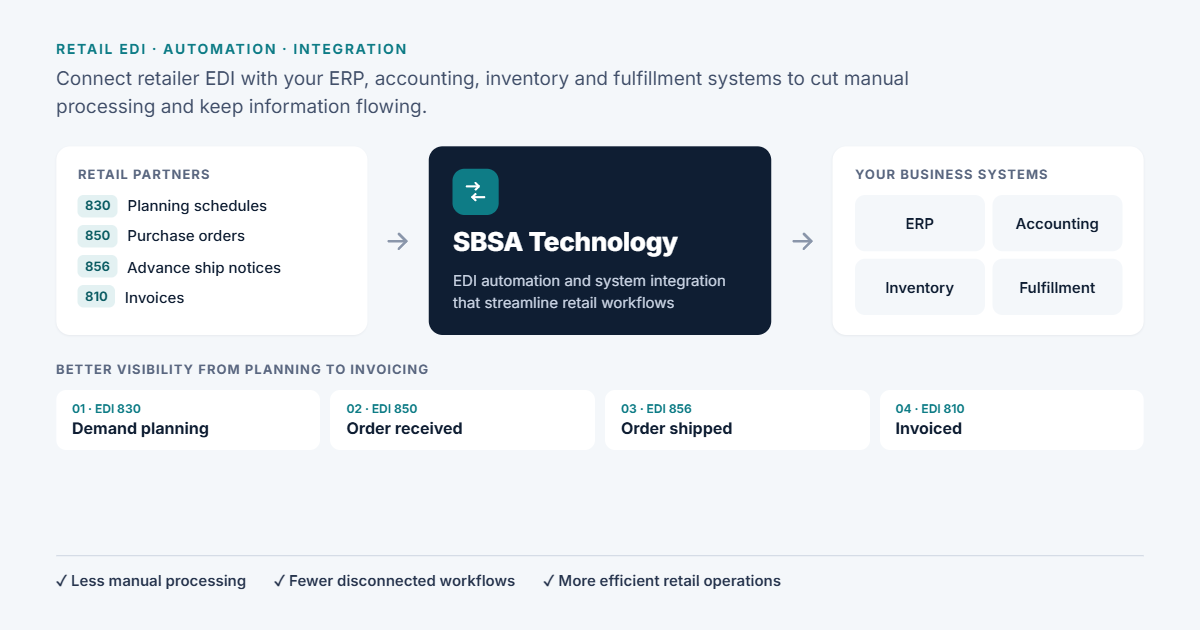 Managing retailer planning schedules becomes more challenging as suppliers work with multiple retail partners, different EDI specifications, and disconnected business systems.
SBSA Technology helps businesses streamline retail EDI and related operational workflows through EDI automation and system integration.
By connecting EDI processes with supported ERP, accounting, inventory, and fulfillment systems, businesses can reduce manual processing and improve the flow of information across their operations.
For suppliers handling retailer transactions such as EDI 830 planning schedules, EDI 850 purchase orders, EDI 856 advance ship notices, and EDI 810 invoices, an integrated approach can help create better visibility from demand planning through order fulfillment and invoicing.
The goal is to reduce disconnected workflows and help teams manage retail operations more efficiently.
Final Thoughts
EDI 830 Planning Schedule gives retail suppliers advance visibility into anticipated demand, helping them make more informed decisions about inventory, production, purchasing, and warehouse operations.
When combined with automated EDI processing and effective ERP integration, planning schedules can help suppliers prepare for changing requirements, reduce avoidable operational disruptions, and coordinate more effectively with retail partners.
Want to streamline your retail EDI operations? SBSA Technology helps manufacturers, distributors, and retail vendors automate EDI workflows and connect business systems to support more efficient operations.
Visit SBSA Technology to learn how EDI automation can support your business.
- Book a demo: sbsatech.com/consultancy
- Talk to the team: sbsatech.com/contact
- Explore the platform: sbsatech.com
- More insights: sbsatech.com/blog