
Sending an EDI document successfully does not always mean the retailer’s system has processed the business information correctly. A purchase order, invoice, or other transaction may be received but still contain information that requires investigation or correction.
EDI 824 Application Advice helps trading partners communicate application-level information about a previously received transaction. For retail vendors, understanding these messages can help identify processing issues, resolve errors faster, and reduce disruptions to order fulfillment and invoicing.
What Is EDI 824 Application Advice?
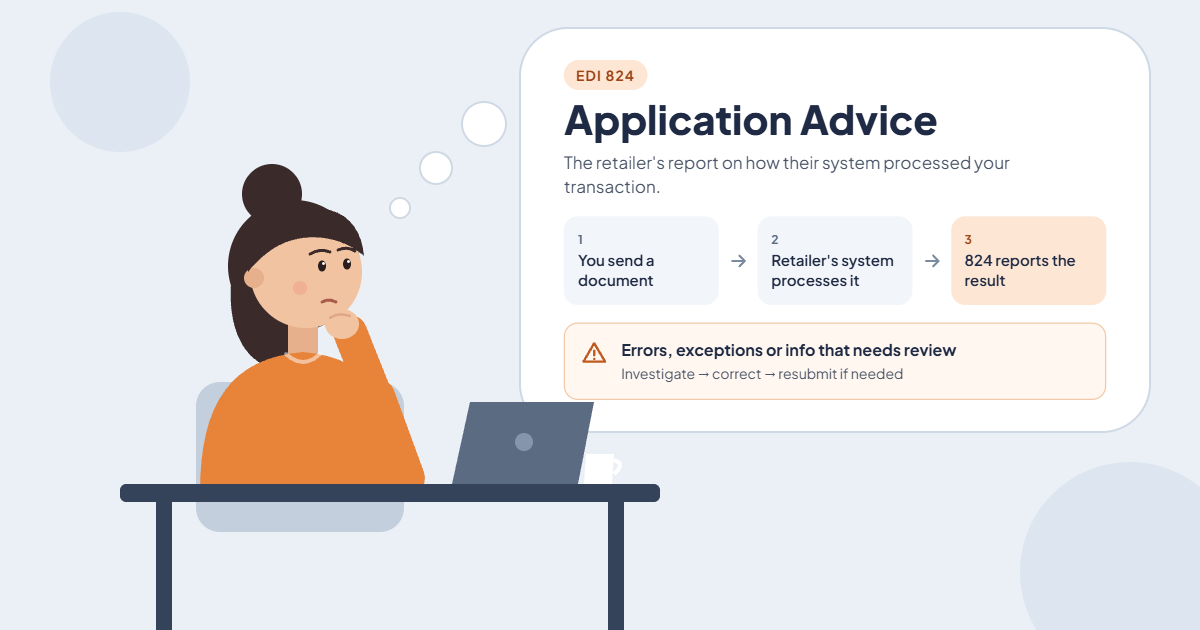
EDI 824 is an EDI transaction set used to communicate the results of an application’s processing of another transaction. Depending on the retailer’s implementation, it may identify errors, exceptions, or other conditions that require attention.
For example, a retailer may send an EDI 824 message indicating that information in a submitted document needs review. The supplier can then investigate the issue and determine whether the original transaction needs correction or resubmission.
The exact information reported in an EDI 824 depends on the trading partner’s specifications.
EDI 824 vs. EDI 997 and EDI 999
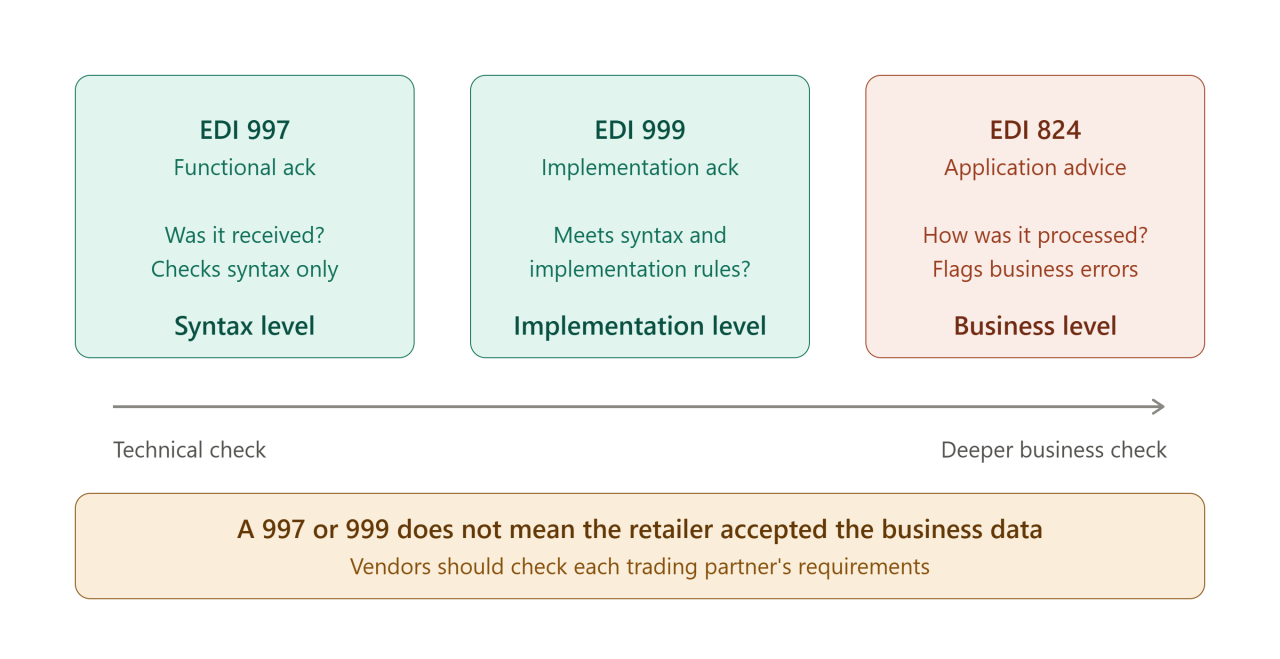
These transaction sets serve different purposes:
-
EDI 997: A Functional Acknowledgment that reports whether an EDI transaction was received and evaluated at the syntax level.
-
EDI 999: An Implementation Acknowledgment that reports whether a transaction meets applicable implementation and syntax requirements.
-
EDI 824: Provides application-level advice about how a transaction was processed, potentially identifying business-related errors or exceptions.
A 997 or 999 acknowledgment does not necessarily mean that the retailer has accepted the business information for processing. Vendors should understand the requirements of each trading partner.
Common EDI 824 Issues Retail Vendors Should Investigate
Depending on the retailer’s specifications, an EDI 824 may help flag situations such as:
-
Invalid or inconsistent business information: Submitted data does not meet the retailer’s application requirements.
-
Incorrect item or reference details: Product identifiers or document references require review.
-
Order or invoice discrepancies: Information conflicts with the retailer’s records or business rules.
-
Processing exceptions: A transaction requires additional investigation before the workflow can proceed.
Not every retailer reports the same conditions through EDI 824, so vendors should always consult the applicable implementation guide.
How Retail Vendors Can Resolve EDI 824 Errors
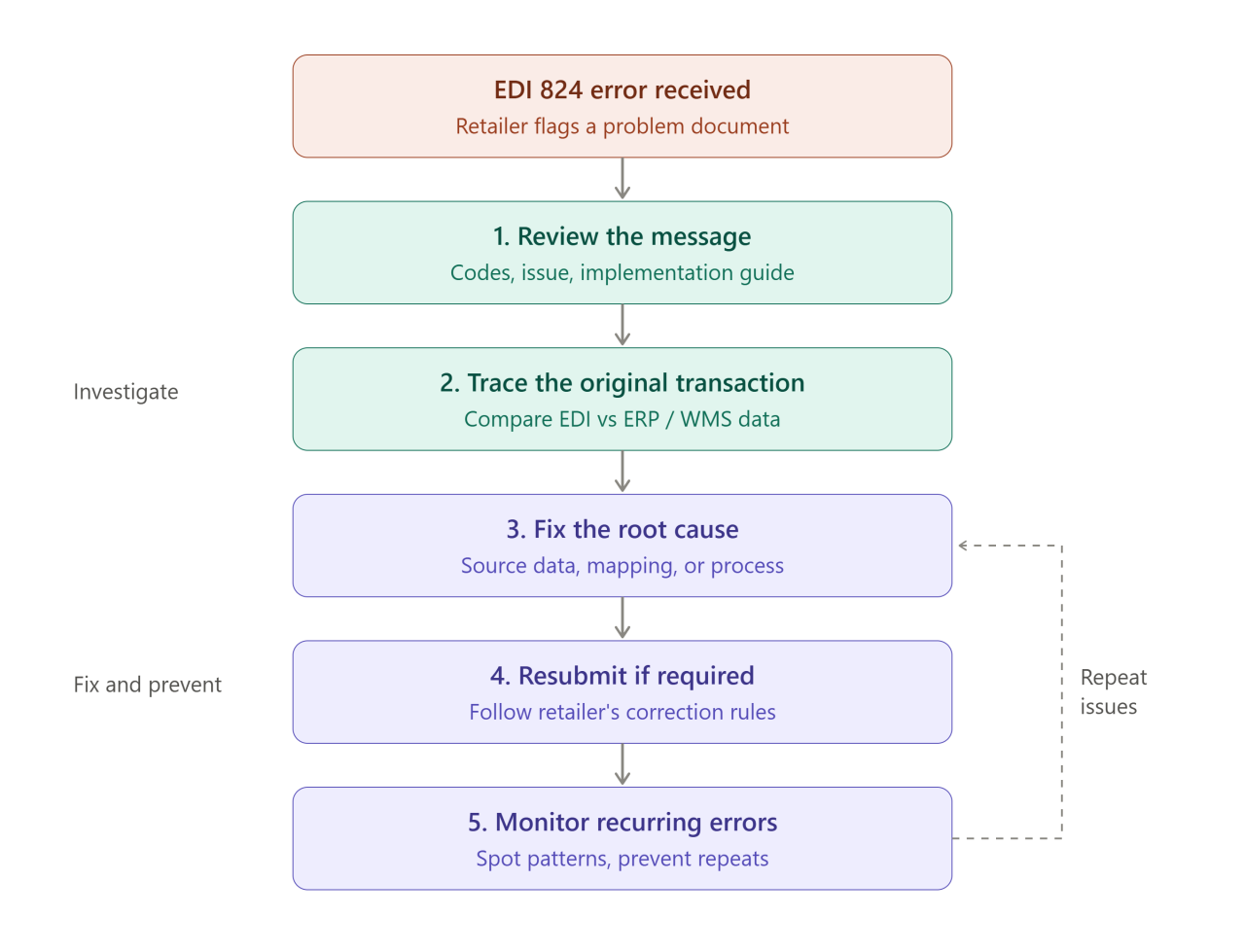
1. Review the Message Details
Identify the transaction being referenced, the reported issue, and any relevant codes or descriptions. Use the retailer’s implementation guide to interpret the message correctly.
2. Trace the Original Transaction
Locate the original EDI document and compare it with the information in your ERP, order management, or warehouse system. Determine whether the issue originated in the source data, mapping, or business process.
3. Correct the Root Cause
Update incorrect information or adjust the relevant integration rules. Avoid simply resending the same document without addressing the reported issue.
4. Resubmit When Required
Follow the retailer’s instructions for corrections, retransmissions, or replacement documents. Confirm whether a new transaction or another response is required before resubmitting.
5. Monitor Recurring Errors
Track repeated exceptions to identify problems such as inconsistent item data, incorrect mappings, or manual data entry. Fixing the underlying cause helps prevent the same issue from affecting future transactions.
How SBSA Technology Helps
SBSA Technology helps retail vendors automate EDI workflows and integrate business systems to reduce manual processing and improve data consistency.
With properly configured integrations and exception-monitoring processes, businesses can identify transaction problems, investigate their causes, and route issues to the appropriate team for resolution. Connecting EDI with ERP and warehouse workflows also helps keep order, shipment, and invoicing information aligned.
Conclusion
EDI 824 Application Advice gives retail vendors an additional way to understand application-level transaction issues. By reviewing messages promptly, tracing errors to their source, and monitoring recurring exceptions, suppliers can improve EDI reliability and reduce avoidable operational delays.
Need help improving your retail EDI operations? Contact SBSA Technology to explore EDI automation and integration solutions designed to help your business process transactions more efficiently.
- Book a demo: sbsatech.com/consultancy
- Talk to the team: sbsatech.com/contact
- Explore the platform: sbsatech.com
- More insights: sbsatech.com/blog