
Getting paid on time is essential for every retail vendor. However, inaccurate invoices, missing information, pricing discrepancies, and retailer compliance issues can delay payments or result in short-pays.
For suppliers selling to major retailers, manually creating and submitting invoices can increase the risk of errors. This is where EDI 810 (Electronic Invoice) helps.
EDI 810 allows suppliers to electronically send standardized invoices to retailers, improving billing accuracy, reducing manual work, and helping businesses maintain more efficient payment processes.
What Is EDI 810?
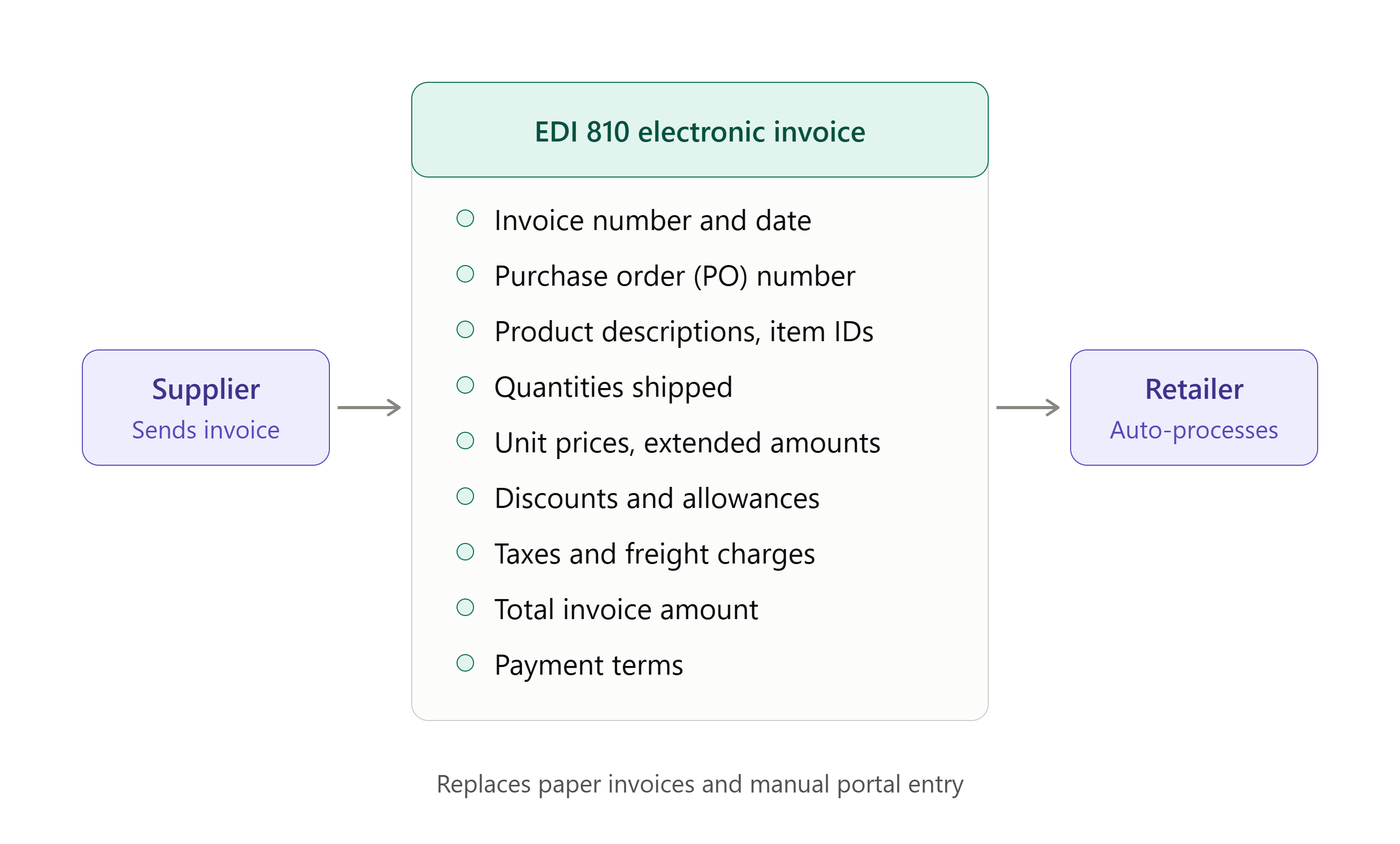
EDI 810 is the Electronic Invoice transaction set used by suppliers to submit invoices electronically to retailers and business partners.
Instead of sending paper invoices or manually entering billing information into retailer portals, suppliers transmit invoice data through an EDI system.
An EDI 810 typically includes:
-
Invoice number and date
-
Purchase order (PO) number
-
Product descriptions and item identifiers
-
Quantities shipped
-
Unit prices and extended amounts
-
Discounts and allowances
-
Taxes and freight charges
-
Total invoice amount
-
Payment terms
This standardized format allows retailers to process supplier invoices more efficiently while reducing manual data entry.
How Does EDI 810 Work?
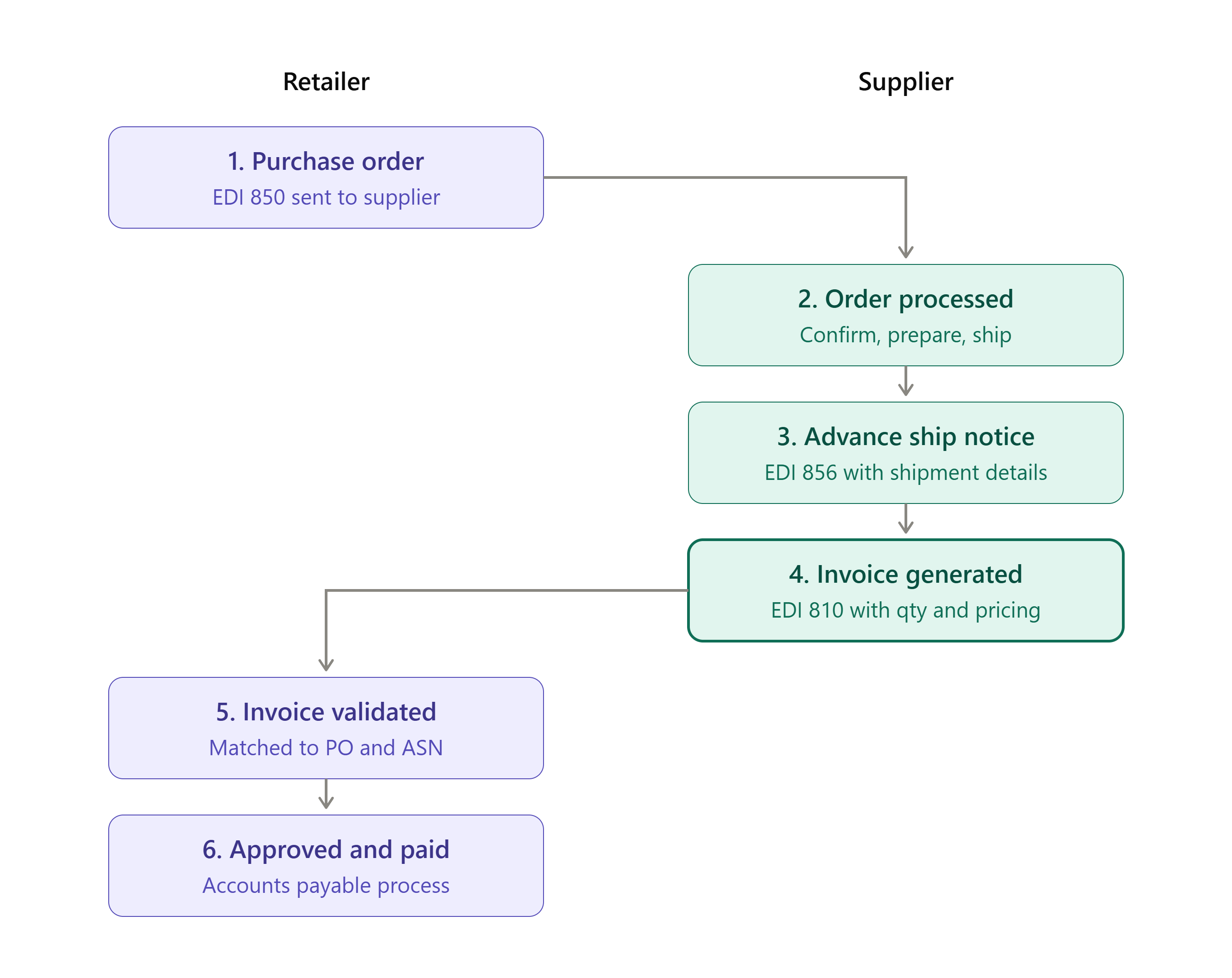
EDI 810 is commonly part of the retail order-to-cash process.
A typical workflow looks like this:
-
Retailer Sends a Purchase Order: The retailer sends an EDI 850 Purchase Order to the supplier.
-
Supplier Processes the Order: The supplier confirms the order, prepares inventory, and fulfills the shipment.
-
Supplier Sends an ASN: The supplier transmits an EDI 856 Advance Ship Notice with shipment details.
-
Supplier Generates an Invoice: Once the order is shipped, the supplier creates an EDI 810 invoice containing the correct quantities, pricing, and order information.
-
Retailer Receives the Invoice: The retailer validates the invoice against its purchase order, shipment records, and applicable business rules.
-
Invoice Approval and Payment: If the invoice meets the retailer's requirements, it can proceed through the retailer's accounts payable process.
Automating this process helps suppliers reduce billing errors and improve invoice visibility.
Common EDI 810 Invoice Errors That Cause Payment Delays
Even small invoice discrepancies can lead to rejected transactions, payment delays, or short-pays.
Here are some common issues suppliers should avoid:
1. Incorrect Purchase Order Numbers
Invoices containing incorrect or missing PO numbers may fail retailer validation.
2. Pricing Discrepancies
When invoice prices do not match the retailer's agreed pricing or purchase order, the retailer may reject the invoice or deduct the difference.
3. Quantity Mismatches
Billing for quantities that do not match shipped or received quantities can result in invoice disputes and short-pays.
4. Incorrect Product Identifiers
Invalid UPCs, GTINs, or retailer item numbers can prevent accurate invoice matching.
5. Missing or Incorrect Charges
Freight, taxes, allowances, and other charges must follow the retailer's requirements. Incorrect amounts can trigger discrepancies.
6. Duplicate Invoices
Submitting the same invoice more than once can create processing issues and payment delays.
How EDI 810 Helps Retail Vendors Get Paid Faster
Automating invoice processing provides several advantages for suppliers.
-
Fewer Invoice Rejections: Automated validation helps identify missing or incorrect information before invoices are transmitted.
-
Reduced Short-Pays: Accurate pricing, quantities, and charges help minimize billing discrepancies.
-
Faster Invoice Processing: Electronic submission reduces manual entry and paperwork.
-
Improved Payment Visibility: Suppliers can track invoice submissions and identify processing issues.
-
Better Financial Management: Accurate invoice data helps businesses maintain reliable accounts receivable records.
EDI 810 does not guarantee faster payment, but it helps eliminate preventable errors that can slow down the payment process.
How SBSA Technology Can Help
Managing retail invoices should not require hours of manual data entry, spreadsheet updates, and error correction.
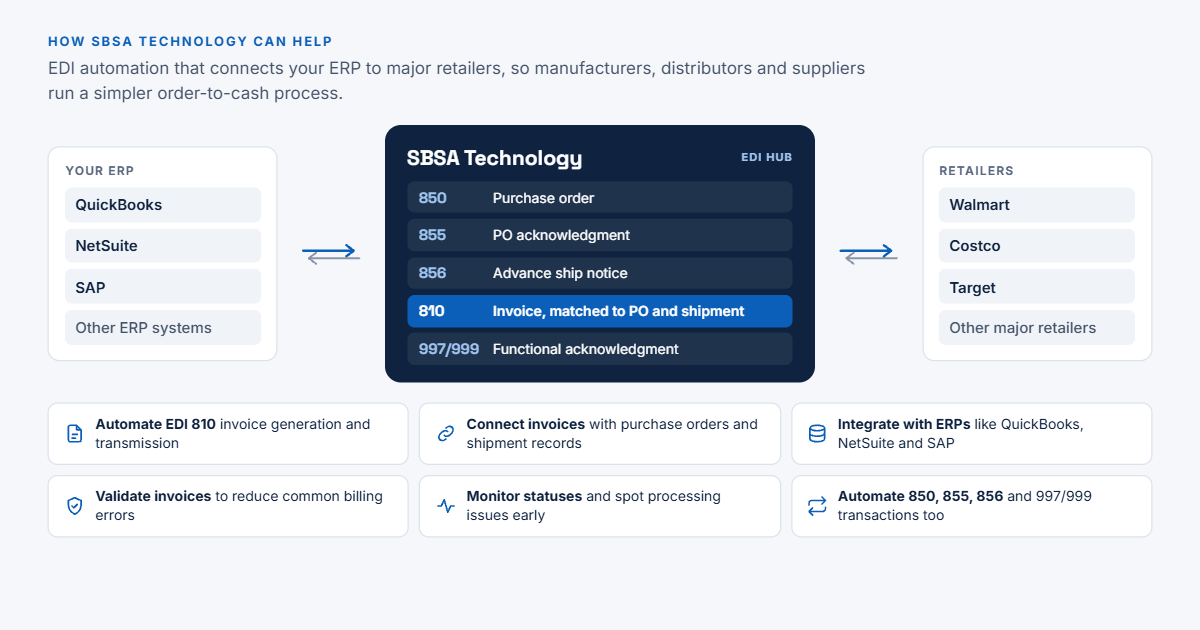
SBSA Technology provides EDI automation and retail vendor operations solutions that help manufacturers, distributors, and suppliers simplify their order-to-cash processes.
With SBSA Technology, businesses can:
-
Automate EDI 810 invoice generation and transmission.
-
Connect invoices with purchase orders and shipment records.
-
Integrate EDI transactions with QuickBooks, NetSuite, SAP, and other ERP systems.
-
Validate invoice information to reduce common billing errors.
-
Monitor transaction statuses and identify processing issues.
-
Automate other retail EDI transactions, including 850, 855, 856, and 997/999.
Whether you sell to Walmart, Costco, Target, or other major retailers, SBSA Technology helps streamline your retail operations through connected automation.
Ready to simplify your retail invoicing process?
Contact SBSA Technology to learn how our EDI automation solutions can help reduce invoice errors, improve retailer compliance, and make your order-to-cash operations more efficient.
- Book a demo: sbsatech.com/consultancy
- Talk to the team: sbsatech.com/contact
- Explore the platform: sbsatech.com
- More insights: sbsatech.com/blog