
Shipping products to major retailers requires more than processing purchase orders and generating invoices. Suppliers must also follow retailer-specific routing requirements to ensure shipments are prepared, scheduled, and delivered correctly.
Two EDI transaction sets that support this process are EDI 753 (Request for Routing Instructions) and EDI 754 (Routing Instructions). These transactions help retailers and suppliers exchange information about shipping arrangements before merchandise leaves the warehouse.
For manufacturers, distributors, wholesalers, and retail vendors, understanding these transactions can help reduce shipping delays, prevent routing errors, and improve retailer compliance.
What Is EDI 753?
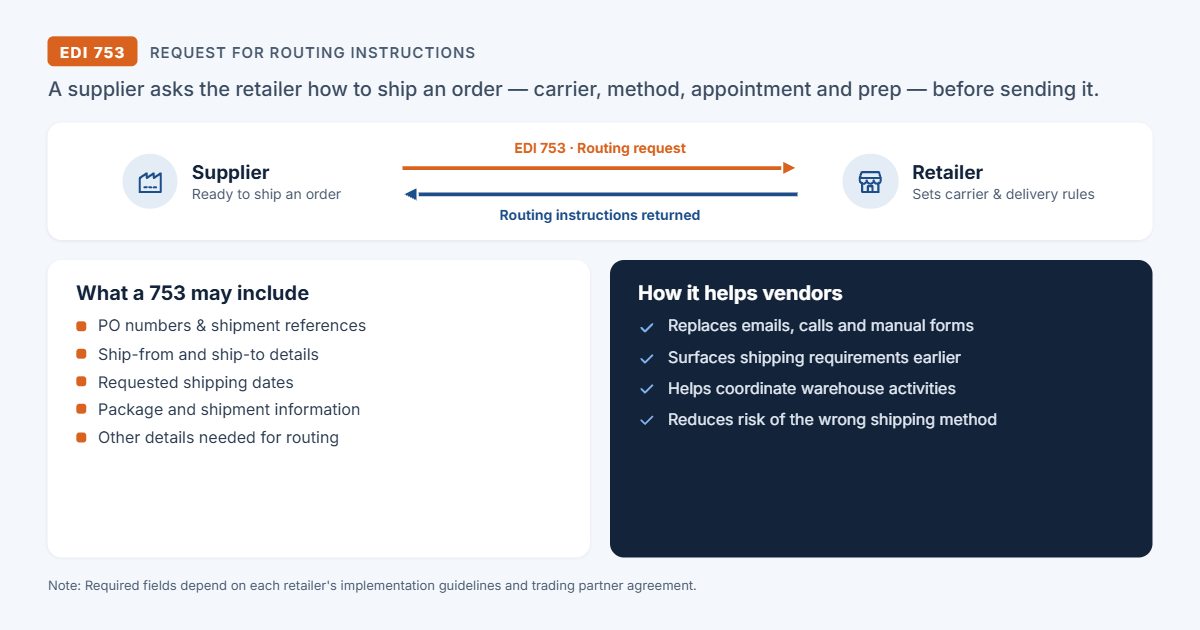 EDI 753 is the Request for Routing Instructions transaction set. It allows a supplier to request shipping and routing information from a retailer before sending an order.
Retailers often have specific requirements regarding carriers, shipping methods, delivery appointments, and shipment preparation. When suppliers need routing guidance, EDI 753 provides a standardized way to request the necessary instructions.
Depending on the retailer's requirements and trading partner agreement, an EDI 753 transaction may include information such as:
-
Purchase order numbers and shipment references
-
Shipment origin and destination details
-
Requested shipping dates
-
Package or shipment information
-
Other details needed to determine the appropriate routing arrangements
How EDI 753 Helps Retail Vendors
EDI 753 helps suppliers request routing information before shipping merchandise. Instead of relying entirely on emails, phone calls, or manual forms, suppliers can exchange routing requests electronically with retailers that support this transaction.
This can help vendors identify shipping requirements earlier, coordinate warehouse activities, and reduce the risk of using an incorrect shipping method.
However, the information required in an EDI 753 transaction depends on the retailer's implementation guidelines.
What Is EDI 754?
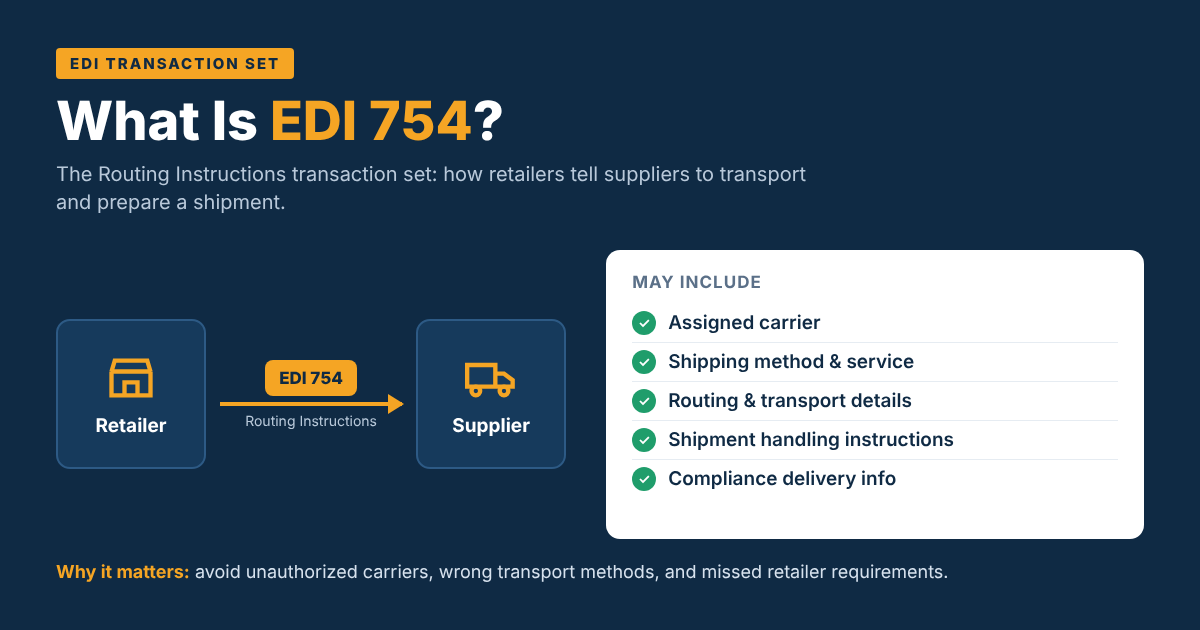 EDI 754 is the Routing Instructions transaction set. It allows a retailer or other authorized party to communicate routing instructions in response to a supplier's routing request or as part of an established shipping process.
These instructions help the supplier understand how a shipment should be transported and prepared to meet the retailer's requirements.
Depending on the trading partner's specifications, EDI 754 may communicate information such as:
-
Assigned carrier or transportation provider
-
Shipping method or service requirements
-
Routing and transportation details
-
Shipment handling instructions
-
Other information required for compliant delivery
How EDI 754 Helps Retail Vendors
EDI 754 gives suppliers the routing information needed to coordinate transportation and fulfillment activities.
For example, a retailer may require a supplier to use a designated carrier or follow a specific shipping procedure. Receiving and processing the routing instructions electronically helps the supplier apply those requirements before the shipment leaves the warehouse.
This reduces the risk of shipping products through an unauthorized carrier, following the wrong transportation method, or missing retailer-specific shipping requirements.
The exact instructions depend on the retailer's EDI specifications and routing policies.
EDI 753 vs. EDI 754: What Is the Difference?
Although EDI 753 and EDI 754 are closely related, they serve different purposes.
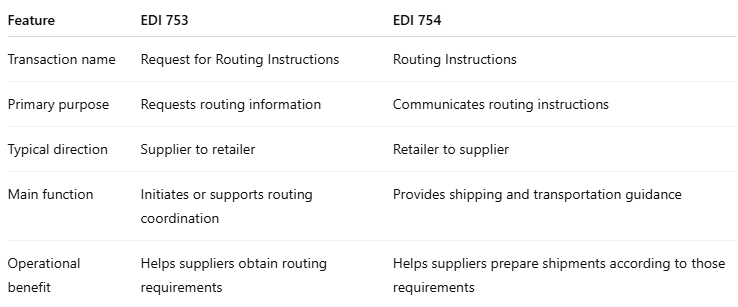
In simple terms, EDI 753 asks for routing instructions, while EDI 754 provides routing instructions.
The precise exchange sequence can vary by retailer. Suppliers should confirm whether a retailer expects these transactions and how they fit into its routing and shipping workflow.
How EDI 753 and 754 Work Together
When supported by a retailer, EDI 753 and EDI 754 can form part of an automated routing workflow.
A typical process may follow these steps:
1. The retailer sends a purchase order.
The supplier receives the purchase order through EDI, commonly using EDI 850, and validates the order details.
2. The supplier prepares a routing request.
Before shipping, the supplier determines whether routing instructions are required. If the retailer supports EDI 753, the supplier sends the appropriate routing request with the required shipment information.
3. The retailer provides routing instructions.
The retailer processes the request and returns routing information through EDI 754 when applicable.
4. The supplier coordinates fulfillment and transportation.
The supplier uses the routing instructions to coordinate warehouse preparation, carrier arrangements, and shipment scheduling according to the retailer's requirements.
5. The supplier sends shipment information.
After the goods are prepared and shipped, the supplier may send an EDI 856 Advance Ship Notice (ASN) containing shipment details, such as carton information and tracking data, as required by the retailer.
6. The supplier completes invoicing.
The supplier may send an EDI 810 invoice after shipment, following the retailer's invoicing rules.
Automating these steps helps connect routing coordination with order processing, warehouse operations, shipping, and billing.
Note: This is an illustrative workflow. Not every retailer uses EDI 753 and 754, and the timing and sequence of transactions depend on the retailer's implementation.
Common EDI 753 and 754 Challenges
Even when suppliers use EDI, routing problems can occur if transaction data is incomplete, instructions are not applied correctly, or systems do not communicate effectively.
1. Incorrect Purchase Order References
A routing request associated with the wrong purchase order can create confusion and delay shipment preparation.
Solution: Validate purchase order numbers and related shipment references before transmitting routing requests.
2. Missing or Incomplete Routing Information
Incomplete requests may prevent the retailer from determining the appropriate shipping arrangements.
Solution: Configure validation rules based on the retailer's EDI implementation guide and required business data.
3. Routing Instructions Not Applied
Receiving an EDI 754 transaction does not guarantee that warehouse or transportation teams will follow the instructions.
Solution: Integrate routing data with the systems used by shipping coordinators and warehouse personnel. Flag missing or conflicting instructions before shipment release.
4. Manual Data Entry and Delays
Manually transferring routing information between EDI systems, spreadsheets, ERP platforms, and warehouse systems can introduce errors.
Solution: Automate data exchange between connected systems wherever possible, reducing repetitive entry and improving information consistency.
5. Limited Transaction Visibility
Without monitoring, suppliers may not immediately notice failed transactions, missing responses, or routing requests that remain unresolved.
Solution: Use transaction monitoring, error alerts, and exception reports to identify problems before they affect shipping schedules.
How SBSA Technology Helps Retail Vendors Automate EDI Operations
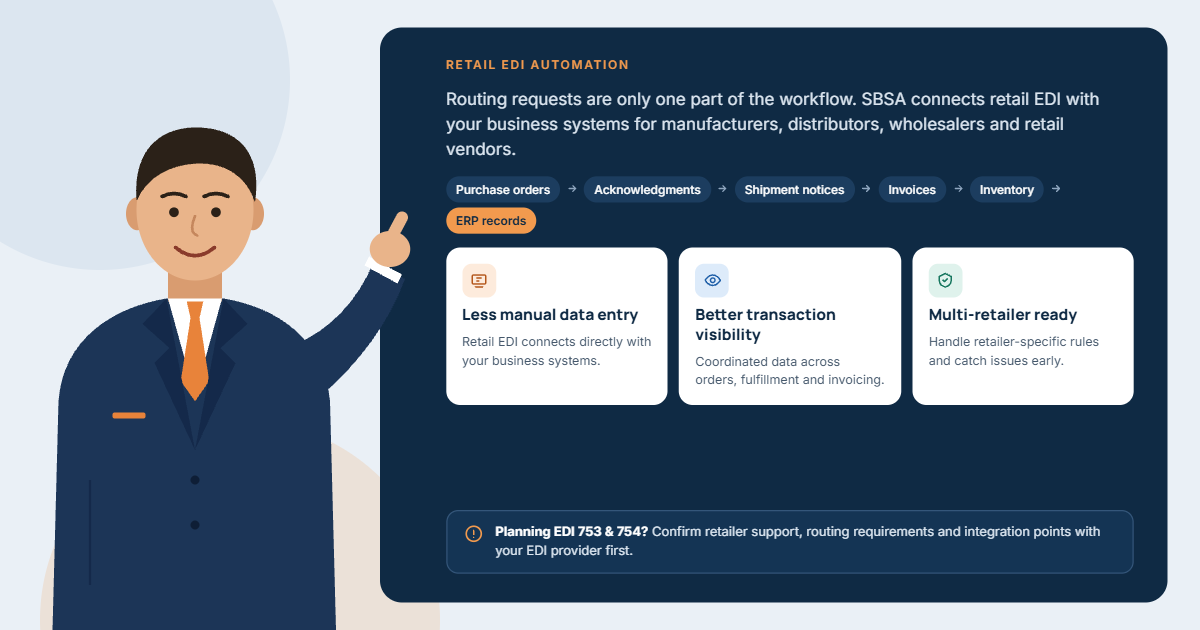 Managing routing requests is only one part of a retail vendor's EDI workflow. Suppliers must also coordinate purchase orders, order acknowledgments, shipment notices, invoices, inventory, and ERP records.
SBSA Technology provides EDI automation and retail operations software designed to help manufacturers, distributors, wholesalers, and retail vendors streamline these connected processes.
By connecting retail EDI with business systems, SBSA Technology helps businesses reduce manual data entry, improve transaction visibility, and coordinate information across order processing, fulfillment, and invoicing workflows.
For vendors working with multiple retail trading partners, an integrated approach can make it easier to manage retailer-specific requirements and identify transaction issues before they disrupt operations.
Before implementing EDI 753 and 754, suppliers should confirm retailer support, routing requirements, and the necessary integration points with their EDI provider.
Final Thoughts
EDI 753 and EDI 754 play complementary roles in retail shipping coordination. EDI 753 allows suppliers to request routing instructions, while EDI 754 communicates routing instructions that help suppliers prepare shipments according to retailer requirements.
When integrated with purchase order processing, warehouse operations, and shipment notifications, these transactions can help retail vendors reduce manual work, improve shipping coordination, and maintain more consistent fulfillment processes.
For businesses seeking to improve retail compliance, automating the entire EDI workflow—not just individual transactions—can provide better visibility and more reliable operations.
Ready to Simplify Your Retail EDI Operations?
SBSA Technology helps retail vendors automate EDI transactions and connect them with their business systems.
Contact SBSA Technology to learn how EDI automation can help streamline your order processing, fulfillment, and invoicing workflows.
- Book a demo: sbsatech.com/consultancy
- Talk to the team: sbsatech.com/contact
- Explore the platform: sbsatech.com
- More insights: sbsatech.com/blog