
Managing multiple shipments arriving on the same trailer can create challenges for suppliers, warehouses, and retail distribution centers. Without accurate shipment details, receiving teams may struggle to identify incoming freight, prepare unloading operations, and reconcile deliveries.
EDI 212 (Motor Carrier Delivery Trailer Manifest) helps automate this process by allowing motor carriers to electronically communicate the contents of a trailer carrying multiple shipments.
What Is an EDI 212?
EDI 212 is an ANSI X12 transaction set used by motor carriers to provide consignees and other interested parties with information about shipments contained in a trailer that has been tendered for delivery.
It typically includes shipment references, carrier information, trailer details, shipment quantities, weights, and delivery-related information.
The transaction is particularly useful for less-than-truckload (LTL) and consolidated freight deliveries, where a single trailer may contain shipments for multiple customers or destinations.
How EDI 212 Works
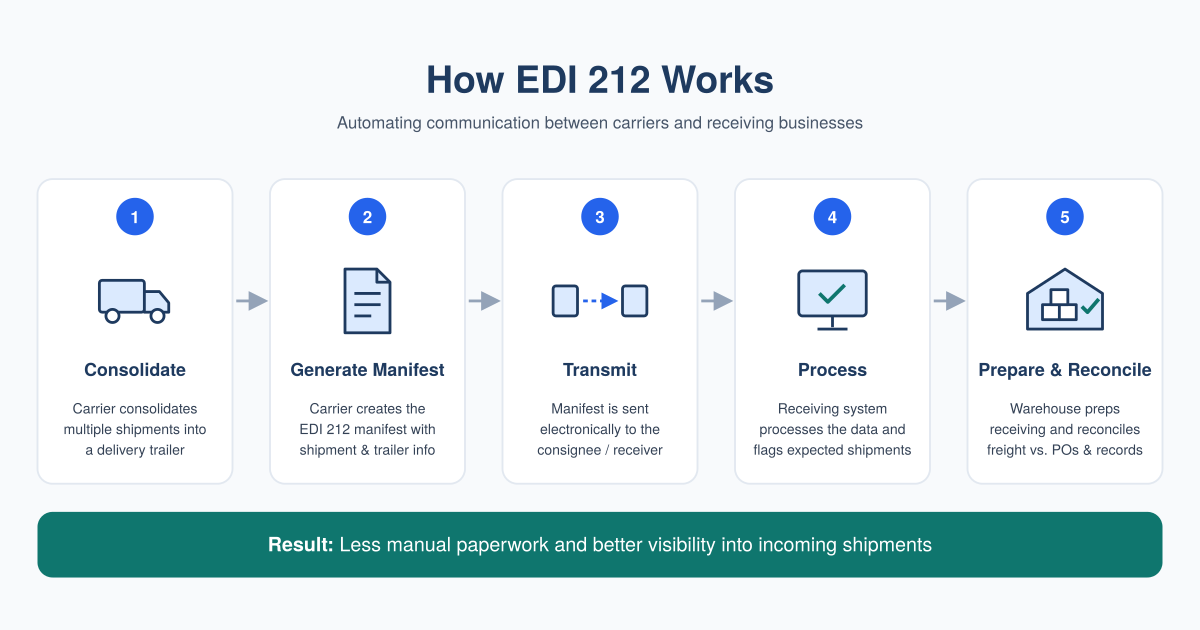 The EDI 212 transaction helps automate communication between carriers and receiving businesses.
A typical workflow includes:
-
The carrier consolidates multiple shipments into a delivery trailer.
-
The carrier generates an EDI 212 manifest containing shipment and trailer information.
-
The manifest is transmitted electronically to the consignee or receiving company.
-
The receiving system processes the information and identifies the shipments expected to arrive.
-
Warehouse teams use the manifest to prepare receiving operations and reconcile freight against purchase orders and shipment records.
Automating this process reduces manual paperwork and improves visibility into incoming shipments.
What Information Does an EDI 212 Contain?
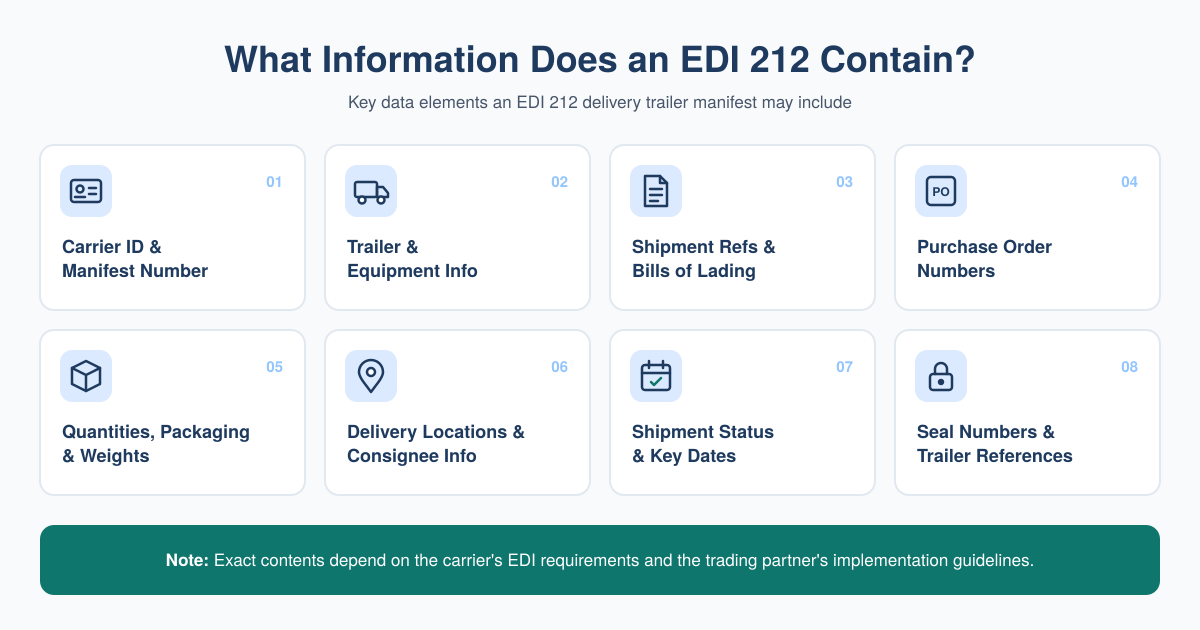 An EDI 212 may include:
-
Carrier identification and manifest number
-
Trailer and equipment information
-
Shipment reference numbers and bills of lading
-
Purchase order numbers
-
Shipment quantities, packaging information, and weights
-
Delivery locations and consignee information
-
Shipment status and relevant dates
-
Seal numbers and other trailer references
The specific information transmitted depends on the carrier's EDI requirements and the trading partner's implementation guidelines.
Benefits of EDI 212 for Suppliers
Improved Shipment Visibility
Suppliers and receiving facilities can identify the shipments included in an incoming trailer before the freight arrives.
Faster Receiving Operations
Warehouse teams can prepare for deliveries, organize receiving activities, and reduce delays caused by manually reviewing shipment documents.
Reduced Manual Data Entry
EDI automation eliminates the need to manually enter manifest information into spreadsheets or warehouse systems.
Better Shipment Reconciliation
Receiving teams can compare manifest details against purchase orders, shipment records, and actual received quantities to identify discrepancies.
Improved Transportation Documentation
Electronic manifests provide standardized shipment information that can be shared between carriers, suppliers, warehouses, and retail distribution centers.
EDI 212 vs. EDI 214
EDI 212 and EDI 214 are both transportation-related EDI transactions, but they serve different purposes.
-
EDI 212: Communicates the contents of a delivery trailer containing multiple shipments.
-
EDI 214: Communicates transportation shipment status updates, such as pickup, in-transit, arrival, and delivery events.
Businesses may use both transactions to improve transportation visibility and receiving operations.
How SBSA Technology Helps Automate EDI 212
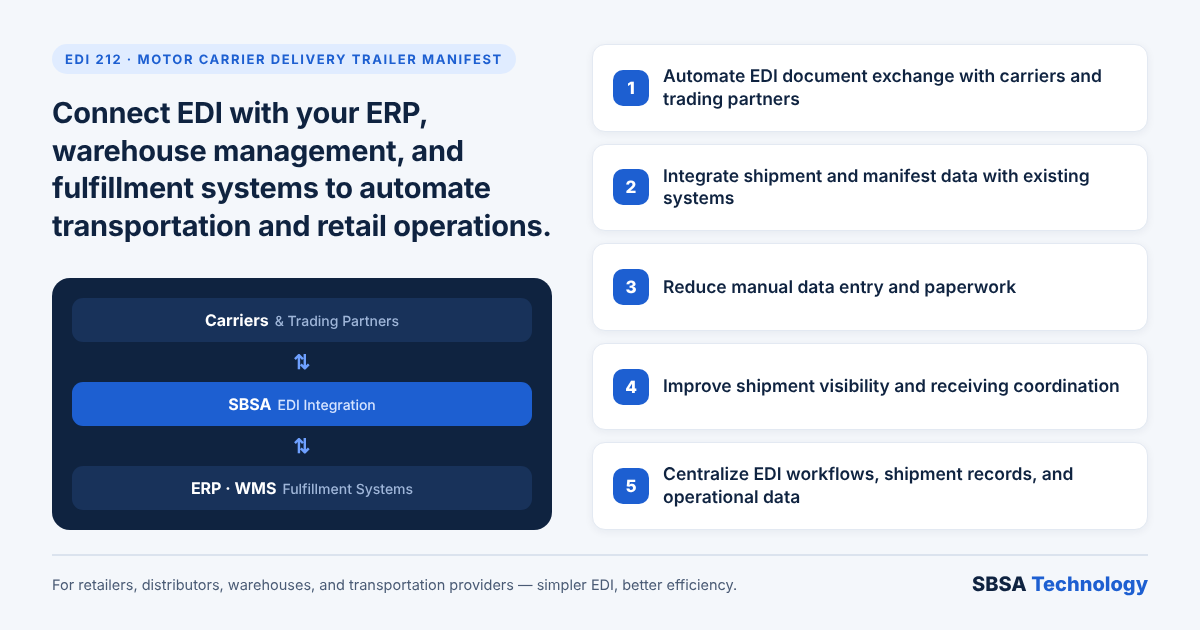 SBSA Technology helps suppliers automate transportation and retail operations through EDI integration with their ERP, warehouse management, and fulfillment systems.
With SBSA Technology, businesses can:
-
Automate EDI document exchange with carriers and trading partners.
-
Integrate shipment and manifest information with existing business systems.
-
Reduce manual data entry and paperwork.
-
Improve shipment visibility and receiving coordination.
-
Centralize EDI workflows, shipment records, and operational data.
Whether your business works with major retailers, distributors, warehouses, or transportation providers, SBSA Technology helps simplify EDI processes and improve operational efficiency.
Looking to automate your transportation and EDI workflows? Contact SBSA Technology to learn how our EDI solutions can help streamline your shipment documentation and retail operations.
- Book a demo: sbsatech.com/consultancy
- Talk to the team: sbsatech.com/contact
- Explore the platform: sbsatech.com
- More insights: sbsatech.com/blog