
Why Costco Runs Everything Through EDI
Electronic Data Interchange (EDI) is simply the computer-to-computer exchange of standard business documents — purchase orders, shipping notices, invoices — without anyone re-keying data by hand. For most big-box retailers this is a nice-to-have efficiency play. For Costco, it's structural.
Costco doesn't run a typical retail backroom. Product flows almost directly from the receiving dock to the floor through cross-docking, with very little staging or storage in between. That model only works if Costco's systems know, in advance and in a predictable format, exactly what's arriving, when, and in what quantities. A supplier who emails a PDF invoice or calls in a shipment update introduces exactly the kind of friction that model can't absorb.
In practice, EDI is what lets Costco:
- Push out purchase orders automatically and get supplier confirmations back without a human touching either side
- Pre-plan warehouse dock assignments based on shipment data that arrives before the truck does
- Match invoices against orders and receipts fast enough to keep payment cycles short
- Cut down on the data-entry mistakes that come from manually transcribing order or shipment details
Because of this, EDI isn't a suggestion for Costco vendors — it's a condition of doing business. Skip it, and you're not just inconvenient; you're actively disrupting how their warehouses operate.
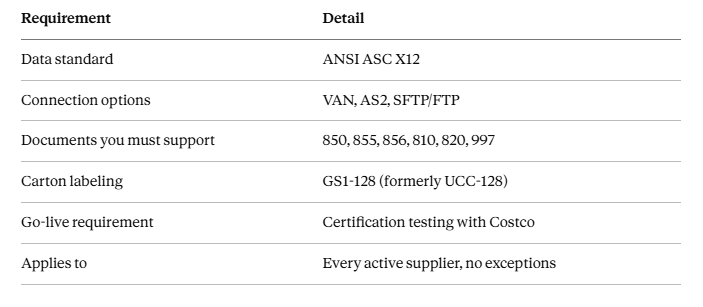
Quick reference: Costco's EDI baseline
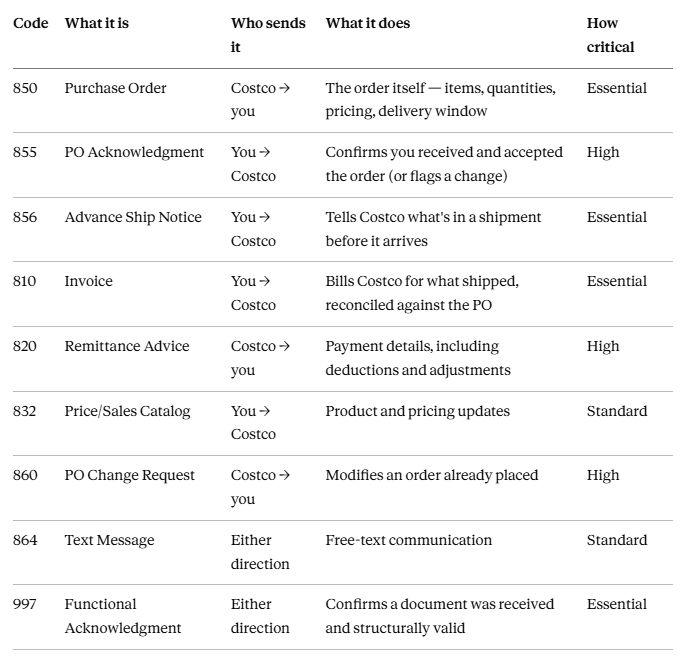
The Documents Costco Actually Requires
Costco's EDI program covers several transaction types, but they don't all carry equal weight. A handful of them determine whether your orders flow smoothly or your payments get held up.
The Three Documents That Have to Agree
At the heart of Costco's compliance system is what's often called the three-way match: Costco's systems automatically cross-check the 850 (what was ordered), the 856 (what was shipped), and the 810 (what you're billing for). When the item numbers, quantities, and pricing line up across all three, payment moves through without anyone touching it. When they don't, you're looking at a chargeback, a payment hold, or both.
This isn't unique to Costco — if you also supply Walmart or Target, you've likely run into similar matching logic. But Costco's cross-docking model makes the consequences of a mismatch land faster and harder.
The ASN Is Where Most Suppliers Get Tripped Up
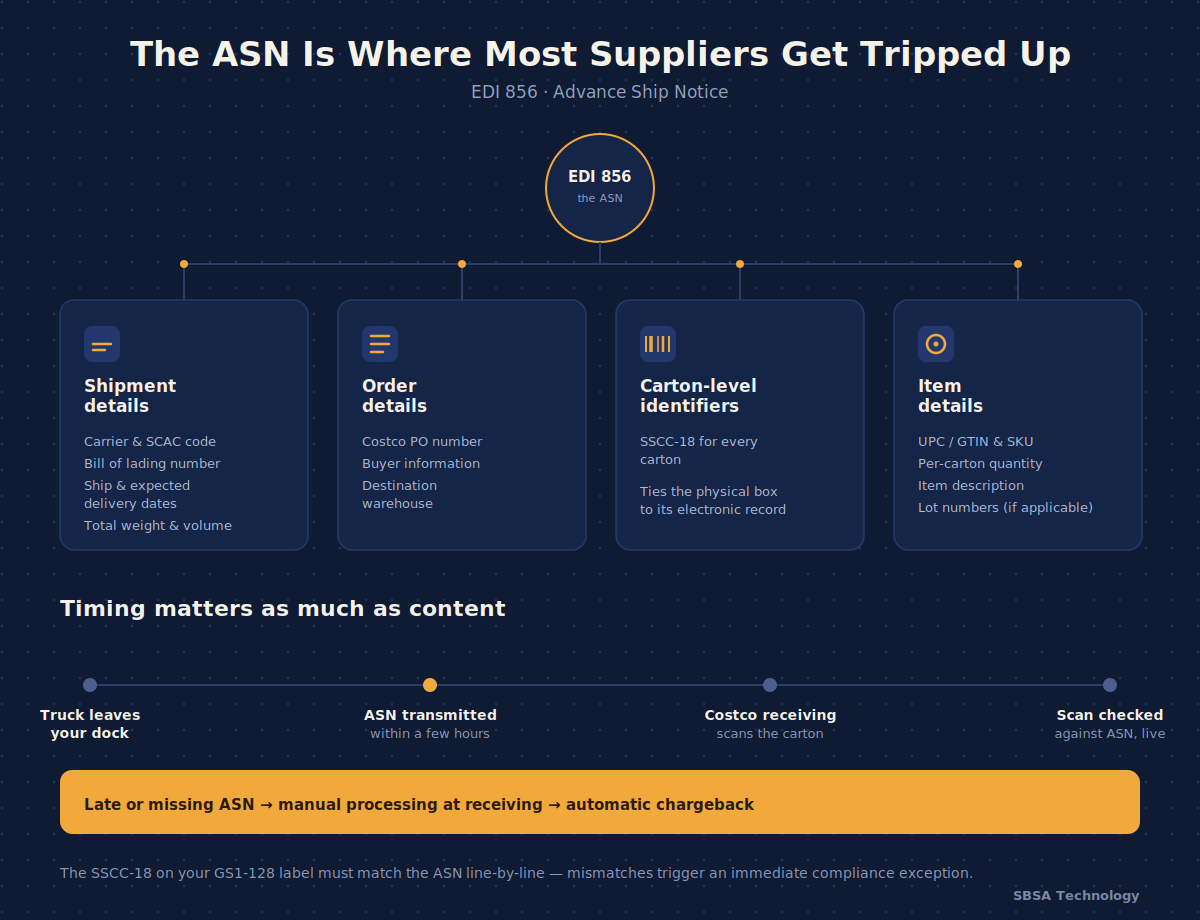 Of all the documents in Costco's EDI program, the Advance Ship Notice (856) causes the most trouble, and it's not close. It's the document that tells Costco's warehouse team what's coming before it physically shows up — which means every downstream process, from dock scheduling to inventory updates, depends on it being accurate and on time.
A compliant ASN needs to carry several layers of information:
- Shipment details — carrier and SCAC code, bill of lading number, ship and expected delivery dates, total weight/volume
- Order details — the Costco PO number, buyer info, destination warehouse
- Carton-level identifiers — an SSCC-18 code for every carton, tying the physical box to its electronic record
- Item details — UPC/GTIN, SKU, per-carton quantity, item description, and lot numbers where relevant
Timing matters just as much as content. Costco expects the ASN to reach them before the shipment does — ideally sent within a few hours of the truck leaving your dock, not the next day. An ASN that arrives late (or after the goods do) forces Costco's team to process the shipment manually, which is precisely the kind of delay their model is designed to avoid — and it's an automatic chargeback trigger.
There's also a physical-to-digital link that has to hold up: the SSCC-18 barcode printed on your GS1-128 shipping labels needs to match the SSCC-18 referenced in your ASN line by line. When Costco scans a carton at receiving, that scan is checked against the ASN in real time. Any mismatch — wrong quantity, wrong item, a barcode that doesn't correspond to anything in the ASN — kicks off a compliance exception immediately.
Given how many data points have to line up perfectly, it's easy to see why the 856 generates more penalties than any other document in Costco's program.
What Non-Compliance Actually Costs You
Costco backs its EDI requirements with real financial teeth. Depending on the type of violation, penalties can run anywhere from a flat $50–$200 per incident up to 1–5% of the total purchase order value. For a supplier shipping into hundreds of warehouses, those numbers compound quickly.
Common chargeback triggers
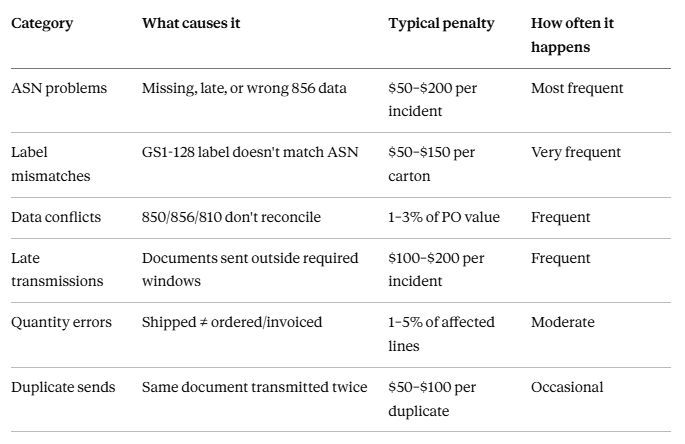
Do the math on a mid-sized supplier: 100 orders a month with even a modest 5% error rate works out to roughly 60 chargeback events a year. At an average of $150 each, that's about $9,000 gone to preventable mistakes. Suppliers dealing with percentage-based data-discrepancy penalties can see that climb into the $50,000–$200,000+ range annually.
Costco does allow suppliers to dispute chargebacks, but disputing after the fact is far more expensive — in time and staff hours — than preventing the error in the first place. The suppliers who stay out of chargeback trouble tend to do four things consistently: automate ASN creation instead of building it by hand, validate every document against Costco's spec before it's transmitted, monitor transactions in real time so errors get caught early, and keep product master data (UPC codes, descriptions, pricing) consistent everywhere it lives.
Where Suppliers Struggle Most
EDI compliance sounds procedural until you're the one implementing it. In practice, most of the friction comes from a handful of recurring problems:
Dense implementation guides. Costco's EDI Implementation Guide spells out exact requirements for every segment and field across every transaction type — and it can run hundreds of pages. Get one field wrong (a bad data type, a missing conditional segment) and documents get rejected.
Data mapping headaches. Your ERP, WMS, and accounting systems all store data their own way. Translating that into Costco's exact X12 structure means handling conditional rules, code translations, and formatting quirks that aren't always intuitive.
ERP integration. Wiring your EDI setup into SAP, Oracle, NetSuite, or QuickBooks is often the heaviest lift in the whole process — deciding between real-time and batch processing, building custom connectors, and keeping everything working through system updates.
Certification delays. Costco won't let you go live until you pass certification testing across every required document type. Between submitting tests, getting feedback, and re-testing, this phase alone commonly takes two to eight weeks.
Thin internal expertise. Smaller and mid-sized suppliers rarely have a dedicated EDI specialist on staff, which usually means either an expensive consultant or a steep learning curve while trying to hit production standards at the same time.
Juggling multiple retailers. If you also ship to Walmart, Target, or other major accounts, each one has its own implementation guide and its own quirks. Managing several sets of requirements in parallel adds real operational overhead.
Getting Compliant: A Practical Roadmap
1. Get the Implementation Guide and read it closely. Once you have a supplier agreement in hand, request the EDI Implementation Guide from your Costco buyer or their supplier operations team. This is your rulebook — X12 versions, required segments, formatting rules, and testing procedures all live here. Go through every transaction set relevant to your product category before you build anything.
2. Decide how you're going to handle EDI. You've got three realistic paths:
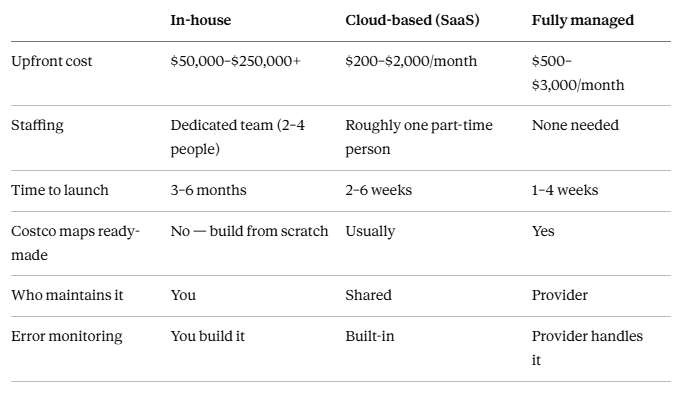
Most growing brands are better served by a cloud-based or fully managed provider — the upfront cost is a fraction of building in-house, and pre-built Costco mappings save weeks of setup time.
3. Map your data and connect your systems. This is where the technical work happens: translating your internal item numbers into Costco's UPC/GTIN structure, connecting your ERP so orders and invoices flow automatically, setting up GS1-128 label printing off the same data source as your ASN, and automating your 997 responses.
4. Pass certification. Submit test documents for every required transaction type, work through Costco's feedback, and iterate until everything validates cleanly. Using your provider's pre-built Costco templates and testing thoroughly on your end before submitting will shave real time off this stage.
5. Go live — and keep watching. Certification is the starting line, not the finish. Ongoing compliance means monitoring transactions in real time, alerting your team the moment something fails validation, reviewing chargeback reports on a regular cadence, and keeping product data current as your catalog changes.
Connection Protocols and Technical Basics
Costco supports a few different ways to actually move EDI documents back and forth:
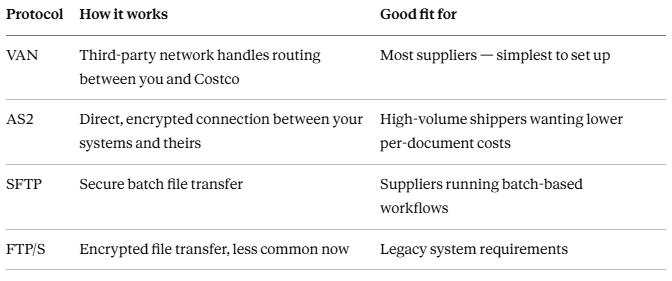
A Value-Added Network (VAN) remains the most common setup because it's the simplest to implement — it acts as an intermediary that validates and routes your documents. AS2 is the alternative worth considering once your volume is high enough to justify it: it cuts out per-document VAN fees, delivers documents instantly, and confirms receipt automatically through MDN receipts. Setting it up requires a digital certificate, an AS2 server or software, and coordination with Costco's EDI team on connection parameters.
On the data-format side, Costco (like most large retailers) typically operates on X12 version 4010 for its core documents, though you should always confirm the specific version in your Implementation Guide, since requirements can shift over time.
Labels Have to Match the ASN, Exactly
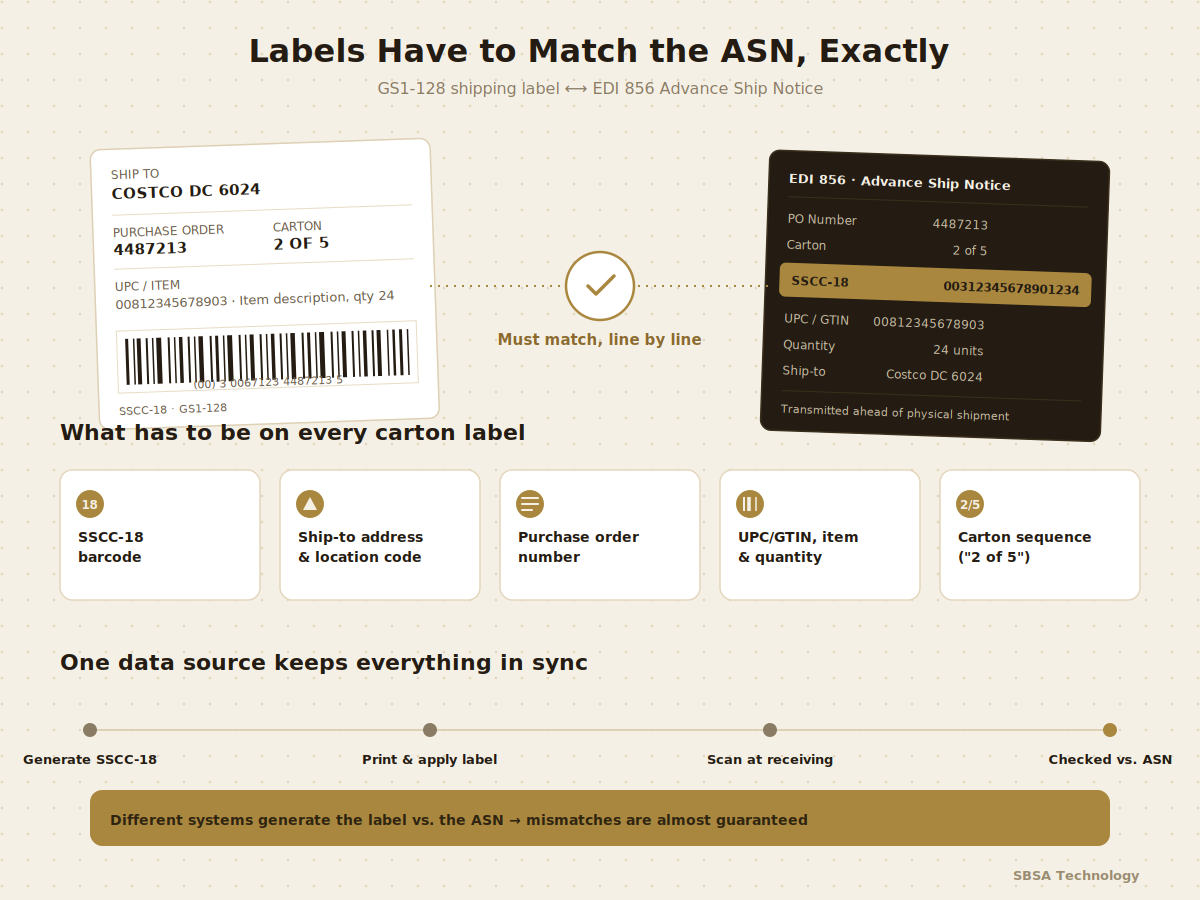
Every carton you ship to Costco needs a GS1-128 barcode label carrying an SSCC-18 — an 18-digit code unique to that carton. This code is the physical-world twin of the SSCC-18 referenced in your electronic ASN, and the two need to match perfectly.
A compliant label includes:
- The SSCC-18 barcode
- Costco's ship-to warehouse address and location code
- The purchase order number
- UPC/GTIN, item description, and quantity
- Carton sequence ("Carton 2 of 5," for example)
The mechanics are straightforward in theory: your system generates SSCC-18 codes, those same codes go into your 856 ASN, labels get printed with matching codes and applied to cartons, and when Costco scans a box at receiving, the system checks it against the ASN instantly — no manual inspection needed.
The catch is that this only works if your labels and your ASN are generated from the same underlying data. Pull them from two different systems and you're all but guaranteed to see mismatches eventually. Use thermal transfer printing for durability, follow Costco's placement guidelines (typically the upper-right corner of the carton), and scan labels after printing to catch bad prints before they ship.
Where Retail EDI Is Headed
A few shifts are worth watching if you're building or upgrading your Costco EDI setup:
Cloud is winning. On-premise EDI infrastructure is steadily giving way to cloud-based platforms, driven by lower upfront costs, pre-built retailer maps, automatic updates, and easier scaling during peak season. The global EDI market was valued near $36 billion in 2023 and continues expanding as this shift plays out.
APIs are supplementing EDI, not replacing it. For high-volume structured documents like purchase orders and invoices, EDI remains the standard with established partners like Costco. APIs are gaining ground for real-time needs — inventory checks, order status — but the two are increasingly coexisting rather than competing.
AI is changing how errors get caught. Newer EDI platforms use machine learning to flag unusual documents before they're transmitted, spot patterns that historically precede chargebacks, suggest data mappings automatically, and surface potential issues before they become compliance failures — all of which matters more as transaction volume grows.
Security is non-negotiable. As supply chains become bigger targets for cyberattacks, encrypted protocols like AS2, secured VAN connections, and routine security audits have moved from best practice to baseline expectation.
Frequently Asked Questions
Does Costco require EDI? Yes — every active Costco supplier must use EDI. There's no manual workaround for the core documents (850, 856, 810, 997).
What exactly counts as an "EDI requirement"? It's the full set of rules a retailer sets for how its trading partners must communicate electronically — which document types are required, what data standard to use (ANSI X12, in Costco's case), which connection protocols are supported, and the formatting rules laid out in their Implementation Guide.
How long does it take to get compliant? It depends heavily on your setup. A cloud-based provider with pre-built Costco maps can get you live in two to six weeks. Custom ERP integrations can stretch to two or three months. Certification testing itself typically adds another one to three weeks on top of whichever path you choose.
What happens if I fall out of compliance? You'll see chargebacks — deductions taken straight out of your payments. Repeated issues can escalate beyond fines into order holds, reduced order volume, or, in serious cases, losing the supplier relationship entirely.
Do I have to use a VAN? No. It's the most common route because it's the easiest to set up, but Costco also supports direct AS2 connections, which high-volume suppliers often prefer for cost and speed reasons. Most EDI providers handle this connection setup on your behalf either way.
Can my existing ERP handle Costco EDI on its own? Not by itself. Your ERP holds your business data, but it won't natively generate X12-formatted documents. You need an EDI solution that connects to your ERP and handles that translation and transmission automatically.
Should I build this in-house or use a provider? For most suppliers, a third-party provider makes more sense financially and operationally. In-house builds run $50,000–$250,000+ before you even factor in staffing. Cloud providers get you live faster and cheaper, with Costco-specific templates already built. In-house tends to only make sense for large enterprises with very high, complex transaction volume.
How SBSA Technology Can Help
Costco's certification process leaves little room for trial and error — a shaky AS2 connection or a mapping error on your first submission can add weeks to onboarding, and once you're live, the same kinds of mistakes show up as chargebacks and delayed payments instead. SBSA Technology works alongside your team through every stage of that process — from initial connection setup to final certification — so the compliance work gets done right the first time instead of getting fixed after something breaks.
Specifically, our team works with you across the parts of the process where suppliers most often lose time:
- Connection setup — Configuring and testing your AS2 or VAN connection with Costco's EDI team, including certificate exchange and MDN receipt validation, so the handshake works the first time you submit it.
- Document mapping — Translating your ERP or WMS data into Costco's exact X12 structure for the 850, 855, 856, 810, 820, and 997, with attention to the conditional fields and formatting rules that cause the most rejections.
- ASN and label alignment — Making sure your SSCC-18 codes, GS1-128 labels, and EDI 856 data all come from a single source of truth, so scanned cartons match what Costco's system expects at receiving.
- Certification support — Preparing and submitting your test transactions, interpreting Costco's feedback, and iterating quickly so you clear certification in as few rounds as possible.
- Post-go-live monitoring — Watching your transactions after you're live, flagging failed acknowledgments or formatting issues before they turn into chargebacks, and tracing recurring errors back to their root cause.
The goal isn't just getting you certified — it's making sure the integration holds up once real purchase orders and real deadlines are on the line.
Conclusion
Costco's EDI program is demanding, but it's not mysterious once you understand the mechanics. A few things matter more than anything else: treat the ASN as your highest-risk document and get its timing and accuracy locked down; build validation into your process so errors get caught before transmission, not after a chargeback lands; pick an EDI approach that matches your actual volume and internal capacity rather than over- or under-building; and remember that certification is just the starting point — ongoing monitoring is what actually keeps chargebacks away.
Get the fundamentals right, and Costco's EDI requirements become a manageable part of doing business with one of the largest retailers in the world — not a recurring drain on your margins.
Let's Talk EDI
Whether you're preparing for your first shipment to Costco or auditing an existing setup that keeps generating chargebacks, SBSA Technology partners with suppliers, distributors, e-commerce brands, and 3PL providers to take the manual work out of EDI, order flow, and retailer compliance.
- See it in action: sbsatech.com/consultancy
- Reach out to our team: sbsatech.com/contact
- Learn more about the platform: sbsatech.com
- Browse more guides like this one: sbsatech.com/blog