
Connecting Fishbowl Inventory to Your Entire Business
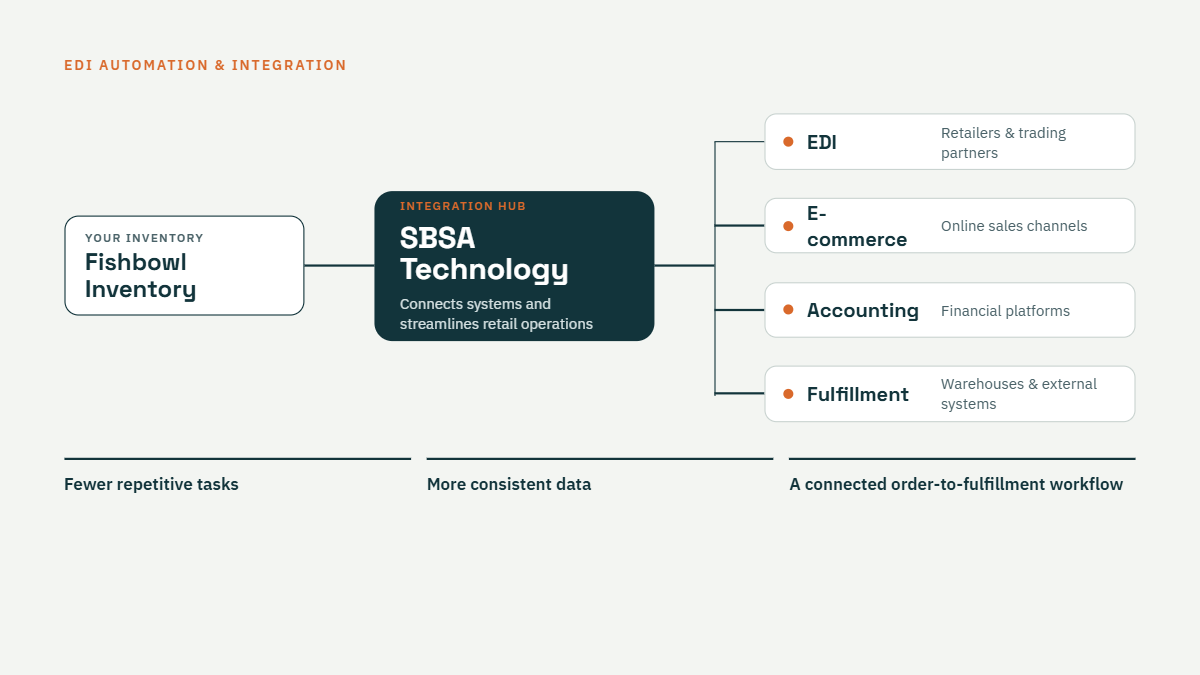
Managing inventory efficiently is essential for growing manufacturers, distributors, wholesalers, and retail suppliers. However, when inventory management operates separately from electronic data interchange (EDI), e-commerce, accounting, and fulfillment systems, businesses can experience delays, duplicate data entry, inventory discrepancies, and order processing errors.
Fishbowl Inventory helps businesses manage inventory-related operations, but companies may need additional integrations to connect their inventory workflows with retailers, trading partners, accounting platforms, and external fulfillment systems.
This is where SBSA Technology can help.
SBSA Technology provides EDI automation and integration solutions designed to connect business systems and streamline retail operations. By integrating Fishbowl Inventory with supported external platforms, businesses can reduce repetitive tasks, improve data consistency, and create a more connected order-to-fulfillment workflow.
Whether your company sells through major retailers, operates multiple sales channels, or manages orders across different warehouses, the right integration strategy can help your team spend less time managing disconnected systems and more time growing the business.
What Is Fishbowl Inventory API Integration?
Fishbowl Inventory API integration refers to connecting Fishbowl's inventory and operational data with other business applications through supported application programming interfaces (APIs), connectors, or integration services.
An API allows compatible software systems to exchange information according to defined rules. Instead of manually transferring information between systems, an integration can automate specific processes when the required interfaces, permissions, and workflows are available.
For example, a business may need to connect Fishbowl Inventory with:
-
Retail EDI systems for purchase orders, shipment notifications, and invoices.
-
E-commerce platforms for order and inventory synchronization.
-
Enterprise resource planning (ERP) and accounting systems.
-
Warehouse management and third-party logistics (3PL) platforms.
-
Shipping and fulfillment applications.
-
Reporting and business intelligence tools.
The exact capabilities depend on the Fishbowl version, the available interfaces, the connected applications, and the business's integration requirements.
For businesses selling to major retailers, API integration can complement EDI automation by connecting retailer transactions with internal inventory and fulfillment workflows.
Why Businesses Need Fishbowl Inventory Integration
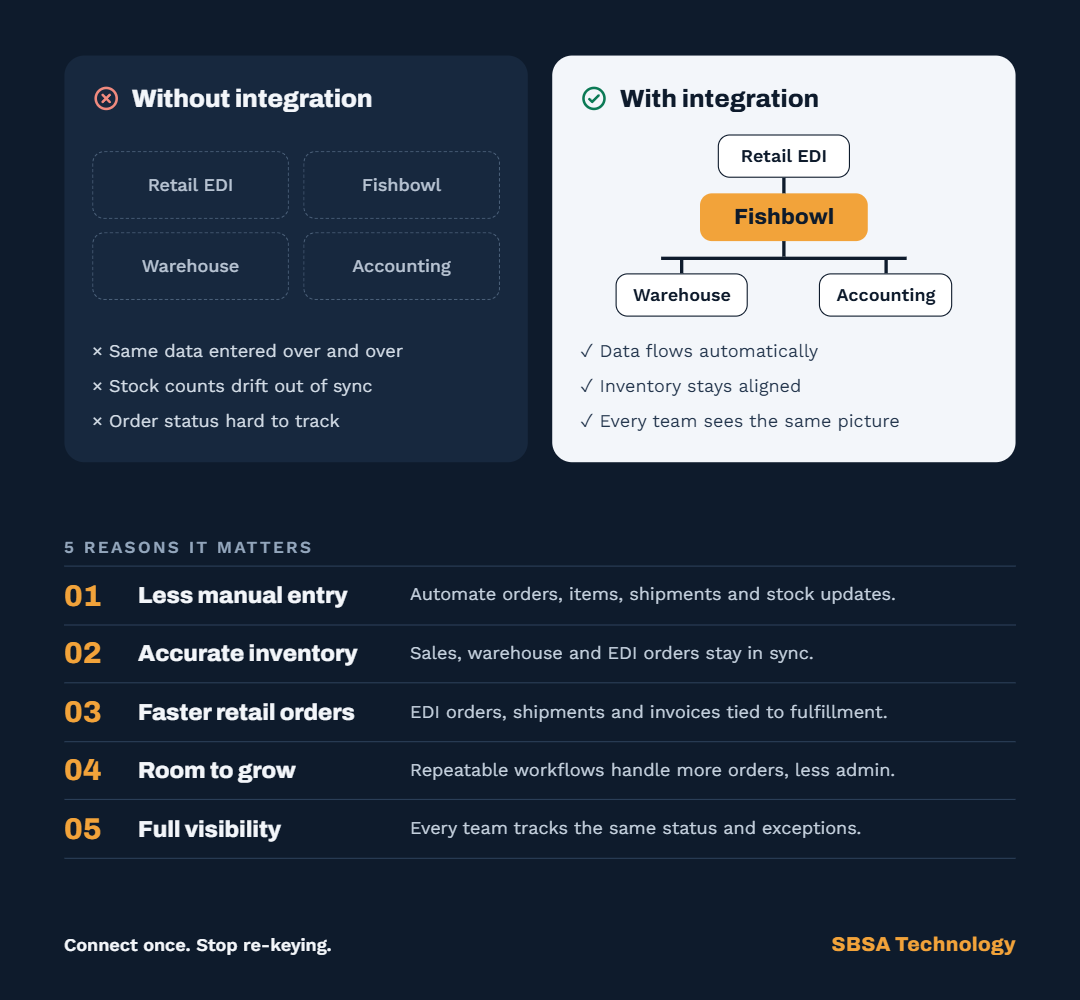
As businesses grow, managing inventory and orders through disconnected applications becomes increasingly difficult.
A company may receive orders through retail EDI, manage stock in Fishbowl, process shipments through a warehouse system, and maintain financial records in a separate accounting platform. If these systems do not exchange information effectively, employees may need to enter or verify the same data multiple times.
1. Reduce Manual Data Entry
Manually transferring orders, item details, shipment information, and inventory updates between applications takes time and introduces opportunities for errors.
An appropriately configured integration can automate supported data transfers and reduce repetitive work.
2. Improve Inventory Accuracy
Inventory discrepancies can occur when sales, warehouse activities, and external orders are not reflected consistently across systems.
Inventory synchronization can help keep connected applications aligned, subject to update frequency, transaction rules, and the capabilities of each system.
3. Streamline Retail Order Processing
Retail suppliers often receive purchase orders electronically and must process acknowledgments, shipments, and invoices according to retailer requirements.
Connecting Fishbowl with an EDI platform can help coordinate these transactions with internal order and fulfillment operations.
4. Support Business Growth
As order volume increases, manual processes can become difficult to maintain.
Automation allows businesses to establish repeatable workflows and reduce the administrative burden associated with processing additional orders.
5. Improve Operational Visibility
When connected systems exchange information consistently, teams can more easily track order status, inventory changes, shipment updates, and exceptions.
This improves coordination among sales, warehouse, customer service, and accounting teams.
How SBSA Technology Helps Connect Fishbowl Inventory
SBSA Technology focuses on EDI automation and retail operations integration. For businesses using Fishbowl Inventory, an integration project can be designed around the systems, trading partners, and processes that need to communicate.
Rather than treating EDI as an isolated function, SBSA can help businesses evaluate how retailer transactions connect with their broader order management and fulfillment workflows.
Retail EDI Integration
Businesses supplying major retailers may need to exchange standardized electronic documents, including:
-
850 — Purchase Order: Communicates a retailer's order.
-
855 — Purchase Order Acknowledgment: Communicates acceptance, rejection, or changes to an order, as supported by the trading-partner requirements.
-
856 — Advance Ship Notice (ASN): Communicates shipment details.
-
810 — Invoice: Communicates billing information.
An integrated workflow can help transfer relevant transaction data between the EDI platform and Fishbowl or other connected business systems.
The specific documents, mappings, validation rules, and automation steps depend on each retailer's requirements and the agreed integration scope.
Inventory and Order Synchronization
An integration can be configured to exchange supported inventory and order information between Fishbowl and connected applications.
Depending on the workflow, this may include:
-
Item and SKU information.
-
Order details and order status.
-
Available inventory quantities.
-
Shipment and tracking information.
-
Fulfillment updates.
-
Relevant transaction and exception statuses.
The objective is to reduce duplicate data entry and help teams work from consistent information.
ERP and Accounting Connectivity
Many businesses use separate systems for inventory management, accounting, and retail order processing.
SBSA can help evaluate integration requirements involving Fishbowl and supported accounting or ERP applications. Where needed, the integration design can define which system owns particular records and how updates should move between applications.
This is especially important when inventory, customer orders, invoices, and financial records must remain consistent.
Fulfillment and Warehouse Coordination
Businesses using external warehouses or 3PL providers may need to exchange order and shipment information across several systems.
A suitable integration can help coordinate the flow of order details to fulfillment partners and return shipment confirmations or tracking information to the appropriate business applications.
The exact workflow depends on the warehouse platform, available interfaces, and fulfillment provider.
API Integration vs. Manual Inventory Management
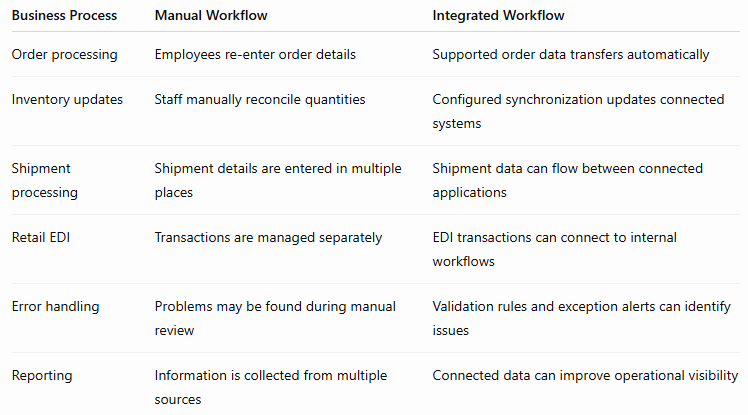
Integration does not eliminate every manual task or guarantee error-free processing. Its value comes from automating suitable workflows, enforcing validation rules, and making exceptions easier to identify and resolve.
Fishbowl Inventory Integration Challenges SBSA Can Help Address
Every business has different systems, retailer requirements, and operational constraints. Common integration challenges include the following.
Incompatible Data Formats
Applications may represent products, quantities, customer records, and order statuses differently.
Integration mapping defines how information is translated between systems while preserving the required business meaning.
Duplicate or Inconsistent Inventory Records
When multiple applications maintain inventory information, unclear update rules can lead to conflicting quantities.
A well-designed integration establishes which system is authoritative for each data field and how changes are synchronized.
Retailer-Specific EDI Requirements
Retailers may require specific document structures, identifiers, packaging details, routing information, and validation rules.
The integration must accommodate the applicable trading-partner specifications rather than assuming that every retailer follows the same process.
Failed Transactions and Exceptions
Missing SKUs, invalid product identifiers, unavailable inventory, and rejected documents can interrupt automated workflows.
A reliable integration design should include appropriate validation, error reporting, and procedures for correcting and resubmitting failed transactions.
Maintaining Operational Continuity
Integration changes must be carefully planned to avoid disrupting existing order processing and fulfillment.
A transition plan may include workflow documentation, testing, transaction reconciliation, controlled cutover, and monitoring after launch.
Why Choose SBSA Technology for Fishbowl Integration?
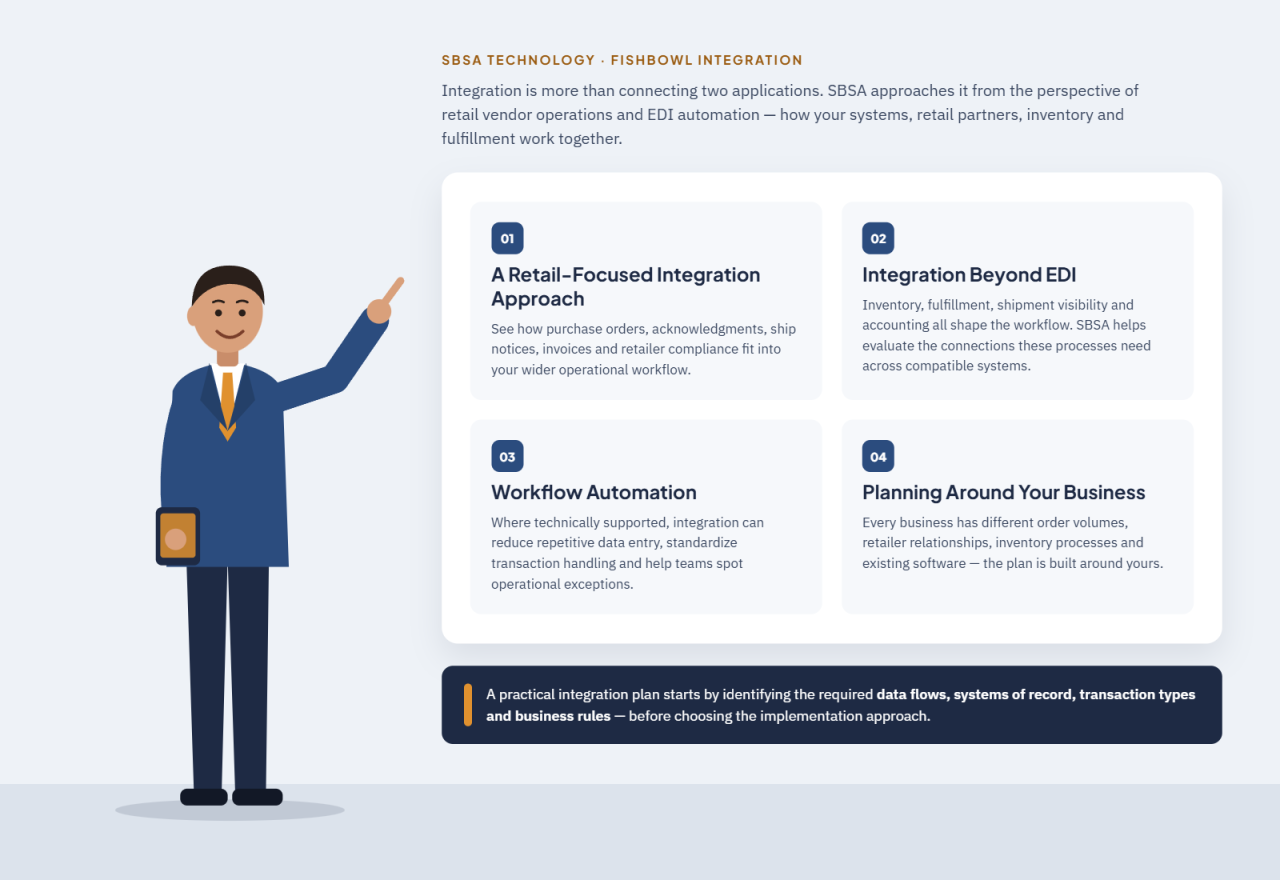
Choosing an integration partner involves more than connecting two applications. Businesses need to understand how their systems, retail partners, inventory records, and fulfillment processes work together.
SBSA Technology approaches integration from the perspective of retail vendor operations and EDI automation.
A Retail-Focused Integration Approach
SBSA's focus on retail EDI helps businesses evaluate how purchase orders, acknowledgments, shipment notifications, invoices, and compliance requirements fit into their wider operational workflows.
Integration Beyond EDI
Retail order processing involves more than transmitting electronic documents. Inventory management, fulfillment, shipment visibility, and accounting processes also affect the overall workflow.
SBSA helps businesses evaluate the connections required to support these processes across compatible systems.
Workflow Automation
Where technically supported, integration can reduce repetitive data entry, standardize transaction handling, and help teams identify operational exceptions.
Integration Planning Around Business Requirements
Every business has different order volumes, retailer relationships, inventory processes, and existing software.
A practical integration plan starts by identifying the required data flows, systems of record, transaction types, and business rules before determining the implementation approach.
Who Can Benefit from Fishbowl Inventory API Integration?
SBSA's integration services may be relevant to businesses such as:
-
Manufacturers managing inventory and retail purchase orders.
-
Distributors processing orders across multiple sales channels.
-
Wholesalers supplying large retailers.
-
Consumer product companies managing retail and e-commerce operations.
-
Importers coordinating warehouse inventory and shipment workflows.
-
Retail vendors using separate systems for inventory, accounting, and EDI.
-
Growing businesses seeking to reduce manual order processing.
The best candidates are organizations with identifiable workflow gaps that can be addressed through supported integrations.
Frequently Asked Questions
Can Fishbowl Inventory integrate with EDI?
Fishbowl integration with EDI depends on the available interfaces, connectors, and integration architecture. An integration solution can be designed to exchange relevant inventory, order, shipment, and transaction data where the required capabilities are supported.
Can SBSA Technology connect Fishbowl Inventory to major retailers?
SBSA specializes in retail EDI and integration workflows. The feasibility of connecting a Fishbowl environment to a particular retailer depends on the retailer's EDI requirements, the customer's existing systems, and the proposed integration design.
Can Fishbowl Inventory integrate with QuickBooks?
Integration options depend on the Fishbowl and QuickBooks products, versions, existing connections, and the specific data that must be synchronized. The intended workflow should be reviewed to determine which application manages inventory, accounting, and order information.
Does API integration eliminate manual data entry?
It can reduce manual data entry for supported processes, but some activities may still require employee review, approvals, or exception handling.
Can integration help reduce inventory errors?
Integration can reduce discrepancies caused by repetitive data entry and delayed updates. Results depend on data quality, synchronization rules, update frequency, and the way exceptions are handled.
How long does Fishbowl API integration take?
Implementation time varies with the number of systems, retailer connections, transaction types, custom mappings, testing requirements, and the availability of technical access. A project assessment is needed to establish a realistic timeline.
How much does Fishbowl Inventory integration cost?
Costs depend on the scope of the project, integration complexity, transaction volume, ongoing support, and the number of connected systems. Contact SBSA Technology to discuss your requirements and obtain a project-specific estimate.
Can we integrate Fishbowl without replacing our current systems?
Potentially. Integration projects often connect existing applications rather than replacing them. Feasibility depends on the available interfaces, compatibility, and the business's requirements.
Connect Fishbowl Inventory with Your Retail Operations
Your inventory system should support your business operations—not create additional manual work.
If your company uses Fishbowl Inventory and needs a better way to coordinate retail EDI, purchase orders, shipment notifications, invoices, inventory updates, or fulfillment workflows, SBSA Technology can help evaluate the integration options.
Start by identifying where information currently gets entered more than once, where inventory discrepancies occur, and which systems need to exchange data.
Ready to explore your Fishbowl integration options?
Contact SBSA Technology to discuss your existing systems, retail trading partners, and automation goals.
-
Book a demo: sbsatech.com/consultancy
-
Talk to the team: sbsatech.com/contact
-
Explore the platform: sbsatech.com
-
More insights: sbsatech.com/blog